


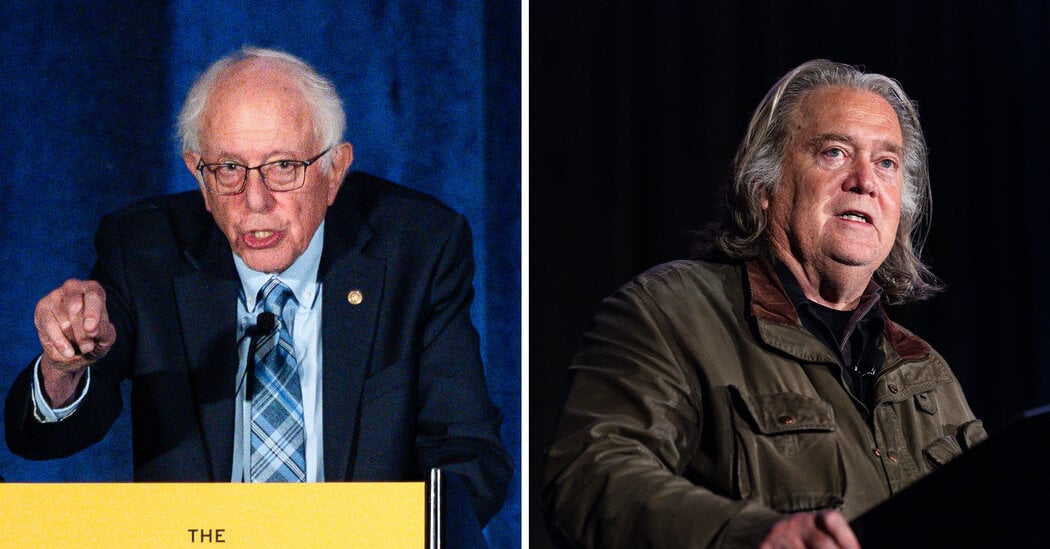
Bernie Sanders and Stephen K Bannon have joined forces in an unusual call for tighter artificial intelligence regulation, warning that the technology is advancing beyond meaningful human control.
The Vermont senator and leading architect of the MAGA movement made back-to-back speeches at the Pro-human Assembly in Washington, where Republican and Democratic politicians, religious leaders, artists and others set aside their political differences to demand that people, rather than machines, remain in charge of their future.
“When you are racing towards a cliff,” Mr Sanders said, “you hit the brakes.” He described the moment as “a dangerous and unprecedented” point in world history and urged people to stand up.
The conference, hosted by the non-profit Future of Life Institute, drew several hundred people amid growing anxiety in Silicon Valley and Washington about the race to develop increasingly powerful systems.
Attendees were united in their fear that artificial intelligence could eventually threaten humanity, although there was no agreement on how far governments should go to restrict its development. A slogan on hats handed out at the event captured the mood: “Keep the future human.”
Calls for controls on artificial intelligence
Speakers proposed a range of measures, from slowing the construction of data centres to banning systems considered too powerful for humans to control. Representative Greg Casar, a Democrat from Texas, said: “The answer is simple: We ban A.I. systems that are too powerful for humans to control.”
Representative Lori Trahan, a Massachusetts Democrat, said the future people wanted was human and “nonnegotiable”. She added: “If we lose grip on this technology, we don’t lose grip as Republicans or Democrats. We lose it as human beings.”
Religious leaders raised concerns about purpose and human agency. Salvatore J Cordileone, the Archbishop of San Francisco, said: “We have to be the masters of A.I.” Walter Kim, president of the National Association of Evangelicals, questioned whether people would live without purpose in a world of “frictionless existence” in which artificial intelligence was expected to solve most problems.
Ashley Judd, the actor and chief negotiator for the union SAG-AFTRA, spoke about the spread of sexual abuse images and disinformation. Parents whose teenage children died by suicide after forming relationships with chatbots made tearful appeals for stronger child-safety rules.
Representative Chip Roy, a Republican from Texas, said constituents felt powerless as data centres were built in their communities with little consultation, while their children became absorbed in technology they did not understand. “We are not supposed to be tools for data collection and technology,” he said.
Both Mr Sanders and Mr Bannon argued that working Americans, whose lives they said would be most affected by artificial intelligence, had been excluded from decisions about regulation.
Mr Sanders has introduced legislation seeking a pause in the development of data centres and has called for President Donald Trump to reach an agreement with China’s president, Xi Jinping, to ban superintelligent artificial intelligence.
Mr Bannon said he did not believe Congress would slow development because of its inaction. Instead, he called for a presidential executive order to curb the technology’s progress and prevent the largest technology companies from expanding their influence through control of the industry.
“American citizens are not going to be supplicants to the oligarchs anymore,” Mr Bannon said, acknowledging the major political differences between himself and Mr Sanders. “We have to rise above it. This is a hinge in history.”
Growing public anxiety
Concern about the technology has intensified in recent weeks. An Anthropic researcher who had previously worked at OpenAI resigned publicly, saying he believed both companies were acting irresponsibly. The chief executives of Anthropic and OpenAI have also acknowledged fears that their systems are advancing at an alarming pace.
A poll released this week by Elon University found that seven in 10 Americans feared artificial intelligence would weaken human bonds, while about six in 10 believed its potential to take over most human tasks would undermine people’s sense of purpose.
A separate poll found that 61 per cent of voters opposed the construction of data centres, the large warehouses that power artificial intelligence.
Despite the concerns voiced at the Washington gathering, there is little agreement in Congress or the White House over what a national policy should look like. On Monday, Mr Trump dismissed calls for safety guardrails as a “hoax” and warned that he could take criminal action against artificial intelligence company executives for harm caused by their technologies.
The conference ended with its central question unresolved: whether human beings can still gain control of the technology before it becomes too powerful to restrain.
