


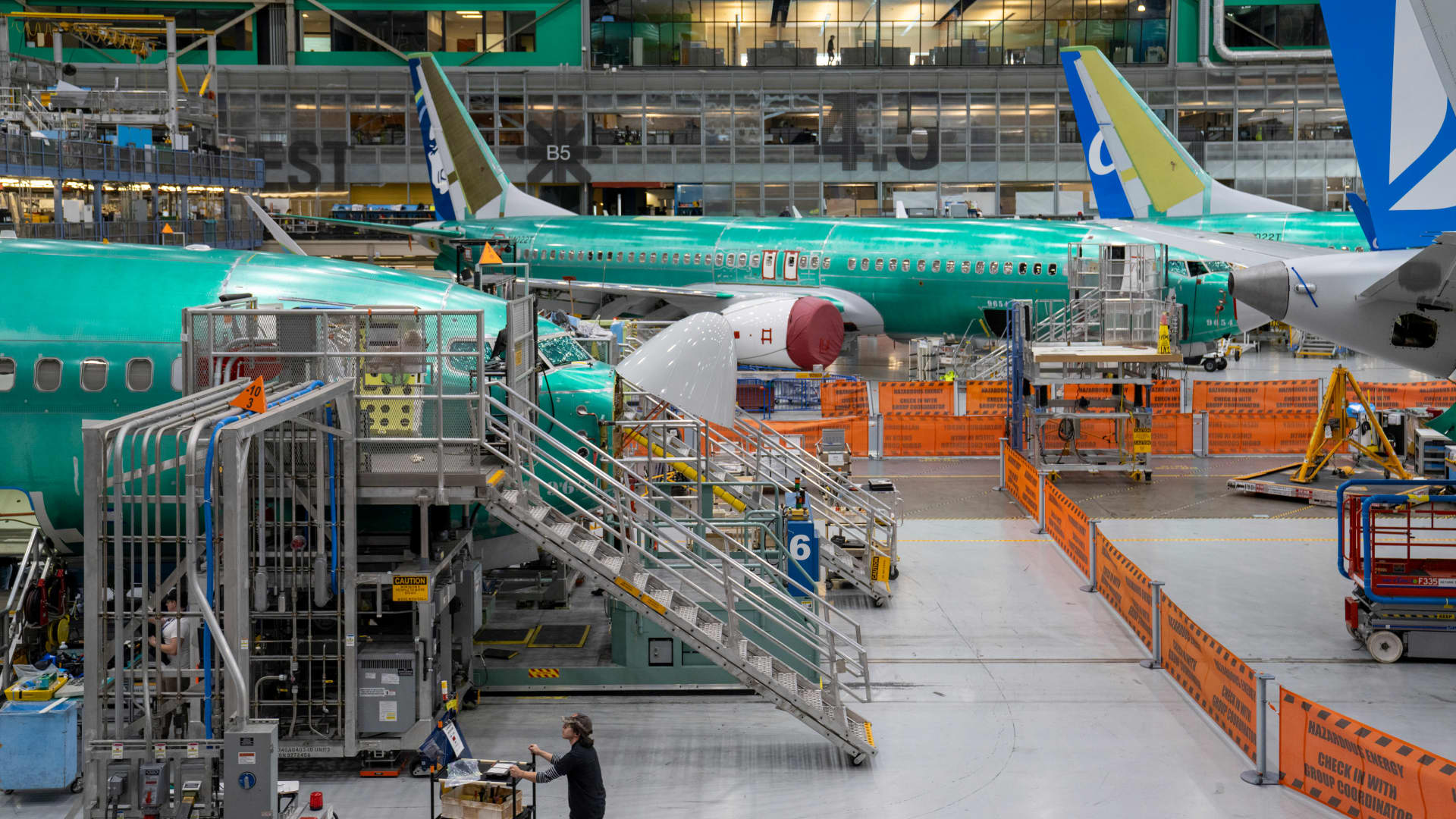
Boeing will not significantly increase production of its best-selling 737 Max aircraft until the second half of 2027, as slower-than-expected wing manufacturing continues to constrain output.
Chief executive Kelly Ortberg said the company was aiming to produce 52 737 Max jets a month in the latter half of 2027, compared with about 47 a month currently. Boeing shares fell 10% in trading on Tuesday.
Mr Ortberg said the pace of production stabilisation was taking longer than expected because of the rate at which wings were being made. “I know everybody wants us to go faster, but we’re going to do it right,” he said.
Aircraft deliveries are central to Boeing’s recovery because customers pay the bulk of an aircraft’s price when it is handed over. The company delivered 161 commercial aeroplanes in the third quarter, one more than in the same period last year.
In a message to staff, Mr Ortberg said expectations were rising and that Boeing needed to improve performance through “lean, productivity and efficiency improvements” while maintaining its standards for safety and quality.
Boeing narrows third-quarter loss
The production warning came as Boeing reported a sharply reduced net loss for the three months to September 30, helped by stronger performance from its defence division.
The company recorded a net loss of $116 million, or 26 cents a share, compared with a loss of $5.34 billion, or $7.14 a share, a year earlier. Excluding one-off items, Boeing reported a loss of 34 cents a share, wider than the 21-cent loss expected by analysts.
Revenue rose 4% year on year to $24.19 billion, ahead of the $23.84 billion expected. Free cash flow increased to $464 million from $238 million in the third quarter of 2025.
Defence revenue climbed 15% to $7.94 billion. By contrast, revenue from Boeing’s commercial aircraft division fell 3% to $10.72 billion, while the unit reported a negative operating margin of 6.5%.
Boeing attributed the commercial division’s performance to a less favourable delivery mix, higher projected costs linked to future production-rate adjustments and increased estimated supply-chain costs. Mr Ortberg told employees that the manufacturer had “more work to do”.
The company has also secured two recent milestones. The US Navy selected Boeing to develop its next-generation fighter jet, while the Federal Aviation Administration approved the 737 Max 10 last week, following certification of the 737 Max 7 in August.
