


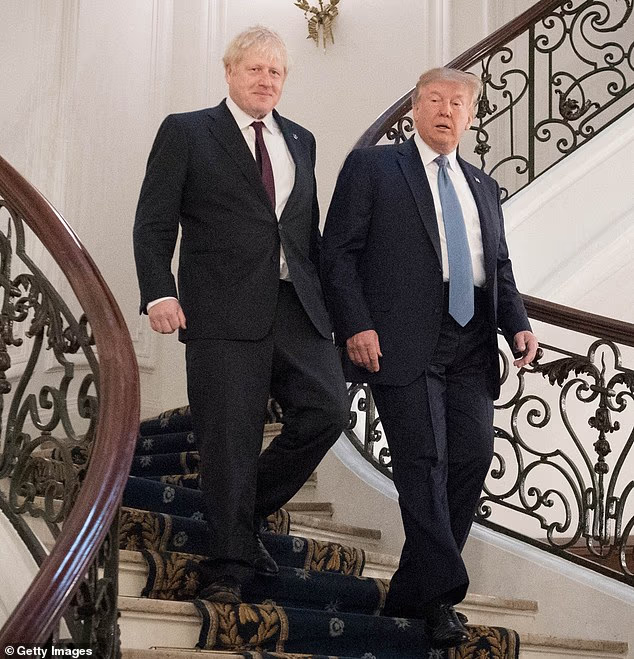
Boris Johnson has condemned Donald Trump’s agreement to buy Russian diesel as “sickening”, accusing the US president of making American motorists fund Vladimir Putin’s war in Ukraine.
The former prime minister said the deal was “outrageous” and urged the Royal Navy to intercept Russian fuel shipments if they attempted to pass through the English Channel.
His intervention came after Mr Trump announced what he called an “energy ceasefire” between Russia and Ukraine, under which both sides would stop attacking each other’s energy infrastructure.
Mr Johnson questioned why Ukraine should be prevented from striking Russian energy assets while Moscow continued attacks on Ukrainian infrastructure and civilians.
“Why should Putin be allowed to destroy Ukrainian energy infrastructure – as well as murdering countless civilians – if the Ukrainians are forbidden from responding?” he said.
He added: “I doubt that Putin has the diesel to ship to the US but if he tries to go via the English Channel I hope it is intercepted by the Royal Navy.”
Russian diesel deal draws backlash
Mr Trump’s agreement involves the release of almost two million tonnes of Russian diesel over the coming months, despite continued Russian attacks on Ukraine.
Moscow is expected to export 300,000 tonnes of fuel immediately, followed by 500,000 tonnes in November and a further one million tonnes after that.
Mr Johnson said the arrangement would do little to reduce fuel prices and argued that the US should instead put pressure on Mr Putin to end the war.
“The Ukrainians are valiantly trying to protect themselves and their families from threats of bombardment,” he said. “We should be helping them and the best way to get this over and get the price of fuel down is to make Putin see sense.”
He added: “It’s ridiculous to try to appease Putin and it won’t make a bean of difference to the price of fuel.”
Mr Trump has blamed rising fuel prices on Kyiv and warned Ukraine to stop attacking Russian oil infrastructure. He said it was time for Ukraine to have a new president who could reach a deal.
Volodymyr Zelensky described the Russian fuel agreement as a “gift to Putin” which played into Moscow’s hands and would prolong the conflict. Mr Trump responded by saying Ukraine should get a new leader.
The US president said the energy ceasefire was effective immediately, writing: “Both parties have agreed. Do not break it!”
Mr Zelensky initially said the announcement was news to him, but later said Ukraine supported the ceasefire if Russia did the same.
“Ukraine always FULLY supports steps toward de-escalation, the protection of lives and the decisions needed to end the war and guarantee lasting peace,” he said.
However, reports later suggested the arrangement was already under strain, with Russia accused of striking a power plant in Kyiv and other energy facilities in the Kharkiv region.
Mr Zelensky said the attacks had taken place after Mr Trump’s announcement. At least three people, including a child, were reported to have died in a Russian attack on Kharkiv.
Johnson and Badenoch criticise Trump
Mr Johnson, who has remained a strong supporter of Ukraine since Russia’s invasion, also criticised Mr Trump in a social media post, saying it was “sickening” that sanctions on Russian fuel were being eased.
He said it was “transparently ridiculous” to blame Ukraine for higher prices, adding that Ukrainian forces were fighting for their lives while American drivers were being asked to bankroll Russia’s military campaign.
The former Conservative leader’s criticism is notable because he previously backed Mr Trump, attended his inauguration and said the US president would provide “strong leadership”.
Kemi Badenoch supported Mr Johnson’s position, saying: “Ukraine’s freedom is not President Trump’s to bargain away.” She said Mr Trump was wrong to ease sanctions on Russian diesel, blame Mr Zelensky and undermine Ukraine.
Wes Streeting said Britain’s responsibility was to bring Kyiv and Washington back together, while acknowledging that Mr Trump was facing domestic pressure over energy prices ahead of the US midterm elections.
“We would obviously prefer a stronger approach on sanctions,” he said.
