


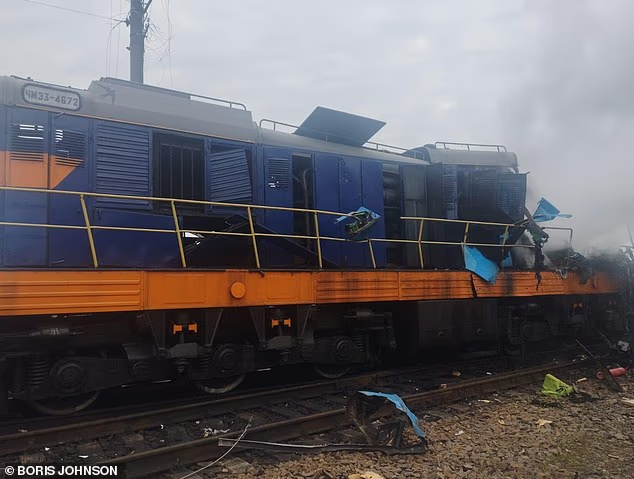
Boris Johnson has warned that Russian attacks on Ukrainian railways reflect growing desperation in the Kremlin and called for faster Western support to strengthen Ukraine’s air defences.
Writing after the destruction of a civilian shunting locomotive close to the Polish border, the former prime minister said Moscow was escalating strikes on passenger trains and transport infrastructure because its forces had failed to make significant gains on the battlefield.
Mr Johnson claimed Russia had suffered 1.5 million casualties during the war, including more than 40,000 men killed or so seriously wounded that they could no longer fight in both July and August. He said the scale of the losses was unsustainable without a general mobilisation.
He argued that Russian mothers would oppose sending an entire generation into the Donbas, where Ukrainian drones have inflicted heavy losses on advancing troops.
The assessment comes as Russian military commentators have reportedly begun calling for negotiations, after Ukrainian drone strikes damaged oil refineries and fuel shortages led to lengthy queues at petrol stations. Mr Johnson also claimed that 28 per cent of Russian stations were supplying fuel of such poor quality that it risked damaging car engines.
He said the Russian public and state media would eventually be unable to maintain the impression that the war was progressing successfully.
Ukrainian railways face intensifying attacks
According to Mr Johnson, the fighting season had produced only limited Russian advances, with Ukrainian forces having regained ground in some areas. He said Vladimir Putin would not be able to capture the fortified belt of the Donbas or the city of Zaporizhzhia without sacrificing millions of troops.
He linked the failure to advance with an increase in attacks on the rail network, including strikes on passenger trains. There had been more attacks on passenger trains in the previous six months than during the preceding four years, he said.
Ukraine’s railway operator, Ukrzaliznytsia, had lost 1,700 employees in Russian attacks, Mr Johnson said. He praised its staff for repairing damaged track and bridges rapidly, while passengers continued to use the network despite the danger.
“It’s terrible to admit this, but we just learn to adapt and get on with our lives,” a Ukrainian woman told Mr Johnson at the weekend.
He said the attacks would not force the railway company or the civilian population to give in.
Calls for more air defences
Mr Johnson said the West needed to demonstrate to Mr Putin that Russia had no prospect of victory by providing substantially greater military support to Ukraine.
He said he had visited Firepoint, a Ukrainian drone and missile start-up, which he described as a world leader. The company produces the Flamingo cruise missile, which he said had been used against Russia’s oil and gas industry.
However, he argued that Ukraine urgently needed stronger air defences to protect trains and cities from ballistic missiles and jet-powered Shaheed drones. With many US Patriot systems being used in the Gulf region, he said Ukraine should be helped to develop its own capabilities.
Mr Johnson called for Ukraine to receive seeker systems capable of tracking fast-moving drones and intercepting missiles. He said the technology could be developed, but that action was needed quickly.
He warned that Ukraine faced a difficult winter as Russia prepared to intensify attacks intended to kill and frighten civilians at home, at work and while travelling.
Mr Johnson also called for the reopening of Black Sea ports so Ukrainian grain and other goods could move again, and for Ukraine to receive access to Starlink communications over Russia to help target missile sites and bases used in attacks.
He further urged Western governments to release hundreds of billions of pounds in frozen Russian funds so that Ukraine could use the money to finance its war effort.
Mr Johnson said the Kremlin would accuse the West of escalation, as it had throughout the conflict, but argued that increased pressure would bring forward the point at which Mr Putin was forced to stop.
