


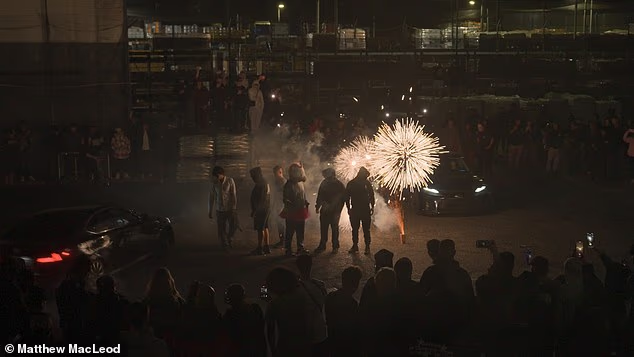
Illegal car meets where drivers drift within feet of spectators are being fuelled by social media, with young men filming increasingly dangerous stunts for online audiences. An investigation into the underground racing scene found gatherings advertised openly on TikTok and Instagram across east London and Essex, before convoys moved between locations to evade police.
At one event in a Basildon retail park, hundreds of people gathered around modified cars as drivers spun through clouds of tyre smoke. Spectators pressed towards the vehicles, while some climbed on to containers and warehouse roofs for a better view.
Three young men ran into the path of a Honda S2000 and jumped over its rear as it swept around them. The final jumper mistimed his leap and fell on to the tarmac.
Children, including some still wearing pyjamas, were among those watching. People held their phones above their heads to record the action as exhausts rattled around the car park and sparks and smoke filled the air.
The event was one of several types of gathering linked to Britain’s boy-racer culture. Family-friendly displays and cruises can develop into illicit after-parties involving doughnuts, drifting and races on public roads.
At a separate meet in Barking, rows of modified “sleeper” cars were parked on the top floor of a multi-storey car park. The vehicles appeared ordinary but concealed powerful engines, while many of the spectators looked under 18 and hoped to secure a lift with older drivers.
In Dagenham, cars tore around an industrial estate as bass music played from parked vehicles. Police eventually arrived and dispersed the crowd, but the gathering simply moved to another venue.
One attendee acknowledged the danger created by the events, saying: “It does encourage people to drive dangerously. I admit it spills on to the roads. On the way in and out of them too.”
Social media turns stunts into competition
The growth of livestreaming and short-form video has changed the culture, allowing stunts witnessed by a small group to reach huge audiences within minutes.
One participant, who used the name Joel, had the initials of London Street Racers tattooed on his thigh. He said he had been run over “a few times” and described how online attention encouraged him to attempt ever more extreme challenges.
“I’ve always tried to find something new that someone hasn’t done before,” he said. “There’s the TikTok dares, where people ask me to do stuff. I do it, I get recognised, then I think, ‘Right, what’s next?’”
Videos found online showed young men speeding, crashing, driving off-road and deliberately “baiting” police officers. Other clips featured drivers racing along rural roads in a trend described as “back road bashing”.
Some street-drifting footage was labelled “AI driver” or “AI generated”, apparently presenting real incidents as artificial. The content was found through connected accounts, hashtags and comments.
At the Basildon gathering, rumours of approaching police triggered a rapid departure. Drivers started their engines and the car park emptied, before another location was shared in a private Telegram group.
That night, the meet appeared at four venues including Southend, Basildon and Newham. Convoys travelled between the sites, while crowds grew at each new location.
Police forces are increasingly treating the underground racing scene as a serious road-safety threat. Operation Hercules, a taskforce established by West Midlands Police, has convicted 137 people of road offences since January last year, with dozens of further cases before the courts.
In 2022, Dhiya Al Maamoury lost control of a modified Nissan Skyline at an illegal event in Oldbury, in the West Midlands. The car struck people watching from the pavement, killing Liberty Charris, 16, and Ben Corfield, 19.
Al Maamoury was jailed after admitting two counts of causing death by dangerous driving and two of causing serious injury. The race had been filmed and posted online, and Liberty’s mother later described the distress of seeing footage of the aftermath.
Fatal crashes put dangerous driving under scrutiny
The consequences of dangerous driving were brought into sharp focus by two fatal crashes in recent weeks.
At 3.39am on August 22, a Volkswagen Passat travelling on the wrong side of the A66 near Middlesbrough collided head-on with a marked police vehicle. The five young men in the Passat died, as did police constables Matthew Blades and Tom Clough.
Another police vehicle had abandoned its pursuit of the Passat about ten seconds earlier. Officers said they were investigating possible links to serious and organised crime.
New figures showed that reports of wrong-way driving on England’s major roads had risen by 25 per cent in the year to August. At least one of the young men who died in the A66 crash had previously posted reckless-driving footage online.
Six days earlier, five teenage boys died in County Kildare after a BMW travelling the wrong way along the M9 hit a car carrying three sisters and a seven-year-old boy. Two of the sisters were critically injured, while the third and the child suffered serious injuries.
Young male drivers are disproportionately represented in fatal crashes, with men aged between 17 and 24 around four times more likely to be killed or seriously injured than those aged 25 or over.
In another case, Abbie Devanney died after a car driven by 17-year-old Charlie Whittaker hit standing water, struck a tree and overturned on an unlit road in Newcastle upon Tyne. Whittaker, who had held his licence for six months, had been travelling at more than 70mph.
Three other teenage passengers suffered life-changing injuries. Police later recovered more than 20 videos showing Whittaker speeding and overtaking dangerously before the crash.
Whittaker admitted causing death and serious injury by dangerous driving and received a sentence of five years and four months. Abbie’s younger sister Amy said the driving had been part of an established pattern.
“I think it would be easier to process if this was kind of a one-off thing,” she said. “But knowing that this was a pattern of behaviour, it was inevitable this was going to happen, and it ended up happening to my sister.”
Amy said she feared the sentence, and the possibility that Whittaker could serve only part of it under Labour’s early-release scheme, would fail to deter young drivers.
“Those boys, they believe they’re invincible,” she said. “Just know how lucky you are that nothing’s happened yet. Stop pushing your luck because something like this will happen to you or someone you know.”
Community workers in Middlesbrough have urged people not to reduce the issue simply to recklessness and bravado. Amanda, who works with young people, said many were navigating “broken systems”, including patchy education and disappearing youth provision.
“There’s nothing out there any more for them,” she said. “Young people just miss out in finding an alternative high.”
Some of the drivers themselves recognise the pressure created by being filmed. One young man said: “As soon as the camera’s on, you want to push yourself to maybe a bit more than what you’re capable of when you drive. And that’s when the accidents happen.”
Following the Middlesbrough crash, the Prime Minister’s spokesman described the online glorification of dangerous driving as “utterly disgraceful”. Parliament’s Culture, Media and Sport Committee sought answers from TikTok, YouTube, Meta and Snapchat, while roads minister Justin Madders called the trend “sickening”.
Meta and TikTok said they prohibit content promoting or encouraging high-risk viral challenges and remove it when they become aware of it. YouTube said extremely dangerous driving was prohibited on its platform, while Snapchat said reckless driving was explicitly banned under its community guidelines.
But at the illegal meets, drivers and spectators continue to chase the next spectacle, with every near miss capable of becoming another piece of content. The attraction, participants say, is the adrenaline; for those left behind after fatal crashes, the cost is permanent.
