


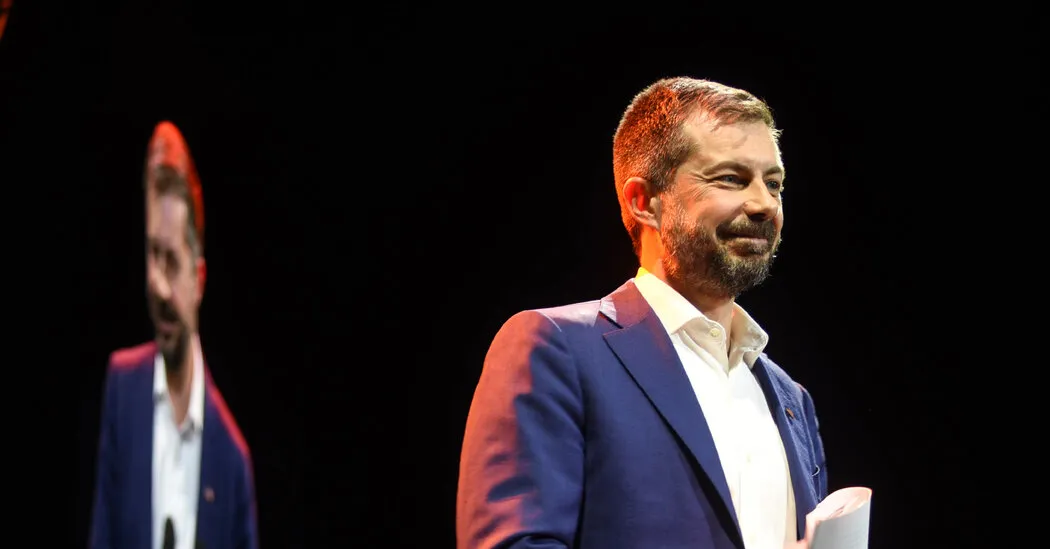
Pete Buttigieg is positioning himself for a possible 2028 presidential run by building relationships across traditionally Republican states and supporting Democrats in races where his party has historically struggled.
Buttigieg, who served as Joe Biden’s transportation secretary for four years, campaigned in person for more than 100 candidates during the 2026 midterm elections. His appearances took him to Oklahoma, Kansas, Texas and Mississippi, as well as other conservative areas.
A person familiar with his thinking said he is expected to decide early next year whether to seek the Democratic nomination for a second time. The approach has allowed him to develop potential allies while making the case that Democrats should compete more aggressively beyond their traditional strongholds.
One beneficiary was Jamie Ager, a farmer who won a seat in western North Carolina after Buttigieg contacted him during his long-shot 2025 campaign. The district had been carried by Donald Trump by nearly 10 percentage points in the 2024 presidential election.
“The broader mistake I was worried about the party making was not paying enough attention to these redder areas, which is why I made a point of paying a lot of attention to them,” Buttigieg said.
Buttigieg builds support for a possible 2028 bid
His strategy has also taken him into states likely to matter in the early stages of a presidential contest. In South Carolina, where Black voters will play a major role in the 2028 primary, he appeared at a Democratic Party conference and later called the state party chair, Christale Spain, to congratulate her on the party’s election successes.
Buttigieg campaigned alongside Scott Colom in Mississippi, where Colom’s narrow victory over Senator Cindy Hyde-Smith will make him the first Black senator from the state since Reconstruction. He also appeared in Iowa with Josh Turek and in Louisiana with Jamie Davis, who came close to defeating a Republican in a Senate race.
“It was a chance to say to observers, to commentators, to the national party itself, but most importantly to these communities, that I believed in them, and I believe that they could elect great Democrats,” Buttigieg said.
His 2020 presidential campaign failed to gain traction with Black voters, who overwhelmingly supported Biden. Spain said it was “critically important” for a potential candidate to be comfortable holding small gatherings in South Carolina.
Buttigieg’s argument is likely to face competition. Possible 2028 contenders include Andy Beshear, the Democratic governor of Kentucky, who campaigned in Oklahoma before the election, as well as Senator Raphael Warnock and newer progressive figures such as Abdul El-Sayed, Michigan’s senator-elect. Representative Alexandria Ocasio-Cortez also attracted significant national attention during the campaign.
David Axelrod, a Democratic strategist and Buttigieg supporter, said building relationships throughout the country would be valuable in a presidential primary, when delegates are contested across the states. But he cautioned that Buttigieg was no longer an unfamiliar newcomer.
“Obviously, he’s not the shiny new thing anymore,” Axelrod said. “That is a challenge.”
Buttigieg, 44, has sought to present his time in the Biden administration as an advantage by highlighting infrastructure investment delivered during his tenure as transportation secretary. He has also adopted a more experienced public image, including jokes about his twins’ chaotic football practice and his age.
He rejected the idea that Democrats face an unbridgeable divide between centrists and progressives. “The candidates who’ve done best are focusing on these everyday-life issues, regardless of whether the commentators prefer to label them as centrists or leftists,” he said.
Buttigieg said affordable healthcare, higher pay, ending the war in Iran and reversing cuts to the social safety net were issues shared by most Democrats and many Americans. “That ought to be our center of gravity,” he said.
An incident in which an anonymous swatting report led social services to separate him from his twins for 24 hours has also influenced his view of political life. He said it had made him more determined to support a political culture in which opponents could disagree without abandoning basic boundaries.
