


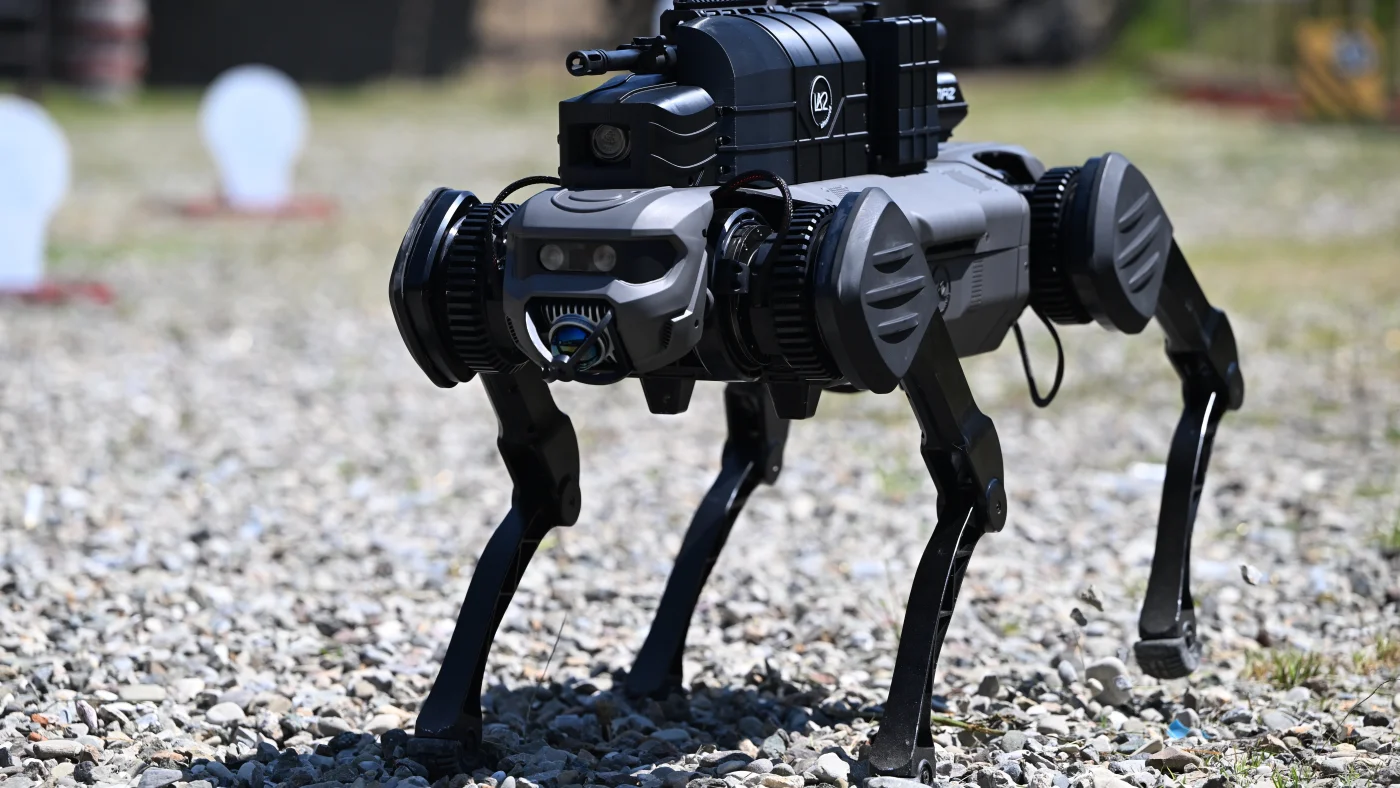
Negotiations on rules for lethal autonomous weapons, widely known as “killer robots”, are under way at the United Nations in Geneva, amid warnings that technology capable of selecting targets and killing without human control could be only months away.
Campaigners say the meeting on the UN Convention on Certain Conventional Weapons may be the last opportunity to agree safeguards before fully autonomous weapons become a reality. The conference is held only once every five years.
AI-assisted weapons have already been used to identify and strike targets in Ukraine and Gaza, although people still control them remotely. Ukrainian civilians have reported being “hunted” by drones while shopping or travelling to school.
The International Committee of the Red Cross, the United Nations and the Pope have called for legally binding rules. UN Secretary-General Antonio Guterres has warned that allowing weapons to kill autonomously would mean “crossing a moral red line”.
The risks posed by autonomous weapons
Humanitarian organisations argue that the decision to take a life, and responsibility for that decision, must remain with a human being.
The Red Cross has expressed particular concern that autonomous systems may not be able to comply with existing laws of war, including the Geneva Conventions. On a chaotic battlefield, circumstances can change quickly, and soldiers who are wounded or surrendering may no longer be targeted.
Georgia Haines, a legal adviser with the Red Cross, said autonomous weapons might not distinguish between a soldier who was still fighting, one who had been injured and one who was attempting to surrender.
“The risk is that, based on the technology we are seeing, they are not able to understand in the same way that a human is the contextual signals. And so the risks are incredibly high that there will be a misidentification of a target,” she said.
Human rights groups have also warned that the technology is becoming cheaper and easier to use. They say wider military adoption could increase the risk of autonomous weapons spreading to terrorist groups or being used by repressive law-enforcement agencies.
In theory, a swarm of autonomous drones could be programmed to target everyone wearing a red jumper, carrying a poster or speaking a particular language.
At least 50 countries, including Ireland, Italy, Brazil, Mexico, France and Germany, are calling for a strict timetable to reach a legally binding agreement on autonomous weapons.
However, the United States, Russia and Israel have indicated that they are opposed to binding rules. Washington has instead proposed a five-year timetable for drawing up non-binding guidelines.
UN negotiations on restrictions for particular weapons are generally conducted by consensus. That approach produced a ban on blinding lasers in 1995, but other agreements have proved more difficult.
A possible compromise under discussion is a longer or open-ended negotiating period, allowing individual countries to adopt any eventual rules as binding or non-binding. Supporters say this could deliver some progress, while campaigners fear it would merely postpone action on a dangerous technology.
