


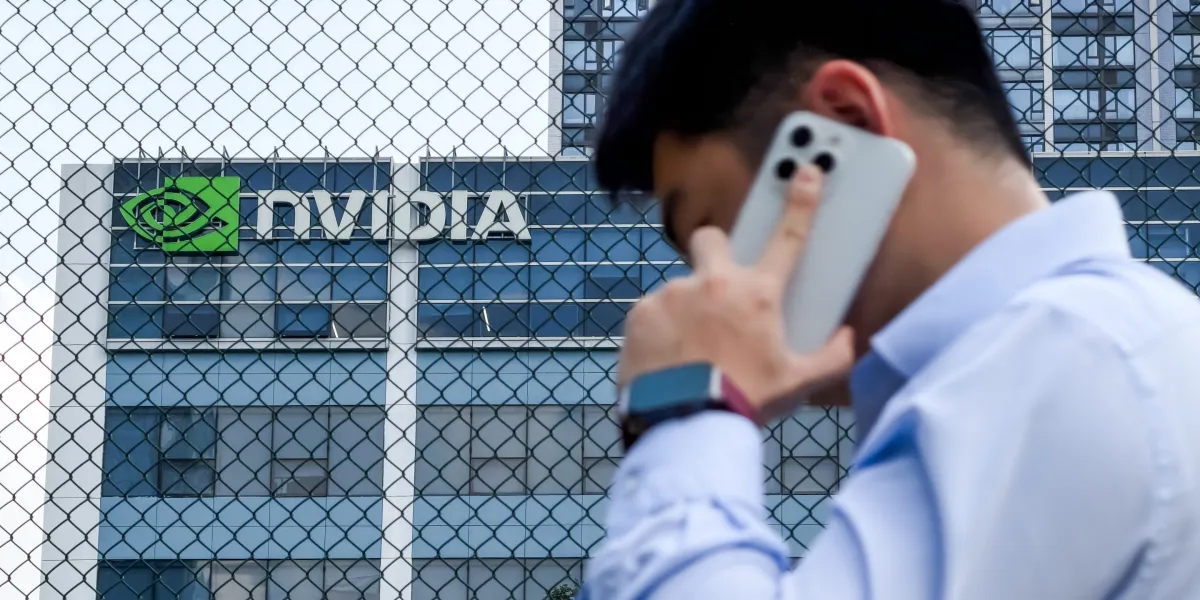
The US Department of Commerce has tightened controls on advanced artificial-intelligence chips, targeting data centres in five countries and closing a loophole that allowed Chinese companies to access processors held overseas.
The interim final rule requires licences for exports of advanced AI chips to data centres in Indonesia, Malaysia, Singapore, Thailand and Brazil. It also requires large data-centre operators anywhere in the world to seek permission before giving access to companies headquartered in China.
Facilities already providing such access will have 90 days from the rule’s effective date to obtain a licence. The measures will take effect once they are included in the Federal Register.
The move follows controversy surrounding Nvidia’s former chief executive Jensen Huang, who was among the most prominent critics of Washington’s restrictions on advanced technology sales to China. Huang argued that the controls risked encouraging the creation of a rival Chinese chip industry and that the US should keep Chinese companies dependent on American technology.
His credibility on export controls has since been damaged by revelations that he had an affair with Alice Huang, a former executive at Singapore-based Megaspeed, which has been accused of funnelling controlled chips to China. Alice Huang is not related to Jensen Huang.
Some reports have claimed that US intelligence regarded Alice Huang as part of a Chinese espionage campaign against Nvidia, although other accounts have questioned that assessment. Megaspeed has denied sending chips to China.
US export controls face pressure from Congress
The new rule is the first update to the US export-control regime since the scandal emerged. It comes as Congress considers legislation that would place existing restrictions on a firmer legal footing and extend them further.
Current controls prevent the sale to Chinese companies of the most advanced AI processors made by Nvidia, AMD and Intel. Chipmaking equipment and high-bandwidth memory are also restricted, although the Trump administration has allowed Nvidia’s H200 chips to be sold to approved Chinese customers.
The administration is reportedly divided over how far to go in tackling chip smuggling. The Commerce Department said the latest rules were “written by and at the direction of the Department of Treasury and the National Security Council”.
Hanna Dohmen, a senior research analyst at Georgetown’s Center for Security and Emerging Technology, said before the rule was issued that “the regulatory path in Washington is going to be harder and bumpier”. She said bills included in this year’s National Defense Authorization Act had gained momentum from the Huang scandal and were now more likely to pass.
Joshua Kurlantzick, a senior fellow at the Council on Foreign Relations, said Congress could impose limits regardless of the administration’s position. “No matter what Trump does, it’s possible that Congress should be able to provide limitations,” he said. “It’s not only about Trump anymore.”
One proposal, the Remote Access Security Act, would give the Commerce Department powers to licence and penalise foreign companies using advanced US AI chips from abroad. The House passed the bill in January, but it has yet to be considered by the Senate.
The Chip Security Act would require advanced processors to include measures such as location tracking and would oblige exporters to report evidence of diversion or smuggling. It would not require kill switches or other more aggressive safeguards.
The AI Overwatch Act would treat advanced chips in a similar way to weapons by requiring the administration to notify Congress before approving sales to China or other adversaries. Congress could then attempt to block a transaction through a joint resolution of disapproval.
The measure also includes an “America First AI” provision, requiring the Commerce Department to certify that exports would not leave US customers without sufficient computing power.
The most far-reaching proposal, the MATCH Act, would largely prohibit the sale and servicing of deep ultraviolet lithography tools in China. It would also impose wider restrictions on facilities linked to major Chinese chipmakers including SMIC and CXMT.
Under the proposed act, Japan and the Netherlands would have 150 days to bring their controls into line with those of the US. If they failed to do so, Washington could extend restrictions to equipment supplied from those countries even where it contained no US-made components.
Ms Dohmen warned that changing regulations alone would not stop chip smuggling. Several measures would still depend on enforcement by US authorities or third parties, and knowledge that a chip had been diverted would have limited impact unless the Bureau of Industry and Security acted.
Malaysia and Singapore caught between Washington and Beijing
Singapore and Malaysia are at the centre of concerns about the use of overseas data centres to provide Chinese companies with access to advanced processors. Megaspeed is based in Singapore, while Malaysia has reportedly been home to its data centres.
Jennifer Lind, an associate professor of government at Dartmouth College, said Washington wanted both countries to remain part of the American technology ecosystem while preventing them from becoming routes through which Chinese firms could obtain advanced chips or the computing power they provide.
The new rule includes an exemption for end-users that are US-headquartered companies or owned by them. Singapore and Malaysia have attracted billions of dollars of investment from American technology companies including Microsoft, Oracle and Amazon, which should qualify for the carve-out. The restrictions on remote access will nevertheless continue to apply.
Both countries have made public moves against chip smuggling, although Mr Kurlantzick said he believed Singapore was taking the issue more seriously. He criticised Malaysia’s response, saying the US was “insanely unpopular” there.
The measures could complicate Malaysia’s ambition to become a major data-centre and AI hub. Mr Kurlantzick said restrictions on Chinese access could be “disastrous” for a country whose prime minister, Anwar Ibrahim, viewed data centres and artificial intelligence aimed at Chinese companies as a potentially important future industry.
Washington is also seeking support for its Pax Silica framework, which is intended to secure semiconductor and critical-mineral supply chains that bypass China. Beijing is promoting a competing initiative, the World Artificial Intelligence Cooperation Organization.
Donald Trump is in Manila for the ASEAN Summit, where he is expected to encourage south-east Asian countries to join Pax Silica. Mr Kurlantzick said the US had not offered countries in the region enough in return for meeting its demands.
China turns towards domestic processors
The impact of the new rules may be limited by Beijing’s own approach to Nvidia hardware. The Chinese government has largely withheld approval for its companies to import Nvidia chips, instead encouraging them to use domestic processors made by companies such as Huawei.
Chinese developers, including DeepSeek, have been working to run artificial-intelligence models on Huawei’s Ascend chips. Huawei also has CANN, a software platform intended to provide an alternative to Nvidia’s CUDA ecosystem.
Ms Lind said export controls still mattered, but that China was already developing its own AI ecosystem. She said the more important question was whether restrictions on semiconductor-manufacturing equipment remained in place and whether China could develop the ability to produce its own frontier chips.
Huawei’s Ascend processors are not considered as capable as Nvidia’s leading AI chips, particularly for training models. The US continues to restrict exports of semiconductor-manufacturing equipment and is expected to maintain those limits.
Before the Commerce Department announced its rule, Ms Dohmen said reports that about 600,000 H200 chips were sitting unused in Hong Kong could become more significant if Chinese companies lost access to overseas computing power.
“Would the Chinese government be more willing to let those H200s flow into China?” she asked. “If there is certain significant demand for remote access, and that’s cut off, there may actually be more need for the H200s.”
She said it remained unclear whether China could supply all the computing power its AI developers required if overseas access disappeared, adding that the country “does not have the capacity at this point to meet that demand”.
