


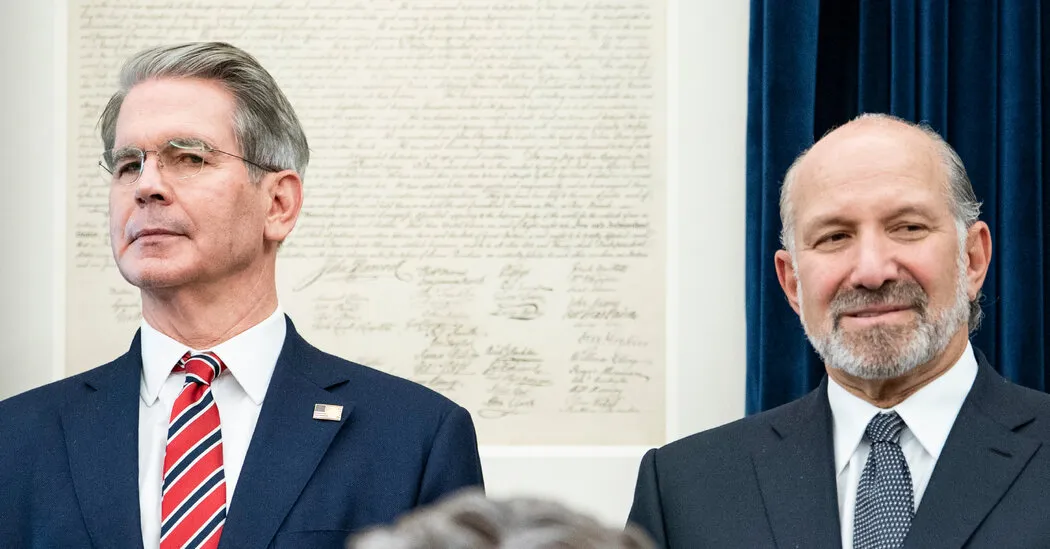
A public clash over China policy between Treasury Secretary Scott Bessent and Commerce Secretary Howard Lutnick has intensified as President Donald Trump begins a high-stakes trip to Asia.
The dispute centres on whether Washington should impose tougher restrictions on advanced Nvidia artificial intelligence chips being accessed by Chinese companies through overseas data centres. After months of internal argument, the Commerce Department issued a far-reaching rule on Monday to restrict such access in south-east Asia.
Mr Lutnick had favoured a softer approach, which would have limited the impact on Nvidia and the overseas data centres using its chips. Mr Bessent and other administration officials pressed for stronger measures to prevent China obtaining access to advanced computing power.
Although the Commerce Department has authority over the issue, its announcement said the rule had been “written by and at the direction of the Department of Treasury and the National Security Council”. Both agencies had argued for more stringent controls.
Christopher Padilla, a former Commerce Department official, said he had never seen the agency publicly distance itself from a rule that it was responsible for issuing and enforcing. He said only Commerce had the technical expertise and legal authority to draft such measures.
“It’s like open mutiny,” Mr Padilla said, describing the statement as an unprecedented public indication of a breakdown in co-operation between government departments.
The dispute has placed Mr Lutnick under pressure over accusations that he delayed measures intended to curb the supply of Nvidia chips to foreign data centres serving Chinese clients. Mr Lutnick has argued that sweeping controls on overseas data centres could damage America’s relations with China and other countries.
Mr Bessent, meanwhile, has adopted a more hawkish position on China, particularly over the race to develop artificial intelligence and the potential economic risks posed by Chinese technology. He has also criticised Nvidia and questioned whether the company encouraged allegedly illicit sales to increase revenue.
“I want to keep coming back to, what was the culture at Nvidia and were they pressing these seemingly illicit sales to goose their revenues and their earnings?” Mr Bessent told Fox News.
He previously said that officials had been pushing for action against Megaspeed, a Singapore-based data centre company under investigation over alleged chip smuggling to China. US intelligence believes a woman who led the firm was a Chinese intelligence asset. Megaspeed has said it conducts legitimate and lawful business and complies with all laws.
Asked about the government’s failure to sanction the company, Mr Bessent said: “Commerce has the pen. You will have to ask them about their internal processes.”
The Treasury secretary traditionally oversees America’s economic relationship with China. After helping to ease tensions over tariffs last year and broker a trade truce, Mr Bessent has taken a harder line amid concerns that Beijing has not fulfilled commitments to buy American farm products or speed up exports of critical minerals.
In a call this month with He Lifeng, China’s vice-premier, the Treasury Department said Mr Bessent had raised concerns about “recent Chinese actions” connected to the countries’ agreement. It added that “continued progress depends on concrete results”.
Mr Bessent has said he does not want to sever economic ties with China, describing his objective as reducing risks rather than ending the relationship. He is also working with Chinese counterparts on an alert system for serious incidents involving artificial intelligence models.
Trump is travelling to Asia for talks aimed at addressing trade tensions with China and the war in Ukraine. Meetings with Chinese leader Xi Jinping are expected to focus on implementing a trade agreement, including reducing tariffs and other trade barriers and ensuring supplies of rare earth minerals to the United States.
Officials have played down the prospect of an agreement on nuclear non-proliferation. The discussions are also expected to touch on nuclear weapons and the war in Iran.
Trump has so far declined to take sides in the dispute between his two economic advisers. “One view is, you don’t want to insult China,” he said as he left for the trip. “The other view is, just go down and dirty and do what you have to do. You can’t say either is wrong or right.”
He added: “I don’t think you want to insult China just before you get there.”
