


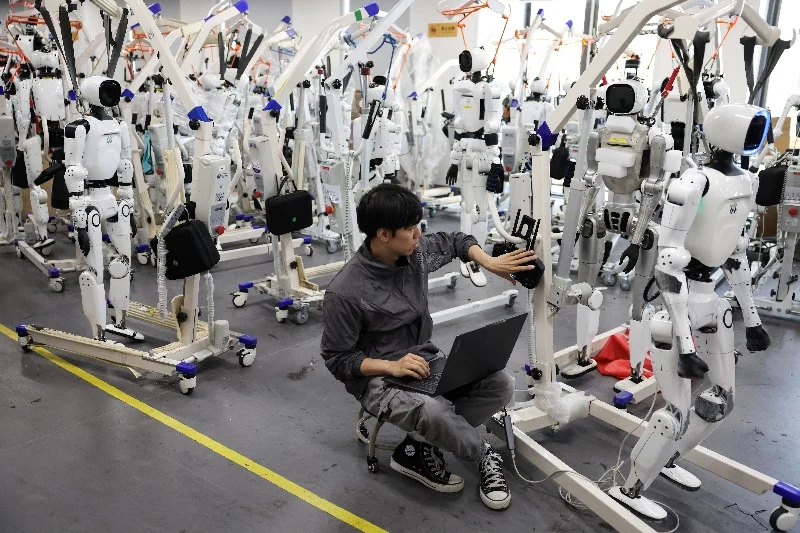
China’s TianGong Ultra humanoid robot is being moved from the track towards practical work after setting a 100-metre record that eclipsed Usain Bolt’s human mark, its development team says.
The machine completed the sprint in 8.64 seconds at the World Humanoid Robot Games in Beijing, nearly a second faster than Bolt’s 9.58-second world record set in Berlin in 2009. It had already improved from 9.39 seconds in the heats to 8.86 seconds in the semi-final.
Jack Guo, who leads development of TianGong Ultra and the smaller Omni model at the Beijing Humanoid Robot Innovation Centre, said the priority was now to make the robots dependable outside competitions.
“We want to turn high performance into high reliability and high usability,” Mr Guo told Reuters.
The centre, known as X-Humanoid, is based in Beijing’s Yizhuang technology district. It was established in November 2023 and has backing from investors including UBTech, Xiaomi and Baidu.
Its engineers are developing hardware, motion-control systems and artificial intelligence for humanoid robots, while also seeking commercial uses for its own machines. Customers include universities, research bodies and companies testing possible industrial applications.
At a Foton Cummins engine plant in Beijing, X-Humanoid robots have been trialled moving boxes. The Tianyi 2.0 model has lifted boxes weighing between 8kg and 12kg and placed them on shelves, although the factory has described the work as an early-stage exploration.
Mr Guo said smaller humanoids such as Omni were more likely to find their first roles in commercial services and light industry. TianGong Ultra, which is heavier and faster, could eventually be used for outdoor inspections or emergency response.
Turning a sprinting machine into a useful worker remains a substantial engineering challenge. TianGong Ultra weighs about 75kg and can exceed 17 metres per second, making it difficult to stop safely after reaching top speed.
During the Beijing competition, robots were sometimes forced into barriers after completing their races. Engineers worked through the night between events, repairing damaged machines and testing alternative running programmes.
The team had trained three sprinting strategies in simulation before the Games. The robot used different programmes in its preliminary, semi-final and final races as engineers adjusted its balance, navigation and starting response.
Mr Guo said the immediate task was to stabilise the robot’s body and movement-control systems for everyday use. More advanced artificial intelligence capable of carrying out complex tasks autonomously would take longer to develop.
The result reflects China’s growing push to commercialise humanoid robotics, with state-backed research, domestic supply chains and intense competition accelerating progress. But for the engineers behind TianGong Ultra, the next test will not be how quickly it can run — it will be whether it can perform useful work reliably.
