


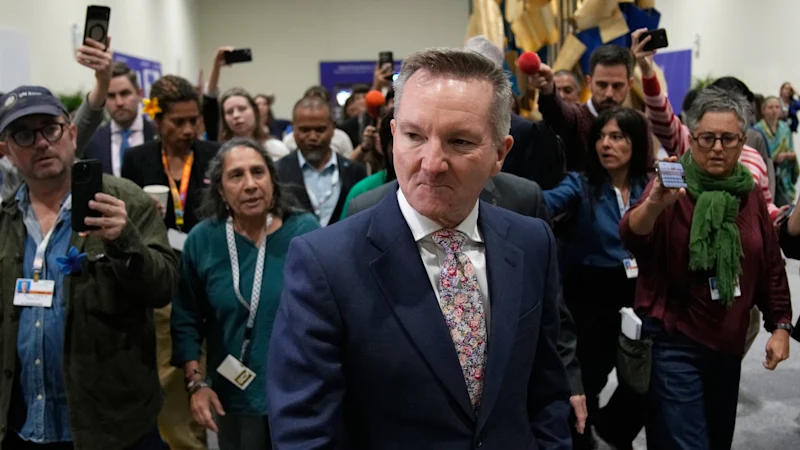
UN climate talks led by Australia’s Climate Change and Energy Minister Chris Bowen have ended without agreement in Turkey after a standoff between Saudi Arabia and Russia-backed oil-producing nations and countries seeking stronger action on climate change.
The proposed final agreement, known as a cover decision or Antalya Pact, failed to secure the consensus required from almost 200 parties to the Paris Agreement. The deadlock centred on whether to reaffirm the need to move away from fossil fuels, while disputes also emerged over carbon capture technology and climate finance.
The European Union rejected the draft, saying it represented a backwards step because it did not refer to fossil fuels or the need for a transition away from them.
Speaking for the bloc during the final plenary session, Ireland’s climate minister, Darragh O’Brien, said: “We will not endorse a cover decision, or an Antalya Pact, that does not even mention fossil fuels, which is the key driver of climate change, and we will not accept negotiating backward in time, and we will not accept a COP that greenwashes fossil fuel.”
He praised Bowen and the Turkish president of the negotiations for their efforts, but said the proposed text “does not begin to address the climate emergency that we face”.
Bowen had attempted to avoid a direct confrontation over fossil fuel wording by including recognition of an agreement reached at earlier talks in Dubai, where countries pledged to “transition away from fossil fuels”. That approach failed to bridge the divisions.
Dispute over fossil fuels and climate finance
Panama also rejected the draft, arguing that it repeated previous commitments without closing the gap between current action and what science required. Its representative said the text placed too much emphasis on carbon capture and storage while weakening language agreed at earlier meetings.
“This is a setback, a rollback,” the representative said.
The Marshall Islands said the negotiations had failed countries facing the most immediate consequences of climate change. Its representative accused the talks of offering “the worst possible response to overshoot” and said vulnerable nations would not accept “false solutions” or compromise their future for the benefit of fossil fuel interests.
“Over the past two weeks, we have been offered next to nothing,” she said. “We cannot do this on our own. We cannot survive on empty promises. People are dying, seas are rising, ecosystems are collapsing.”
The failure came shortly after the UN Environment Programme acknowledged that the world was on course to miss the Paris Agreement’s 1.5C warming target and enter a period increasingly described as climate “overshoot”.
Russia said it supported the goals of the Paris Agreement but objected to making a rapid fossil fuel phase-out central to the conference. A Saudi representative said the Arab League’s 22 members accounted for less than 2 per cent of historical greenhouse gas emissions, while other groups were responsible for 55 per cent.
Saudi Arabia also said Arab countries had called for climate finance from wealthy nations to poorer countries to be tripled. The representative said that proposal had been removed from the draft because of a lack of flexibility over including figures related to climate finance.
Mohamed Adow, director of Power Shift Africa, criticised the EU for demanding fossil fuel plans from other countries while, he alleged, expanding fossil fuel use and blocking finance needed by developing nations. “Without money and credible action at home, those demands are hollow,” he said.
China expressed reservations about parts of the proposed agreement but said it would accept the cover decision in an effort to demonstrate unity and preserve collective action.
Pressure on the COP process
The breakdown is a serious setback for the COP process and for Bowen, who took on the role of president of the negotiations after Australia’s bid to host the talks failed at the previous conference in Brazil.
Australia had hoped the presidency would strengthen ties with Pacific island nations, which regard climate change as an existential threat, as China’s influence in the region grew. Fiji’s environment minister, Lynda Tabuya, said Bowen had made every effort and that responsibility for the failure rested collectively with all parties.
“Consensus requires compromise, courage, and political will from all of us,” she said.
Mary Robinson, the former president of Ireland and a member of the Elders, offered a harsher assessment, saying the recognition of climate overshoot should have prompted greater urgency. She accused the Turkish and Australian co-presidencies of showing a “shameful lack of urgency and leadership” and said the talks had been undermined by attacks on climate science from those seeking to protect fossil fuel interests.
