


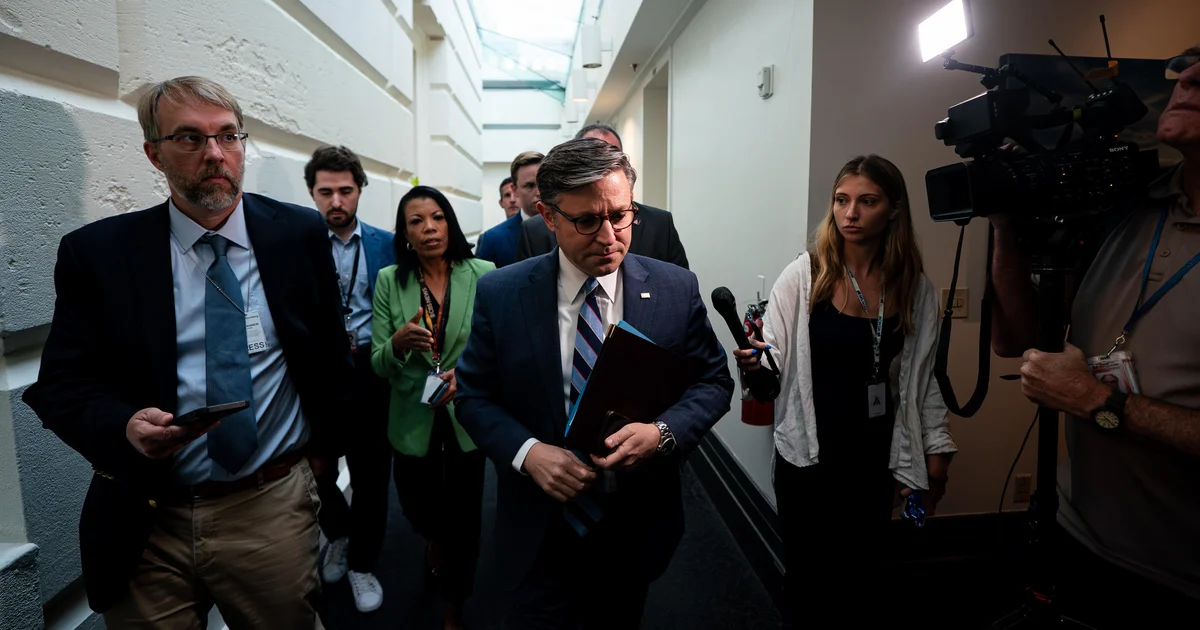
Congress faces mounting pressure to agree safeguards for artificial intelligence before the House of Representatives breaks for recess at the end of the week, with Democrats urging Speaker Mike Johnson to delay the break until lawmakers act.
In a statement, the lawmakers said: “Reasonable minds may disagree about precisely how Congress should regulate this rapidly evolving technology. We cannot disagree about the imperative for Congress to act.”
Mr Johnson has argued that Congress needs more time to develop the right policy and said AI companies also carried responsibility. He warned that rushing through legislation could damage the United States’ position in the competition with China.
“If Congress just races in and does some sort of emergency session to try to regulate AI, we will lose the race to China, and that is a threat to every single American,” Mr Johnson told CNN’s State of the Union programme.
President Donald Trump appeared to share that view, dismissing concerns raised by AI executives during remarks at his golf course in Ireland.
“We’re leading China in AI. We’re the most sophisticated country in the world. And frankly, I want to keep it that way because whoever wins AI wins,” Mr Trump told reporters. “We can put guardrails, we can do this and that. But I think you have a lot of negative voices that are bringing it up that shouldn’t be bringing it up.”
Mr Trump later said he was not “downplaying” the risks, but believed the technology would be “more good than bad”.
The White House has said the administration is working on an AI framework, although its content remains unclear. David Sacks, Mr Trump’s former AI czar, has argued that companies should regulate themselves.
“I support your decision to be responsible,” Mr Sacks wrote in a social media post. “But stop pretending you need anyone else’s permission.”
Proposals for AI regulation
The debate comes ahead of Mr Trump’s planned meeting next week with Chinese President Xi Jinping, as both countries compete to advance artificial intelligence.
Proposals in Congress include requirements for transparency and audits, a federal “kill switch”, and a waiver of antitrust laws allowing companies to co-ordinate on safety standards.
Independent Senator Bernie Sanders has proposed banning superintelligent AI and pausing development until federal safety rules are established.
The lack of progress in Congress has also moved the issue into the US midterm election campaign. Former president Barack Obama told a fundraiser that Democrats needed a clear position on the technology.
“This is something that is moving very fast in private hands, and if we don’t get on top of it, I think can be dangerous. If we do get on top of it, I do think it’s beneficial,” he said during a discussion with House Democratic Leader Hakeem Jeffries.
Abdul El-Sayed, the Democratic candidate for the Senate in Michigan, backed Mr Sanders’s proposal during an appearance on Face the Nation with Margaret Brennan.
“We need to act, and we need to act now,” Mr El-Sayed said. “So, we’ve also been calling for a pause on any of this frontier AI research until we can assure that this is being done safely.”
