


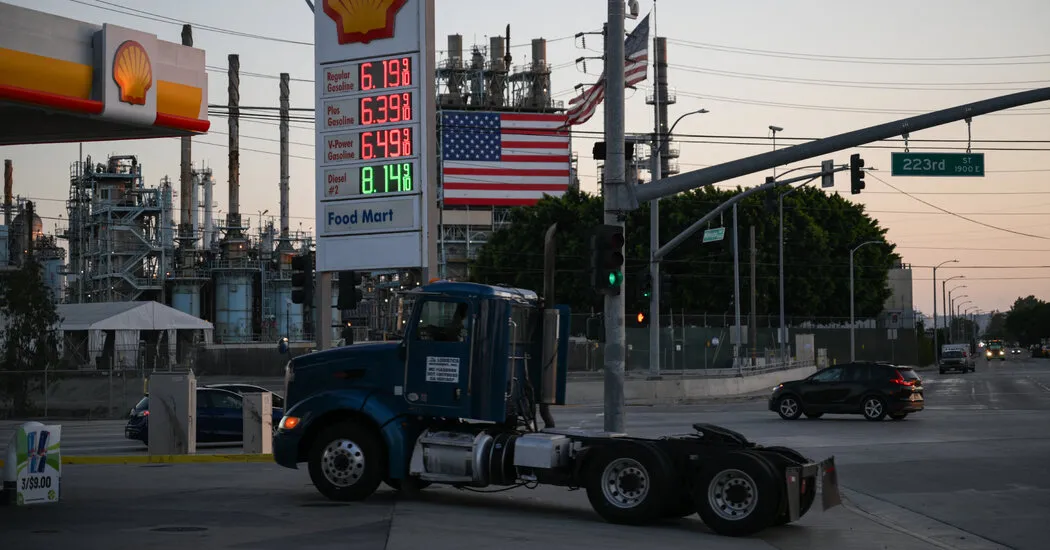
Donald Trump is considering a diesel export ban or other restrictions on shipments from the United States, in an attempt to bring down fuel prices before the midterm elections.
The proposal is being backed by some Republican lawmakers and candidates, who argue that keeping more diesel in the US would reduce costs for farmers, hauliers and other businesses. Energy experts, however, warn that the move could provide only temporary relief and may eventually push prices higher.
Diesel was selling at an average of $6.51 a gallon on Thursday, compared with $3.69 a year earlier, according to the AAA motor club. Prices have risen sharply since Israel and the US began attacking Iran nearly seven months ago, disrupting global energy supplies, while Ukrainian strikes on Russian refineries have added to pressure on diesel and other fuels.
Trump could use emergency powers to restrict diesel exports
Mr Trump has said his administration is discussing options to limit diesel exports. But Chris Wright, the energy secretary, said on Wednesday that officials were not considering “a full blanket ban or zero exports of diesel”.
Jason Bordoff, founding director of Columbia University’s Center on Global Energy Policy, said the president could impose some restrictions under broad emergency powers, although it was unclear whether he could introduce a complete ban without Congress.
A 2015 law gives the president authority to restrict crude oil exports for up to a year in certain national security and emergency situations, including sustained shortages or US prices exceeding those in other countries. The legislation does not clearly cover refined fuels such as diesel.
Mr Bordoff said the administration might instead seek to use another power, potentially under the Defense Production Act. “We’ve seen this administration find extraordinary authority,” he said. “It doesn’t have to be a complete ban.”
Congress could impose a diesel export ban itself, but the House is not scheduled to return to Washington before the November elections.
Refineries could cut production if supplies build up
The US produces more diesel than it consumes and exports the surplus. It makes about 5.3 million barrels a day of distillate fuels, including diesel and heating oil, with domestic use typically accounting for about 70 per cent of output.
The country is the largest single source of diesel traded internationally, supplying roughly 20 per cent of the eight million barrels transported by sea each day, according to the American Petroleum Institute.
An export restriction could initially force refineries, fuel distributors and other companies to store excess supplies. That might temporarily lower prices in areas such as the Midwest and north-east, where farmers are facing high costs and inventories are low.
But once storage capacity was filled, producers could reduce output, cutting the overall supply and driving petroleum prices higher. Refineries produce diesel alongside petrol, jet fuel and other products, and changing the balance is costly and time-consuming.
Analysts say it could therefore be easier for refineries to reduce production across the board, pushing up the prices of petrol, aviation fuel and other fuels as well as diesel.
“Higher diesel prices are a concern, but the main driver of the higher prices is the war in Iran,” said Gbenga Ajilore, chief economist at the Center on Budget and Policy Priorities and a former senior adviser at the Department of Agriculture. “End the war in Iran, open up the Strait of Hormuz, and diesel prices will fall.”
European importers warn of further disruption
Restrictions on US exports would also put pressure on countries that have become more reliant on American diesel as supplies from Russia and the Middle East have fallen.
Olof Gill, a deputy chief spokesman for the European Commission, said the European Union viewed reports of a possible ban with concern. “Any disruption would risk negatively impacting both sides,” he said.
Britain’s diesel prices have risen by 39 per cent since the war in Iran began on February 28 and are close to the level reached after Russia invaded Ukraine in 2022.
Richard Portes, professor of economics at London Business School, said: “Right now, we don’t need that shock. We’ve got enough inflationary pressures in the economy as it is.”
Brazil, a major oil producer, also relies on the US for nearly 20 per cent of its diesel consumption. Monica de Bolle, a senior fellow at the Peterson Institute for International Economics, said the impact could be significant because Brazil did not have large oil and diesel reserves to draw on in an emergency.
