


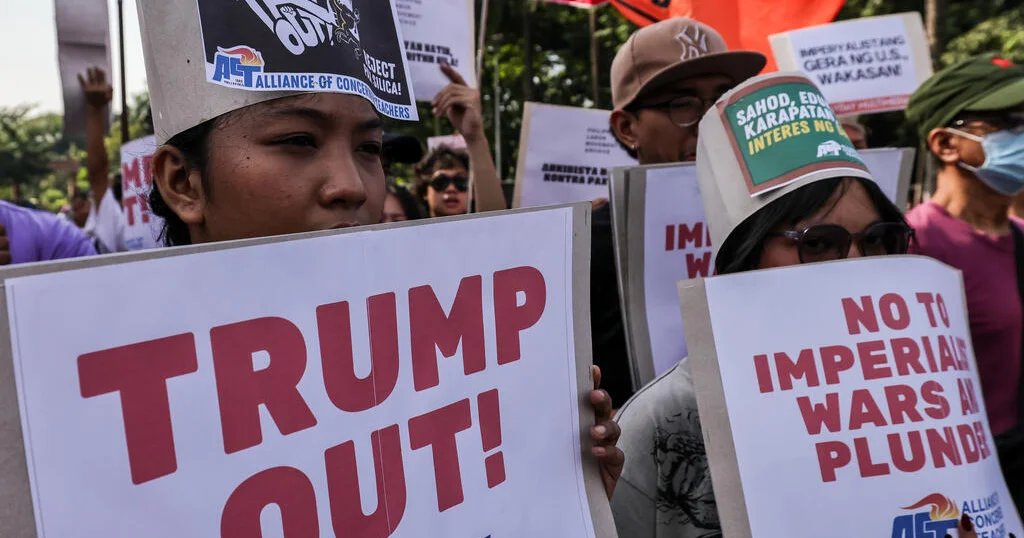
Protests against Donald Trump’s visit to the Philippines have been held across the country, with demonstrators opposing plans for a 4,000-acre artificial intelligence and manufacturing hub north of Manila.
The proposed development is the first major project under Pax Silica, a US-led initiative designed to build high-tech supply chains that do not rely on China. Protesters in Manila carried signs reading “Trump Out”, as well as images portraying the US president as a clown or devil and messages rejecting the initiative.
Critics say the industrial hub could displace farming communities and members of the indigenous Aeta people, place pressure on water supplies and amount to US imperialism in the Philippines.
“They have been grabbing our lands. They have been grabbing our economy. … Pax Silica is just for the US. It’s not for us,” said Maninging Vilog, a teacher and advocate for Aeta communities.
Kaiser Cortina, a 20-year-old protester, questioned whether the project would benefit ordinary Filipinos.
“If you look at the farmers, what do they care about AI? The people selling water … selling cigarettes, the people who drive buses. What do they care about AI?” he said.
Philippines AI hub backed by Marcos
Philippine president Ferdinand Marcos Jr, who has also faced protests this week, supports the project and has described it as an opportunity to move the country into advanced manufacturing and research.
His administration has said the development could create between 100,000 and 130,000 jobs. Mr Marcos said in October that he was “terribly excited” about its potential economic benefits and the prospect of moving up the “value chain”.
More than 25 countries have joined Pax Silica since it was announced by the US State Department in December 2025. The participants include the UK, Israel, Japan and India, while the Philippines joined in April before plans for the hub were announced.
The initiative focuses on securing the hardware and infrastructure needed for artificial intelligence, amid US concerns about reliance on Chinese supply chains and access to advanced computer chips.
Participants signed a declaration on Sunday setting out a “common understanding of the sensitive technologies and critical infrastructure that underpin” AI supply chains.
However, US and Filipino officials are not expected to make major announcements on Pax Silica during Mr Trump’s visit for the Asean summit in Manila. He is due to meet Mr Marcos on Wednesday before travelling to China.
Antonio Tinio, a member of the Philippine House of Representatives, said there were no specific votes on Pax Silica planned in the legislature and claimed it was “far from certain” that construction would begin or that the hub would succeed.
He said opposition to the proposed development reflected wider concerns about AI data centres in the US and across south-east Asia, including Malaysia and Indonesia.
