


The Trump administration has exposed a deep division over how aggressively to restrict China’s access to advanced artificial intelligence chips, as President Donald Trump travelled to Asia for talks with President Xi Jinping.
Mr Trump acknowledged that Treasury Secretary Scott Bessent and Commerce Secretary Howard Lutnick had disagreed over a loophole allowing Chinese companies to obtain computing power through data centres in other countries.
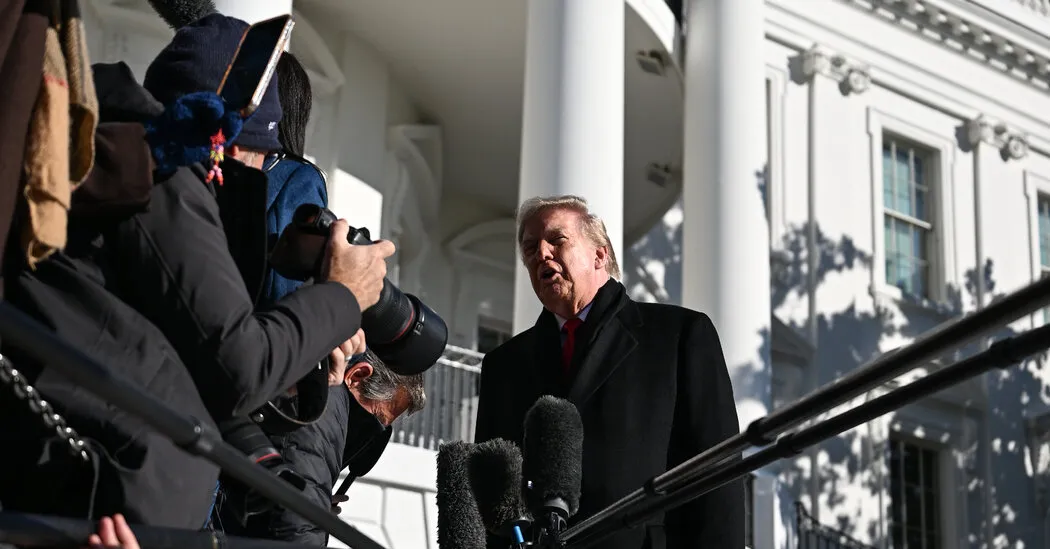
“One wants to be friendly with China, and one wants to have a blowup with China,” Mr Trump told reporters before leaving for Asia. “Both are acceptable, but they’re different views.”
The dispute has brought wider tensions inside the administration into the open. Mr Bessent, Secretary of State Marco Rubio, who is also national security adviser, Trade Representative Jamieson Greer and much of the National Security Council have supported broad limits on China’s access to AI chips.
Mr Lutnick’s Commerce Department is responsible for writing and enforcing chip export controls. He had pushed for a softer approach to overseas data centres, warning that tougher restrictions could provoke another trade war with Beijing.
Despite that opposition, the administration issued a new rule on Monday requiring data centres outside the United States to obtain a government licence before providing significant computing power to companies headquartered in China, Russia, Iran and a small group of other high-risk countries.
The measure is intended to prevent Chinese firms from renting advanced Nvidia chips which they are prohibited from purchasing directly. US officials involved in the debate have said that China’s AI models pose a major cyber-security threat to the United States.
The rule will take effect in 90 days, with enforcement left to Mr Lutnick. The Commerce Department said the measure had been “written by and at the direction of the Department of Treasury and the National Security Council”, an unusual acknowledgement of the disagreement behind the policy.
A White House spokesman, Matthew Middleton, said the action would ensure that America’s most advanced chips went “first to U.S. S.I. innovators, not Chinese shell companies”. He said the administration would continue to protect America’s technological advantage and national security.
Mr Trump nevertheless signalled that he remained concerned about antagonising Mr Xi. Defending Mr Lutnick, he suggested that delays in taking action against Megaspeed, a Singapore-based data centre company under investigation over alleged chip smuggling to China, had been intended to avoid provoking Beijing.
“If you didn’t delay it, if you didn’t do something, you could have a blowup with China,” Mr Trump said. “I don’t think you want to insult China just before you get there.”
Trump questions allegations surrounding Nvidia chief
The policy dispute has intensified following the resignation of Nvidia chief executive Jensen Huang last week. Mr Huang stepped down after revelations about two extramarital affairs, including a relationship with Alice Huang, whom US officials have identified as an asset of China’s Ministry of State Security.
Ms Huang founded Megaspeed, which is being investigated by US authorities over allegations that it smuggled chips to China. The company has said it operates a lawful and legitimate business, while Chinese officials have denied that Ms Huang is an intelligence operative.
Mr Trump again cast doubt on the allegation on Monday. “I don’t know that she is a spy,” he said. “Usually, what happens with that is that any woman coming to the country that’s a beautiful woman that comes from China, they say she’s a spy.”
When a reporter said that Mr Rubio had warned him about Ms Huang, Mr Trump asked: “Who told me that?” After being told it was Mr Rubio, he replied: “I haven’t heard that.”
Mr Trump has continued to support Mr Huang and said he “would not mind” seeing him reinstated. Nvidia has been important to the president’s economic agenda, with Mr Trump previously describing the company as central to the stock market and the wider economy.
The president is due to meet Mr Xi and Russian President Vladimir Putin at a summit in Shenzhen, the Chinese technology hub, this week. Advisers have said Mr Trump has shifted between the administration’s rival positions on China, raising concerns among supporters of tighter controls that the new chip rule could eventually be used as a bargaining tool with Beijing.
