


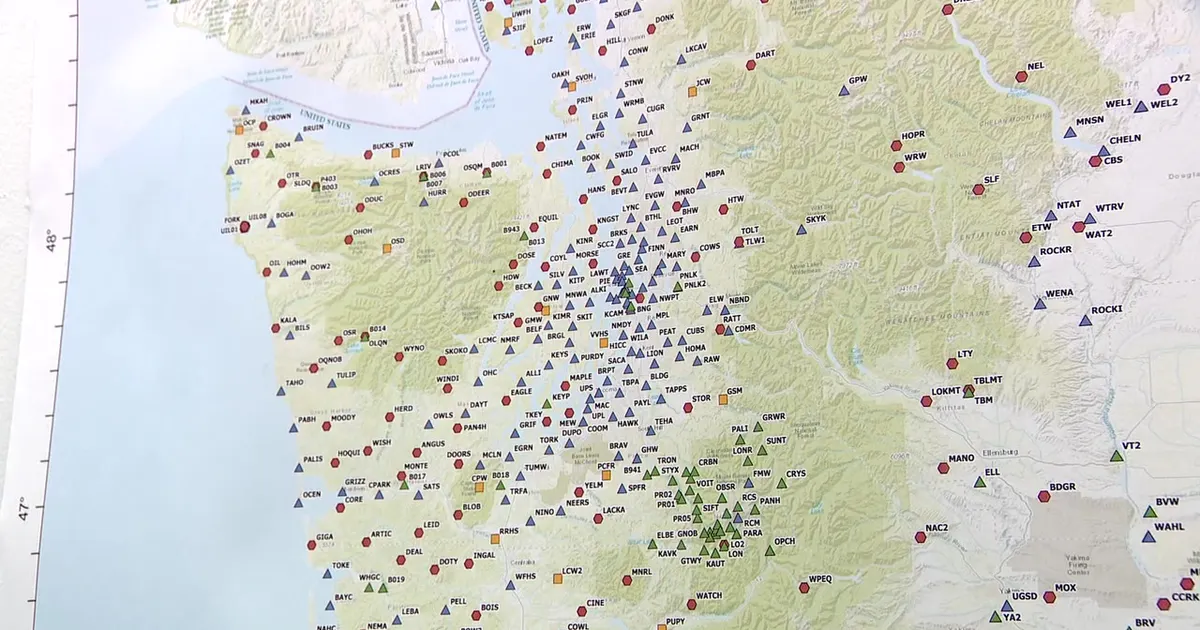
A major earthquake on the Seattle Fault could send a tsunami up to 33ft into Elliott Bay, with people along the waterfront having little time to escape, scientists have warned.
The fault runs beneath Bainbridge Island, Seattle and Lake Washington, making it a particularly serious threat to the densely populated Puget Sound region. Harold Tobin, director of the Pacific Northwest Seismic Network, described it as the area’s “worst-case scenario”.
Unlike a tsunami generated by a distant offshore earthquake, waves caused by movement on the Seattle Fault could reach the shoreline within minutes of the ground beginning to shake.
“As soon as people felt the earthquake, if you’re close to the waterline, if you’re in the harbour anything like that, you want to quickly move to higher ground,” Tobin said.
The Seattle Fault earthquake threat
The last major rupture on the fault occurred during the winter of 923-924, according to the Washington Geological Survey. Geological evidence suggests it produced an earthquake of about magnitude 7 to 7.5 and caused land around Puget Sound to rise sharply.
Researchers believe the event generated a local tsunami, with waves potentially reaching heights of up to 33ft along what is now Seattle’s waterfront. At Restoration Point, on the eastern side of Bainbridge Island, the ground was lifted by about 23ft.
Daniel Eungard, a geologist with the Washington Geological Survey, said the historic evidence demonstrated why earthquakes and tsunamis remained an unavoidable part of life in the Pacific Northwest.
Washington is regarded as having the second-highest earthquake risk in the United States. A major Seattle Fault event would affect not only the city centre but also marinas, harbours, houseboats and critical infrastructure around Elliott Bay.
The earthquake itself could cause severe damage before any wave arrived. Older brick buildings in areas such as Pioneer Square would be particularly vulnerable, while collapsed facades and debris could block roads used by emergency crews.
Washington’s decade of earthquakes
Recent public interest in the threat has been heightened by a magnitude 4.2 earthquake felt around the Seattle area. Scientists stress, however, that a quieter period does not mean a major earthquake is imminent, nor does it indicate that the danger has passed.
Washington’s history shows that notable earthquakes can appear to cluster. Four significant events struck within roughly a decade from 1939, beginning with an earthquake shortly before midnight that reportedly sent theatre audiences into the streets in Aberdeen, Chehalis and Seattle.
A magnitude 5.5 earthquake followed in 1945, causing damage along the Cascades. A magnitude 6.3 event struck the following year, damaging buildings and a packaging plant.
The most destructive earthquake of that period came in 1949. The magnitude 7.1 event killed eight people, twisted chimneys and damaged buildings across the region, while large cracks opened in the pavement around Green Lake.
Harold Tobin said the 1949 earthquake was similar to the magnitude 6.8 Nisqually earthquake of 2001 because both occurred deep within the Earth’s crust. Neither ruptured the surface or created the kind of immediate local tsunami associated with a major Seattle Fault earthquake.
Scientists do not know why some periods are more seismically active than others, and the pattern does not provide a timetable for future events. Daniel Eungard cautioned that the interval between the 1949 earthquake and Nisqually was not evidence of a repeating cycle.
“It’s not a stop watch, it’s not every 50 years on the dot,” he said.
Experts say lessons from past earthquakes can help improve building standards and emergency planning. Structures that survived earlier shaking without being strengthened, however, cannot be assumed to withstand a future major earthquake.
