


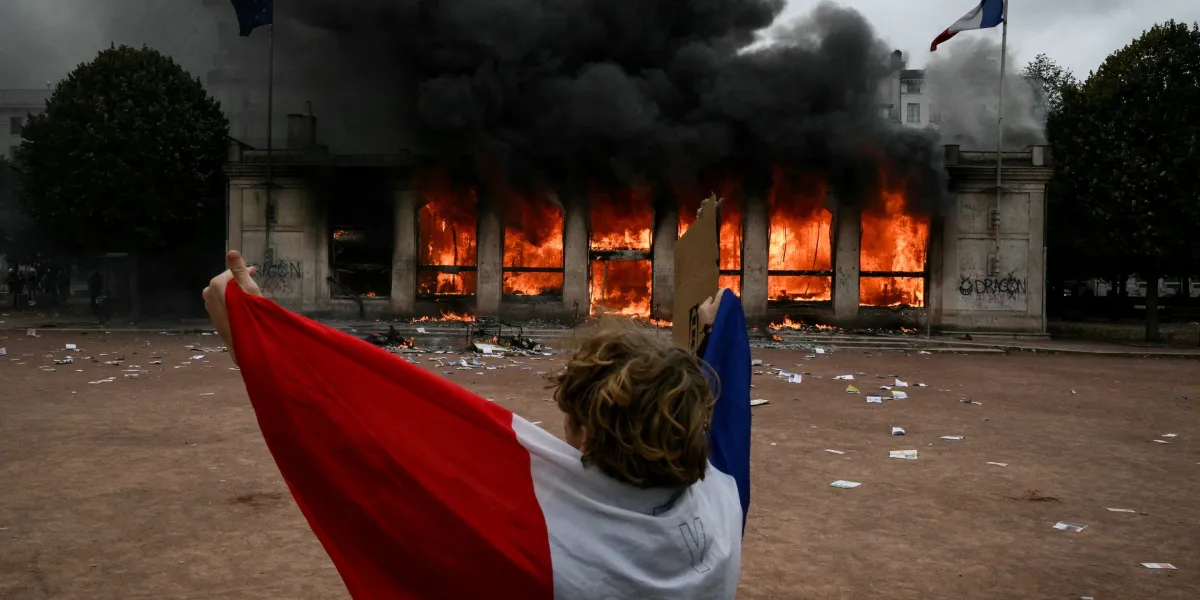
France’s debt crisis has deepened as nationwide protests over the cost of living erupted into rioting, while investors pushed borrowing costs to their highest level in 24 years ahead of a crucial budget vote.
Luxury shops and supermarkets were looted in some cities, while public buildings were defaced and set on fire. The unrest followed demonstrations earlier this month by students protesting about deteriorating classrooms, teacher shortages and schools ill-equipped to cope with rising temperatures.
Protesters blamed years of underinvestment in education. The unrest has added to pressure on the government as it attempts to contain France’s deficit and convince financial markets that the country remains governable.
Public debt has reached a record $4 trillion, equivalent to 119% of gross domestic product and the highest ratio since the aftermath of the Second World War. The pandemic, along with the wars in Ukraine and Iran, has worsened the public finances, while President Emmanuel Macron has stepped back from reforms intended to reduce the burden.
Sébastien Lecornu, the latest in a succession of French prime ministers, has proposed a 2027 budget that would reduce the deficit modestly, from 5.4% to 5% of GDP. The plan faces its first critical vote in the National Assembly on Tuesday.
Financial markets have become increasingly concerned that neither the far right nor the far left will support the measures needed to restore the public finances. Marine Le Pen has pledged to reduce the retirement age to 62, and has previously suggested lowering it to 60, while far-left presidential candidate Jean-Luc Mélenchon has proposed cancelling the central bank’s holdings of French debt.
France debt crisis puts pressure on government
Mujtaba Rahman, managing director for Europe at Eurasia Group, said France was facing simultaneous crises in liberal democracy, fiscal management and youth disaffection.
“But the fiscal crisis is the most dangerous, underlying many of the country’s woes and threatening to bring it to ruin,” he wrote in a New York Times opinion article. “France, truly, is on the brink.”
He argued that the pressures were closely linked. Although France spends more on education than the European Union average, more than a quarter of that money goes towards the pensions of retired teachers, he said.
Economist Paul Krugman has also linked the country’s pension arrangements to the student protests, arguing that generous government pensions have left education under pressure and effectively shifted resources towards older people.
Rahman said the market’s distrust was driven more by political uncertainty than by economic conditions. Investors fear France is becoming socially volatile and institutionally paralysed, with the presidential election in May unlikely on its own to resolve the problems if a subsequent legislative election in June fails to produce a parliamentary majority.
France could avoid an immediate escalation if Ms Le Pen instructed her allies in the National Assembly to abstain on the budget, allowing it to pass. A failure to secure approval, however, could sharply increase the cost of servicing the country’s debt.
“If his government fails to pass the budget, the cost of servicing French debt may explode,” Mr Rahman warned. “France could be forced to seek assistance from the International Monetary Fund and to pray for it from the European Central Bank — a humiliation for the world’s seventh-biggest economy.”
Thierry Wizman, global foreign exchange and rates strategist at Macquarie Group, said a series of further shocks could be required before France regained the confidence of bond investors. These could include a no-confidence vote, a credit downgrade by Moody’s, wider protests and violence, a further rise in the gap between French and other bond yields, and a Le Pen victory in the presidential election.
Mr Wizman said the European Central Bank might not intervene quickly because of concerns about encouraging “moral hazard”, while other rescue mechanisms lacked the capacity to support an economy the size of France’s.
“Either way, it would seem that one would have to go through the valley before getting to the other side of the fiscal responsibility gap,” he said, adding that France might only commit to austerity after “all that transformational pain of the next few months”.
