


At least four leading Australian universities allegedly collaborated with Chinese defence groups on research, including on technology linked to anti-ship missiles, according to a report by a US think tank.
The China Aerospace Studies Institute (CASI), based in Alabama, released a report examining hundreds of interactions between Western institutions and Beijing between 2015 and 2025, either through research collaborations or conference attendance.
The section covering Australia names at least 13 research centres and universities across the country.
The University of Sydney was identified in the report as having the fourth-highest number of interactions with People’s Republic of China (PRC) defence laboratories over the decade.
These interactions allegedly included joint research on aerodynamics, antennas, microwave technology and communications anti-jamming systems.
The report also referred to a ‘PRC military researcher’ at the University of Western Australia (UWA) in 2015 who was allegedly involved in missile development.
‘This researcher has worked with other lab researchers on controllability of complex networks,’ the report said.
‘He has also worked on route planning algorithms for anti-ship missiles.’
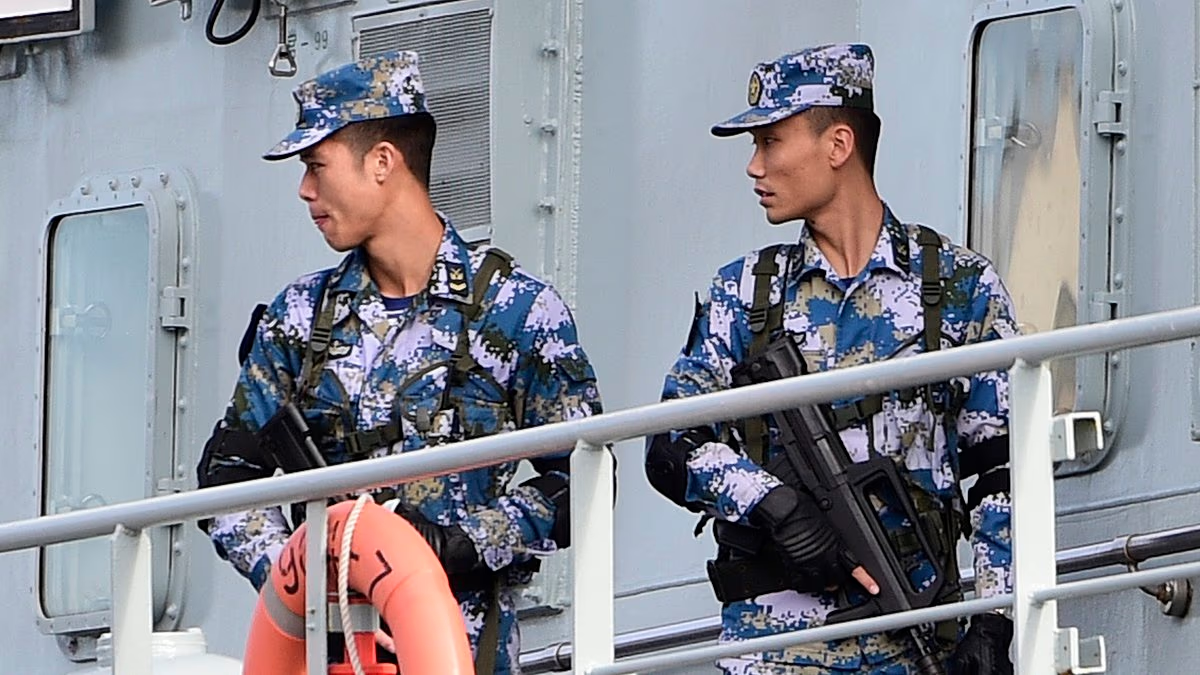
At least four leading Australian universities allegedly collaborated with Chinese defence groups on research, including on technology linked to anti-ship missiles, according to a report by the China Aerospace Studies Institute. Pictured, Chinese navy personnel
The University of Technology Sydney (UTS) allegedly had a cooperative relationship with a PRC defence laboratory on antennas and microwave technology, the report states.
Swinburne University of Technology also allegedly conducted joint aerodynamics research with a PRC defence laboratory.
Universities whose staff attended conferences or events involving PRC defence laboratories included UTS, Australian National University, RMIT University, La Trobe University and Swinburne, as well as the universities of Wollongong, Melbourne, Sydney and New South Wales.
Responding to the report, Strategic Analysis Australia director Michael Shoebridge said China invests heavily in universities and research, but collaboration on defence-related work posed an ‘absolute’ risk if Australia were to become a target.
‘It’s a whole different thing to be wilfully blind about research that is so directly applicable to the military,’ he told the Daily Mail.
‘Any research that is directly applicable to Chinese military capability is not in Australia’s interest.
‘For example, to have somebody in the UWA helping a Chinese outfit develop anti-ship missiles when the likely target is Royal Australian Navy ships is simply an outrageous lapse of judgement and a terrible failure.’
Mr Shoebridge referenced a 2018 report by the Australian Strategic Policy Institute (ASPI) which revealed China’s military had sent more than 2,500 military scientists and engineers abroad to foreign universities.

Strategic Analysis Australia director Michael Shoebridge said China invests heavily in universities and research, but collaboration on defence-related work posed an ‘absolute’ risk
‘I was alarmed in 2018 that top Australian universities had deep partnerships with key Chinese universities which have a core purpose of supporting the Chinese military and intelligence agencies,’ he said.
‘So eight years on, to find that the same universities have the same problem, is depressing and alarming.’
The revelations come as experts warn the threat of a direct attack on Australia is ‘real and growing’.
The Lowy Institute published a report in June citing China’s expanding fleet of warships, submarines, heavy bombers and nuclear weapons.
The report said any attack would depend on Beijing’s strategic objective, outlining a series of scenarios ranging from symbolic strikes designed to intimidate Australia to widespread attacks targeting critical infrastructure and the nation’s political leadership.
In July, Foreign Minister Penny Wong accused Beijing of ‘destabilising and risky’ behaviour after an incident between the China Coast Guard (CCG) and the Armed Forces of the Philippines (AFP).
Earlier that month, the PLA Navy launched a ballistic missile carrying a simulated training warhead into the Pacific Ocean, with reports suggesting a range capable of reaching as far as Brisbane.
CASI’s 236-page report lists more than 700 interactions between Western research institutions and Beijing-linked entities, with Australia accounting for a significant number of them.

In July, the PLA Navy launched a ballistic missile carrying a simulated training warhead into the Pacific Ocean, with reports suggesting a range capable of reaching as far as Brisbane
The US had the highest number of interactions, with 204 of the 713 recorded, according to the study.
Several other Western countries also had ‘higher rates of contact among fewer institutions, including Australia, the UK, Canada, the Netherlands and Sweden’.
‘Such interactions between Western research institutions and PRC military research labs are at the very least problematic, and at most an urgent security concern,’ the report said.
‘While some instances described herein are more troubling than others, even the seemingly less problematic cases provide opportunities for the gathering of valuable technology and knowledge by actors whose main goal is to develop new technologies for the PRC military.’
CASI is the US Department of the Air Force’s premier centre for the study of China and its aerospace capabilities.
While Mr Shoebridge highlighted the risks such collaborations might pose, international politics expert Professor Mark Beeson, who works with UTS, argued that risks can also come from other nations.
‘We can’t trust everything China says or does, but that is doubly true of the Trump administration,’ he said.
‘Better relations with China are essential given our economic dependence and China’s location. They’re not going anywhere. A better question may be what’s the risk of not working with China?’

A University of Western Australia spokesperson said the report does not allege misconduct nor identify military applications that come from the research
When contacted about the report, a UWA spokesperson said the report does not allege misconduct nor identify military applications that come from the research.
‘The University of Western Australia is aware of a China Aerospace Studies Institute report that references historical academic publications associated with a former UWA visiting postgraduate student,’ they said.
‘The publications identified in the report are more than a decade old. The report does not allege misconduct by UWA, nor does it identify any specific subsequent military application arising from the cited UWA-linked research.
‘UWA is committed to conducting research responsibly and in accordance with Australian laws, regulations and national research security requirements.’
The University of Sydney said in a statement it was not familiar with the organisation that prepared it.
‘We will review it and see if it contains data that can link to our current research,’ the statement to the Daily Mail said.
The university said researchers comply with all applicable laws, government guidance, ethics requirements, research conduct codes and university standards when conducting research.
Similarly, a spokespeople for the UNSW, the University of Melbourne and Swinburne said the institutions followed and are committed to government guidance and legal requirements.
The Swinburne spokesperson added that a former staff member ceased employment before attending a conference in China and has no ongoing relationship with the university.
They noted the research collaboration from 2007 to 2016 was established during a period when ‘collaboration was actively encouraged by the Government’.
