


Democrats will take control of Congress in January after sweeping Republican election defeats, setting up two years of investigations, budget battles and clashes with President Donald Trump.
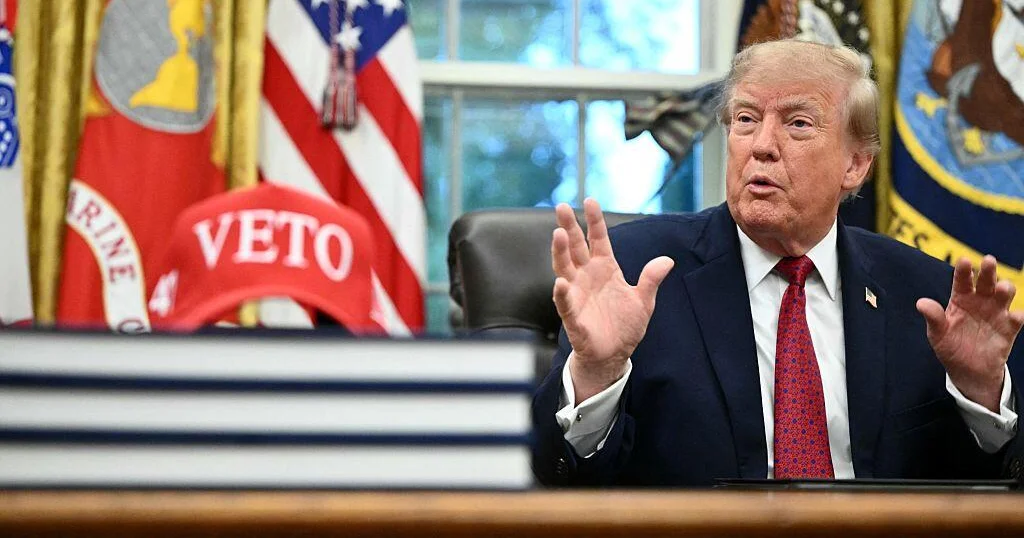
Mr Trump has offered mixed signals about how he intends to deal with the new political reality. As the losses mounted, he told Politico: “We’re going to work with the Democrats.” But before polling stations had closed, he told CBS News: “I have the ultimate power, it’s called ‘veto’.”
By the following day, the president was combining both positions. “I’ll get along, probably, with the Democrats, unless they want to be destructive, but I have the power of the veto,” he told reporters at the White House.
A red hat bearing the word “VETO” was later placed on the Resolute Desk in the Oval Office.
Democrats prepare investigations
The new Democratic committee chairs are expected to use Congress’s investigative powers aggressively, beginning with the subpoena authority attached to their posts.
Representative Robert Garcia of California, who is expected to chair the House Committee on Oversight and Government Reform, has been preparing inquiries into the Trump family’s business dealings, alleged corporate corruption, the Department of Homeland Security and Immigration and Customs Enforcement.
He has also identified the Jeffrey Epstein scandal as an area for investigation. Other possible subjects include Donald Trump Jr’s wedding celebrations in the Bahamas, which Garcia said were partly paid for by a Russian oligarch, and a 2 billion dollar investment received by Jared Kushner’s private equity fund from Saudi Arabia’s sovereign wealth fund.
Garcia said the committee would examine the Trump family’s cryptocurrency ventures, companies linked to the president’s sons that received Pentagon contracts, alleged pay-to-play arrangements and claims involving kickbacks connected to Homeland Security contracts and donations towards a White House ballroom.
“Lawyer up,” Garcia warned. He said administration officials who had “caused real harm” should expect scrutiny, naming White House deputy chief of staff Stephen Miller, former Homeland Security official Corey Lewandowski and former secretary Kristi Noem among those who could be called to testify.
Garcia acknowledged that the Justice Department under Mr Trump might not pursue enforcement action against people who refused to co-operate. However, he said Democrats could bring civil contempt proceedings through the courts, as well as pursue contempt charges.
Representative Jamie Raskin of Maryland, who is expected to lead the House Judiciary Committee, also plans to examine the Justice Department’s handling of the Epstein investigation and Ghislaine Maxwell’s transfer to a low-security prison.
Mr Raskin has identified what Democrats describe as “slush funds” for further scrutiny, including an international initiative called the Board of Peace, an “anti-weaponisation” fund created from a settlement involving Mr Trump’s lawsuit against the IRS and Treasury Department, and funding for the White House ballroom.
On the House Armed Services Committee, Representative Adam Smith of Washington has promised “vigorous oversight” of the Defence Department. He said the alleged “illegal war against Iran”, government contracts, military strikes in the Caribbean and Latin America and the deployment of troops to US cities would be among his concerns.
Mr Smith also criticised what he called the politicisation of the armed forces and the removal of personnel on the basis of loyalty and ideology.
Douglas Kriner, a professor in Cornell University’s government department, said divided government traditionally brought more investigations, with the House generally taking a more aggressive approach than the Senate.
The White House has warned that Democrats could face criticism if investigations were used for political purposes. Spokeswoman Lauren Bis said Mr Trump was willing to work with anyone to deliver “victories for hardworking Americans”, but accused Democrats of choosing to work against the public if they pursued “sham investigations and radical left policies”.
Impeachment is not currently a priority
Despite Mr Trump’s repeated campaign predictions that Democrats would seek to impeach him if they regained control of Congress, Democratic leaders have so far shown little appetite for such a move.
House Democratic leader Hakeem Jeffries said he had not spoken to a single member of the Democratic caucus about impeachment. Mr Trump was impeached twice during his first term, when Democrats controlled the House, but neither attempt resulted in a conviction in the Senate.
Some newly elected Democrats on the party’s left have also urged a focus on legislation aimed at improving the lives of working-class Americans. Representative-elect Melat Kiros of Colorado said she was not convinced there was a route to impeachment that would lead to Mr Trump’s removal.
Mr Raskin, who served as the lead House manager during Mr Trump’s second impeachment, has said there are more important issues to address, despite believing the president had committed impeachable offences.
Mr Trump said he was “not even a little bit” concerned about another impeachment attempt, arguing that it would damage the Democratic Party if pursued “for no reason”.
Congress’s spending power returns
Democrats will also regain influence over federal spending after two years in which Mr Trump frequently bypassed Congress and Republicans generally backed his budget priorities.
Representative Rosa DeLauro of Connecticut, who is expected to chair the House Appropriations Committee, said she intended to use the powers available to her to hold the administration to account and tackle what she described as corruption.
“I will fight Donald Trump and the Cabinet secretaries as well,” she said. “I’m going to hold the Trump administration accountable for the corruption. I’m going to rein in corruption at the highest level of government. I would do that through appropriations.”
Ms DeLauro said spending bills would contain “guardrails” and that every option, including removing funding for particular activities, would be considered.
However, Democrats will still need Republican support for major legislation, including measures to fund the government. Most bills require 60 votes in the Senate to overcome a filibuster, meaning bipartisan agreement will remain necessary.
Molly Reynolds of the Brookings Institution said that, with limited exceptions, legislation passed during Mr Trump’s first two years had needed bipartisan backing to clear the Senate’s procedural hurdle.
Mr Kriner said Democrats could use spending bills and restrictions on appropriations to influence what federal agencies were able to do. He said disputes over the White House Office of Management and Budget making spending decisions about money already approved by Congress had significant implications for the balance of power between the branches of government.
Trump nominees face tougher path
Democratic control of the Senate is also expected to make it harder for Mr Trump to secure confirmation for his nominees.
The president has repeatedly said he does not intend to dismiss Defence Secretary Pete Hegseth. But he has also said that replacing him before the new Congress takes office would make it easier to secure confirmation for a successor.
Unless the president puts forward candidates capable of attracting support from both parties, he may have to rely on acting officials to fill posts requiring Senate approval.
Mr Trump is also expected to make greater use of executive authority, having already relied heavily on presidential action during his second term despite previously enjoying unified control of government.
Brandon Rottinghaus, a political science professor at the University of Houston, said executive action had been Mr Trump’s preferred way of pursuing his objectives with fewer checks from Congress. He added that political constraints were likely to encourage further unilateral action, although the courts would limit its reach.
Mr Trump used his pen to sign an executive order designating the Oval Office and Cabinet Room as national landmarks, although a future president could reverse that decision with another executive order.
Republicans face their own choices
The president’s difficulties may not come only from Democrats. Republicans who spent the first two years supporting his agenda could become more willing to defy him as they consider their own political futures.
Brandon Rottinghaus said Mr Trump was facing a “ticking clock” as his term-limited presidency entered its final two years.
“The last two years are going to be the hardest of his political career,” he said, arguing that the president’s influence over Republican lawmakers would diminish as they focused more closely on what came next for them.
“Republicans are going to have to figure out a way forward around Donald Trump,” he added.
