


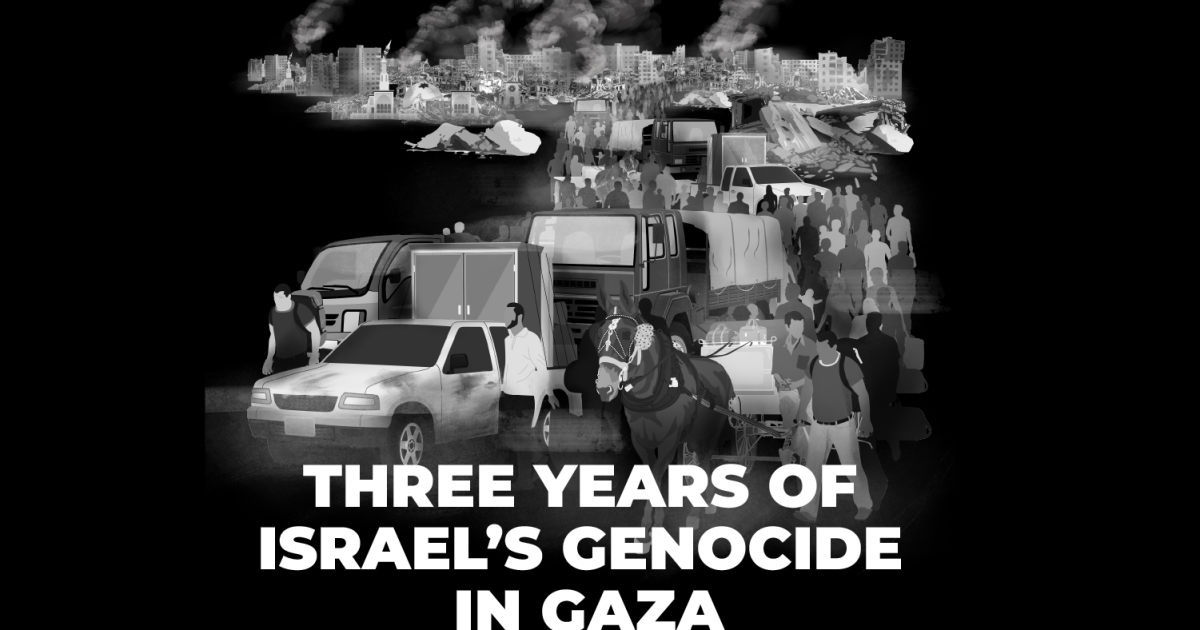
Three years of war in Gaza have left at least 74,000 Palestinians dead and more than 175,000 injured, according to figures from the Palestinian Ministry of Health. The destruction has extended across homes, hospitals, schools and essential water infrastructure, while attacks have continued despite a ceasefire declared in October 2025.
The conflict began after Hamas’s armed wing, the Qassam Brigades, and other Palestinian groups attacked southern Israel on October 7 2023, killing 1,139 people and taking about 240 captives. Israel responded with sustained bombardment and tightened its 16-year blockade into a total siege.
The ministry’s death toll records people whose deaths were registered at hospitals or officially documented. It does not include those still missing or believed to be buried beneath collapsed buildings, meaning the overall number is likely to be higher.
Three years of war in Gaza: one in 30 people killed
At least 21,000 children are among those killed, representing about 3 per cent of Gaza’s pre-war population – roughly one person in every 30.
More than 175,000 people have suffered injuries, equivalent to around one in every 13 people in Gaza. The World Health Organisation estimates that about 24 per cent of the injured have life-changing injuries requiring long-term rehabilitation, with children making up a quarter of that group.
Gaza’s remaining medical facilities are struggling with overwhelming demand and diminishing supplies.
Ceasefire overshadowed by continuing attacks
A ceasefire came into effect at noon on October 10 2025. However, more than 1,000 people have been killed since then, according to figures cited in the assessment of the conflict.
Israel attacked Gaza on 325 of the following 361 days, leaving only 36 days without reported attacks, deaths or injuries. The United States has continued to maintain that the ceasefire is holding.
The Palestinian Ministry of Health says at least 1,460 Palestinians have been killed and 5,116 injured since the ceasefire began.
The continuing violence has left Gaza’s health system in ruins. Ninety-four per cent of hospitals and other healthcare facilities have been fully or partially put out of service, according to the UN Office for the Coordination of Humanitarian Affairs.
Only 42 of Gaza’s 666 healthcare facilities are still functioning. International humanitarian law provides special protection for medical units and personnel, while the intentional targeting of a hospital is defined as a war crime under the Rome Statute of the International Criminal Court.
Water, homes and education devastated
Water insecurity affects 91 per cent of households in Gaza. Wells, pipelines, desalination plants and sewage systems have been damaged, while some surviving water sources have been contaminated or cut off by fighting and displacement.
Nearly half the population is surviving on less than six litres of water a day for drinking and cooking. The emergency minimum for short-term survival is 20 litres.
The damage to buildings is similarly extensive, with 82 per cent of structures destroyed. Entire neighbourhoods have been wiped out, leaving 1.98 million Palestinians displaced – about 90 per cent of Gaza’s population.
Education has also collapsed. About 93 per cent of schools require complete reconstruction, leaving more than 700,000 pupils without access to formal education.
At least 63 university buildings have been destroyed, while those still standing are being used as shelters by displaced people.
Nearly 300 journalists killed
Gaza has become the deadliest place to work as a journalist, with nearly 300 journalists and media workers killed since October 7, according to the Shireen Abu Akleh Observatory.
Twelve Al Jazeera staff members are among those reported killed: Samer Abudaqa, Hamza Dahdouh, Ismail al-Ghoul, Ahmed al-Louh, Hossam Shabat, Ibrahim Thaher, Mohammed Qreiqeh, Mohammed Nofal, Anas al-Sharif, Mohammed Salama, Mohammed Wishah and Ahmed Wishah.
Foreign media organisations are barred from entering Gaza, apart from a small number of reporters embedded with Israeli soldiers under strict military censorship.
