


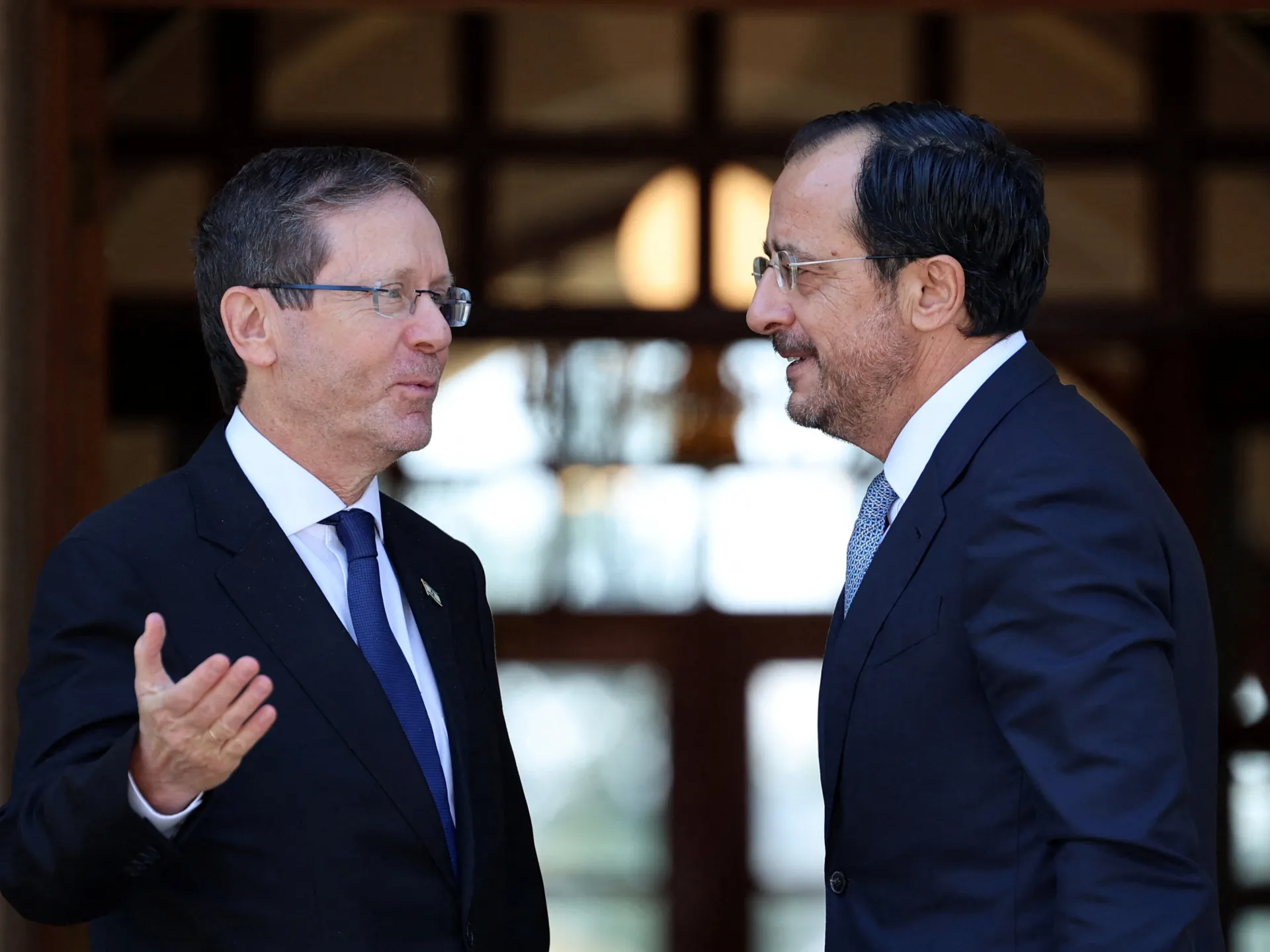
Israel’s influence in Cyprus is expanding across water, healthcare, energy and defence, prompting concern among some Cypriots that the country is allowing a foreign power to gain leverage over essential systems.
The relationship is presented by the Cypriot government as a security alliance aimed at countering Turkey, which has occupied the island’s northern part since its 1974 invasion. But critics fear the partnership is giving Israel an increasingly powerful position in a country whose economy and military are far smaller.
“It’s trying to dominate as much as possible, land-wise, company-wise,” said Christos Achniotis, a Cypriot who has followed the island’s history and politics. He said Israel’s influence was also growing politically and militarily.
Israel’s growing role in Cyprus
Israel’s state-owned water company, Mekorot, is involved in supplying Cyprus, while Israel Aerospace Industries is providing the island with new air-defence systems. Israeli companies also operate a growing hospital network and hold a stake in Cyprus’s largest gasfield.
Israel’s economy is about 15 times larger than Cyprus’s, while its military spending is about 73 times greater, according to figures cited in the source material.
Israeli investment in Cyprus reached €5.1 billion at the end of 2024, more than six times the level recorded in 2017, Central Bank of Cyprus figures show. The total may be higher because some investments made through companies with difficult-to-trace ownership are not captured.
The Tel Aviv Stock Exchange is also considering a bid for the Cyprus Stock Exchange, which the Cypriot government is privatising. A European Union licence held by the Cypriot exchange could give Israel greater access to the eurozone market, according to a source close to Cyprus’s finance ministry cited by the Cyprus Mail.
In healthcare, Hadassah Medical Centre Limassol, the Israeli hospital group’s first centre in Europe, began treating patients in July and was formally opened on Thursday.
Israel’s NewMed Energy owns 30 per cent of the Aphrodite gasfield, according to company filings. The two governments are negotiating over the field because Israel says it extends into its waters.
Water supply and concern over control
The most sensitive area for some Cypriots is water. About 80 per cent of the island’s drinking water comes from the sea, while reservoirs were just 21 per cent full in March.
Desalination plants now supply most of the water reaching domestic taps. Agriculture Minister Maria Panayiotou said in June that desalination would cover almost all household demand by next year.
Mekorot operates two of Cyprus’s five permanent desalination plants, at Larnaca and Episkopi, through joint ventures with the Cypriot company Netcom. In August, it expanded its co-operation with Cyprus by signing a memorandum with the Nicosia District Water Board to assist with water and sewerage management in the capital.
Danae Laou, who works in hospitality in Limassol, said the agreements had crossed a line.
“It’s terrifying to see, but at the same time, we have no power,” she said.
Laou said Israel’s control of vital resources in the occupied West Bank had made her concerned that a similar pattern could develop in Cyprus. Mekorot is listed by the United Nations among companies linked to Israeli settlements in the West Bank.
Najla Abdellatif Vallander, a Swedish-Palestinian environmental campaigner who founded Zero Waste Palestine, said Mekorot’s operations in the West Bank amounted to “water theft”. She alleged that Palestinian water sources were diverted to Israeli settlements, while Palestinians were prevented from accessing their own supplies.
“This is water apartheid,” she said.
Mekorot had not responded to a request for comment at the time of publication.
Military ties with Israel
Cyprus is replacing Russian-made air defences with the Israeli-built Barak MX system, with deliveries beginning in late 2024.
Israeli special forces have also trained in the Troodos mountains, whose terrain resembles southern Lebanon. In 2022, the two countries held their largest joint military exercise, simulating a conflict with Hezbollah.
Israeli and Cypriot military officials signed a 2026 co-operation plan in late December 2025 covering joint exercises, training and what the Israeli military described as “strategic military dialogue”.
Israel has sought to frame the relationship around the threat from Turkey. Cyprus was divided after Turkey invaded following a coup backed by Greece’s military government in July 1974. Turkey and the Turkish Cypriot leadership are the only authorities to recognise Northern Cyprus.
On Tuesday, the Israel Allies Foundation launched a caucus of six Cypriot lawmakers from three parties. Its president, Josh Reinstein, later described Turkey as a “common adversary” following a meeting with the Cypriot president.
Cyprus’s opposition AKEL condemned the initiative as “extremely provocative”, questioning how Cyprus could demand pressure on Turkey while supporting what it called “another occupying and settler state”.
Israeli Prime Minister Benjamin Netanyahu told the United Nations General Assembly last month that Turkish President Recep Tayyip Erdogan “illegally occupies northern Cyprus, an EU member”.
Ioanna Lamprou, a writer in Limassol, said Netanyahu understood how the island’s unresolved division could shape public opinion.
Cypriots who felt abandoned over the occupation could become “more sympathetic to Israel and to Netanyahu’s government because of this”, she said, while failing to recognise that the West Bank was also under illegal occupation.
Laou said she understood why the Cypriot government wanted the partnership, because “Cyprus can’t protect itself from anything”.
But Ceylan Hassan, a Turkish Cypriot researcher and environmental social scientist, accused Israel of using the same approach as earlier powers on the island: offering protection from a larger threat.
Israel was doing “the whole colonial thing of let’s create a problem and then be the solution to it and never let it go”, Hassan said.
Concerns over sovereignty
Achniotis said Israel’s proximity and resources made Cyprus particularly vulnerable. Israel is “a small area with big money and a big military”, while Cyprus is strategically placed in the Mediterranean and only a 35-minute flight away, he said.
The issue has taken on added significance for him since the war in Gaza began. In 1902, Zionist leader Theodore Herzl proposed Cyprus as a possible Jewish homeland, but the idea was rejected by Britain’s colonial secretary.
Reflecting on the treatment of Palestinians, Achniotis said: “I think it can happen to anyone.”
He added: “You feel a kind of insecurity. Why are they going to respect you?”
