


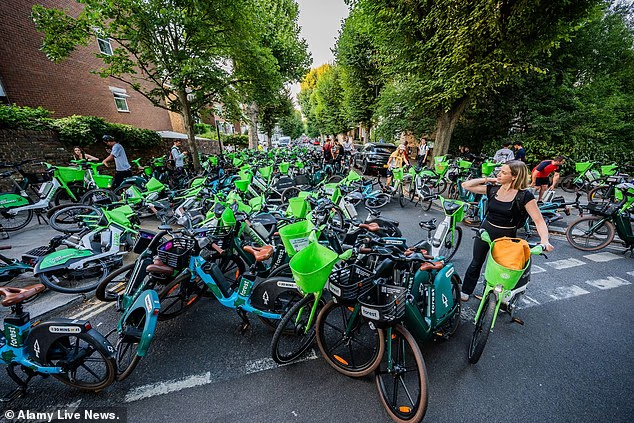
Lime’s parking enforcement system allowed rented e-bikes to be left blocking pavements, entrances and protected areas across south London, with no warning or fine issued after 26 separate parking contraventions.
An investigation found that riders could ignore warnings generated by the Lime app and complete journeys despite leaving bikes in locations that obstructed pedestrians, including outside theatres, a cathedral and homes.
The company’s dockless scheme operates in boroughs including Wandsworth, Southwark and Greenwich, where users are not always required to leave bikes in designated bays. Lime’s guidance says they should be parked neatly at the side of the pavement and away from entrances, ramps and footpaths.
During the investigation, the app displayed a message telling the user to move a bike away from pedestrian routes when it detected an obstruction. However, the warning could simply be dismissed, allowing the rental to end.
Bikes were left blocking entrances to Greenwich Theatre and the Globe Theatre, while another was placed on the steps of Southwark Cathedral. The app also allowed bikes to be left in the porches of multi-million-pound homes.
Investigators were able to leave bikes in the middle of Borough Market and Greenwich Market, despite both areas being intended to have exclusion zones. A bike was also parked outside the Cutty Sark and Old Royal Naval College areas, where the app was generally more effective at preventing parking but did not always stop it.
The 80lb electric bikes have become a particular problem in London, where badly parked vehicles have been found blocking station and business entrances. Lime also operates in Salford, Nottingham, Oxford and Milton Keynes.
Lime says riders who break its parking rules should receive a warning, followed by fines of up to £20 for further offences, with repeat offenders facing a ban from the service. Yet no warning was issued during the 26 test violations.
Lime says improved GPS will strengthen parking enforcement
The weakness appears to be linked in part to the accuracy of the bikes’ GPS technology, which can make it difficult to establish precisely where a vehicle has been left.
Lime announced earlier this year that it was introducing bikes with improved GPS, saying the technology would make “a huge difference” to parking enforcement.
The issue has also raised concerns over accessibility. Lime recently apologised to a blind couple after an app glitch led to bikes blocking pavements in Bromley, south-east London, where the company’s bikes are not permitted. The couple were forced to walk across a busy main road with their guide dog.
Erik Matthies, policy lead at the Royal National Institute of Blind People, said the company’s efforts “clearly still fall short of what is needed”. He said badly parked e-bikes “present a danger” to blind and partially sighted people.
A Lime spokesman said: “Proper parking is important to Lime and we take instances of misparked vehicles seriously.”
He added: “This year alone we’ve issued hundreds of thousands of warnings and tens of thousands of fines to riders who parked incorrectly in London.”
