


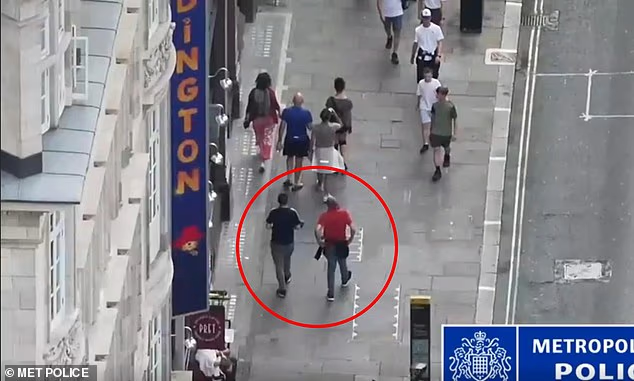
Police drones helped track down two shoplifters across central London after officers watched their movements from five miles away and directed patrol cars to their location.
David Browning and Daniel Marshall, both 40 and from Westminster, had taken several bottles of wine from a convenience store before walking along The Strand. Staff called 999, and a remotely operated drone was sent to follow them.
When two patrol cars arrived, the men split up. One was arrested quickly, while the drone continued tracking the other and relayed his movements to officers on the ground.
Both men later pleaded guilty to handling stolen goods. Browning was returned to prison after being found to have been out on licence for a previous offence, while Marshall is awaiting sentence for other shoplifting offences.
The incident illustrates the Metropolitan Police’s expanding use of drones as first responders to 999 calls, a development officers say can bring them to a scene far faster than patrol cars.
Police drones reaching incidents in less than two minutes
Police forces carried out 86,000 drone flights across the country last year, according to the National Police Chiefs’ Council. Since 2023, the organisation has promoted beyond-visual-line-of-sight operations so drones can reach incidents before officers travelling by road.
Flying at just under 50mph in a straight line, the aircraft arrive in less than two minutes on average. That compares with a ten-minute target for patrol cars responding under blue lights.
Superintendent Taryn Evans, the NPCC’s lead for drones, said the arrest rate had doubled when the technology was used because suspects were less likely to disappear before officers arrived.
She described a scenario in which men wearing balaclavas were reported stealing mobile phones on Oxford Street. By the time a police car reached the area, she said, the suspects might have heard the sirens and escaped.
With a drone overhead, pilots can identify where they have gone and guide officers to intervene at a time and place of their choosing, she said.
The Metropolitan Police says drones have contributed to a 21 per cent reduction in mobile phone thefts in the capital in a single year.
Its central drone hub is based at Hammersmith police station in west London, where teams of two pilots monitor screens showing details of 999 calls. The force currently has seven drones operating from docking stations on police rooftops in Islington, at Charing Cross and in Kennington.
The system, including the aircraft, docking stations, screens, software and other equipment, has cost £400,000 this year and has been used at more than 4,000 incidents, according to the Met.
Police air support across the country has increasingly shifted from helicopters to drones, with 80 per cent of operations transferred over the past five years. A National Police Air Service helicopter costs £5,700 per flying hour, while 48 per cent of that time is spent travelling to or from an incident.
In one example, pilots were sent to a report of a woman threatened inside her home by her brother, who was carrying a steel pole. After checking the drone’s charge, parachute system, weather conditions and surrounding airspace, they launched it using GPS route mapping.
The aircraft located the woman and followed the man as he left the property. He hid behind a bus stop before patrol officers arrived, but the pilots directed them to his hiding place and he was arrested.
Special Constable Radwane Gasmi, one of the pilots involved, said the suspect might otherwise have escaped, leaving officers to identify and locate him through a later investigation.
Concerns over privacy and facial recognition
The rapid expansion of police drone use has prompted concerns from civil liberties campaigners, who warn that the technology could eventually become a form of constant airborne surveillance.
Jake Hurfurt, head of research and investigations at Big Brother Watch, said drones could provide quicker updates during emergencies but should not be used as “constant flying surveillance cameras”.
Campaigners are particularly concerned that the Met has not ruled out fitting drones with live facial recognition technology. Such systems can zoom in on faces and compare them with watchlists of wanted people, known criminals and sex offenders.
Big Brother Watch has also raised questions about possible use of International Mobile Subscriber Identity technology, which can scan the unique signatures of mobile phones and track individuals. Hurfurt said mass use of the technology could identify people attending large gatherings such as demonstrations.
“It’s alarming that the Met has refused to rule out using facial recognition technology on drones, which could turn them into quasi-covert face scanning devices, and it has dodged questions about other intrusive surveillance capabilities,” he said.
Hurfurt said the public should be told how, when and why drones were being used, arguing that the Met had not published a policy covering them.
Supt Evans declined to comment on whether there were plans to introduce the phone-scanning technology. She said, however, that drones recorded no more than helicopter crews had been able to see for decades, and that all filming was logged.
She added that officers who used the equipment inappropriately would be identified and disciplined.
Professor William Webster, the UK’s independent biometrics and surveillance camera commissioner, said independent checks were needed to ensure police forces were not effectively marking their own homework.
He called for independent auditing, including safeguards to ensure that footage of innocent people was deleted within a specified period. He also questioned how members of the public could be alerted to drone surveillance when the aircraft might not be visible and there were no warning signs.
Specific legal boundaries for police drone use have yet to be established by the Government, although data protection laws and police and Civil Aviation Authority protocols govern what can be filmed, how footage is stored and where aircraft may fly.
Metropolitan Police Commissioner Sir Mark Rowley has argued that officers cannot afford to fall behind criminals who are increasingly using technology.
“Policing today will fail if it is not allowed to keep pace with criminals through technology. That is not a prediction for the distant future. It is a present reality,” he said.
Parliament is expected to consider a policing reform Bill in the New Year. Prof Webster hopes it will strengthen independent oversight while allowing forces to use drones where they improve public safety.
