


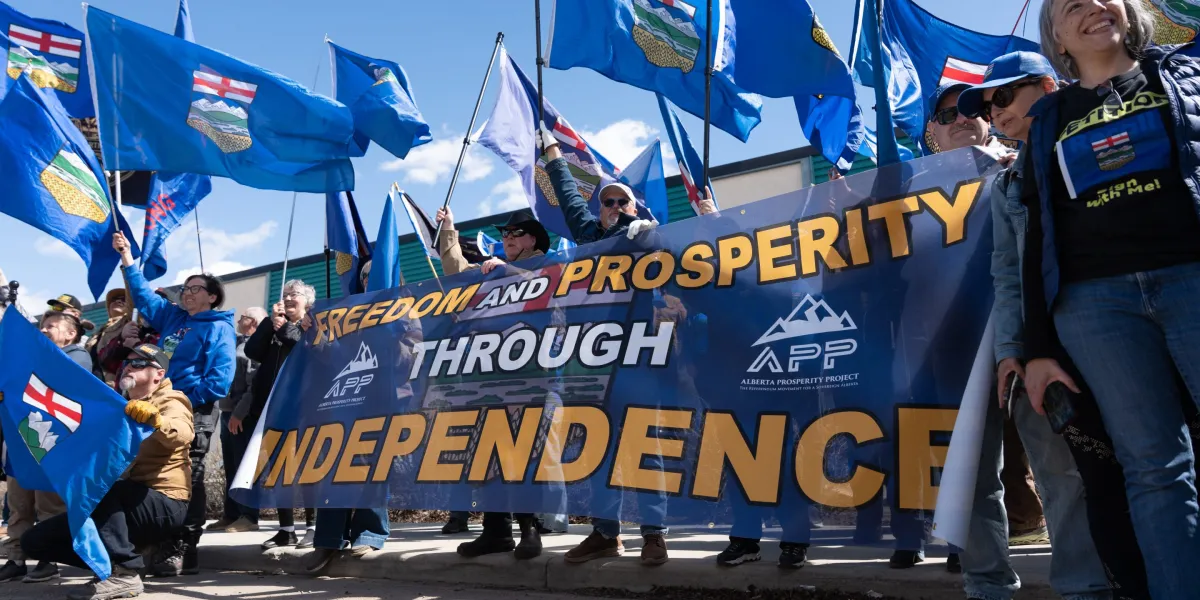
Alberta voters will decide on Monday whether to begin the legal process that could lead to a referendum on separating from Canada, placing the country’s oil-rich province at the centre of a renewed national-unity debate.
The vote on October 19 will not determine independence itself. Instead, residents will choose between remaining in Canada and taking the first step towards a future separation referendum.
Premier Danielle Smith, who called the vote but supports Alberta remaining part of Canada, has said that backing for starting the process is “still too high for my liking”. A recent poll put support at about 23 per cent.
Alberta has the world’s fourth-largest proven oil reserves and sends about 90 per cent of its crude oil exports to the United States. Its relationship with Ottawa has long been strained by disputes over energy policy and federal authority.
The province became particularly hostile to the federal Liberals under Pierre Trudeau and, decades later, his son Justin. Alberta leaders argued that Justin Trudeau’s national carbon tax and other climate measures damaged the oil industry.
Separatist parties had traditionally attracted only 1 or 2 per cent of the vote, according to former Alberta premier Jason Kenney. But the movement gained momentum during the pandemic and after the 2022 Freedom Convoy protests, which disrupted parts of Ottawa and blocked major Canada-US border crossings.
“They needed a new cause,” Mr Kenney said. “And it naturally morphed into separatism.”
How Alberta separatism gained momentum
Jeff Rath, one of the independence movement’s leaders, said federal rules preventing unvaccinated Canadians from flying had been his breaking point.
“If Trudeau won’t let me leave Alberta, I’m just going to pick up my whole province and go,” he recalled telling a friend. “COVID was really the straw that broke the camel’s back.”
Mr Rath said many people had been radicalised by the convoy, which began as a protest against vaccine requirements for cross-border lorry drivers before expanding into a broader revolt against pandemic restrictions.
Mr Kenney said anger over globalisation, vaccines and Covid restrictions had brought previously isolated activists together through social media. He said the movement had since developed organisations, fundraising networks and links to political campaigners.
He also claimed there was significant overlap between separatist activists and people who support Russian president Vladimir Putin or promote conspiracy theories about Ukrainian president Volodymyr Zelenskyy. Mr Kenney stressed that he was referring to activists rather than typical voters who might support separation as a means of sending a message to Ottawa.
He said the Make America Great Again movement had been “inspirational” for some separatists, and alleged that activists had tried to infiltrate the United Conservative Party, which he founded. Ms Smith replaced him as leader in 2022 after appealing to party members angered by Covid restrictions.
“Literally, you can look at the players,” Mr Kenney said of the convoy and separatist movements. “It’s the same people.”
Carney offers Alberta a different relationship with Ottawa
Prime Minister Mark Carney has made expanding the markets available to Alberta’s oil a national priority and supports a proposed pipeline to Canada’s west coast. His more business- and energy-friendly approach, combined with opposition to Donald Trump’s trade war and rhetoric about making Canada the 51st US state, has made him unusually popular in conservative Alberta.
Mr Kenney, previously one of the most prominent conservative critics of Ottawa’s approach to the province, said Mr Carney “speaks as an Albertan”, understands its grievances and ambitions, and is moving in the right direction on energy.
Mr Rath described the prime minister as a “formidable opponent”, acknowledging that every major politician in Alberta and Canada opposes the separatist campaign. He said he would be “thrilled” if more than 30 per cent supported the initiative, despite that falling well short of a majority.
“Canada is facing real threats to our economy, to our security, to our way of life,” Mr Carney said. “We have to be strong and we are stronger together.”
Separatist leaders have also taken their campaign to Washington. Mr Rath said he and other advocates had met US State Department officials three times and presented a document setting out what an independent Alberta could offer the United States.
He claimed that those involved had direct access to the White House and said a possible oil pipeline through the US to the Pacific had been discussed at their most recent meeting with the State Department.
The State Department said it “regularly meets with a wide range of representatives” and that the vote was a decision for the people of Alberta. Mr Kenney called the outreach “bonkers”, arguing that people with “zero democratic mandate” were discussing the status of a state that did not exist.
US Treasury Secretary Scott Bessent has described Alberta as “a natural partner”.
Keith Wilson, another independence leader and former lead counsel for the 2022 convoy organisers, said the campaign was intended to give Alberta greater leverage in negotiations with Ottawa, even if it did not result in independence.
“That’s right, because it’s called leverage. It’s called negotiation,” Mr Wilson said, adding that he would accept major structural changes to Alberta’s relationship with the federal government short of separation.
Mr Kenney said the separatist movement was unlikely to disappear. Even support of 10 to 20 per cent, he said, would be far above its historic vote share, while a result approaching 30 per cent on low turnout would embolden activists.
“That’s not a threat to Canada,” he said. “But it is a threat to the conservative movement.”
Alberta is not the only Canadian province facing a national-unity challenge. Quebec voters returned the separatist Parti Quebecois to power on October 5, although support for independence remains about 30 per cent and its leader has said he will not hold a referendum while Mr Trump is US president.
Quebec voters have rejected independence twice, most recently by a narrow margin in the 1995 referendum.
