


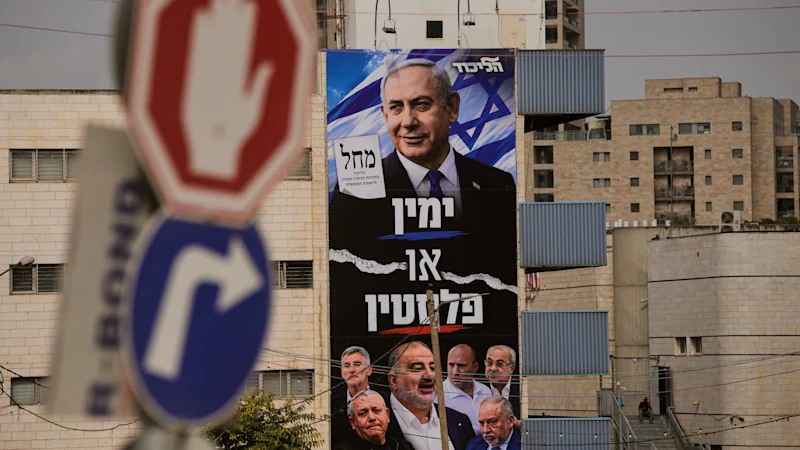
Israel’s general election on October 27 is being presented by senior former politicians as a decisive test of the country’s identity, with Prime Minister Benjamin Netanyahu fighting to remain in power after years of political upheaval, war and deepening polarisation.
Former prime minister Ehud Olmert said he had often heard Israeli elections described as the most important in the nation’s history, but believed the claim was justified this time.
“The crisis we are in today is the most threatening to the nature of what Israel was and what Israel is supposed to be that we have seen,” he said.
Mark Sofer, a former Israeli ambassador to Australia, said the vote was “almost existential” from an Israeli perspective.
Since the previous election in 2022, Netanyahu has pursued a plan to weaken the Supreme Court, prompting mass protests. The Hamas attack of October 7 2023 then killed more than 1,200 people in Israel and was described as the country’s worst security failure.
Israel has since fought Hamas in Gaza, Hezbollah in Lebanon and Iran’s theocratic regime. The conflict in Gaza has killed an estimated 75,000 people, while Israel’s international standing has fallen sharply, including in Australia and the United States.
Netanyahu, who has led Israel for much of the past two decades and has been indicted on corruption charges, is seeking another term. His opponents want to remove him from office and begin what they describe as a new period in Israeli politics.
How Israel’s general election works
Voting is voluntary, although turnout is usually high. At the last election, 4.8 million of the country’s 6.8 million eligible voters took part, representing 71 per cent turnout.
Israeli voters must generally cast their ballots in person on election day. Exceptions apply to people serving the country overseas, including diplomats and defence personnel, who can vote in advance by post.
Residents of Israeli settlements in the West Bank can vote, while Palestinians living in the West Bank cannot. Ballots are made of paper and electronic voting is not permitted.
Voters elect members of the Knesset, Israel’s 120-seat parliament. It has a single chamber, and the electoral system is based on nationwide proportional representation rather than local constituencies.
That means Israelis vote for party lists, not individual candidates. The number of Knesset seats awarded to each party reflects its share of the national vote, with successful candidates taken from lists arranged before election day.
Likud, Netanyahu’s conservative party, won 23 per cent of the vote in 2022 and secured 32 seats. The centrist Yesh Atid party won 18 per cent and received 24 seats.
A party must win at least 3.25 per cent of the vote to enter the Knesset. Votes cast for parties that fall below that threshold do not contribute to the allocation of seats, making alliances between smaller parties strategically important.
At the 2022 election, two left-wing parties narrowly missed the threshold, leaving nearly 290,000 votes without representation and assisting Netanyahu’s return to power.
The main political blocs
No single party is expected to govern alone. Israeli governments are formed through coalitions, often bringing together parties with significant ideological differences.
Netanyahu’s pro-government bloc includes Likud, the ultra-Orthodox United Torah Judaism and Shas parties, and two ultra-nationalist parties led by Itamar Ben-Gvir and Bezalel Smotrich.
Both Ben-Gvir and Smotrich have been sanctioned by Australia for inciting violence against Palestinians.
The opposing grouping, often described as the anti-Netanyahu or change bloc, is led in the polls by Yashar, a centrist party founded last year by former military chief Gadi Eisenkot.
It also includes Together, a new party led by former prime ministers Naftali Bennett and Yair Lapid; the left-wing Democrats; and Yisrael Beiteinu, a secular right-wing nationalist party.
The parties share a determination to remove Netanyahu, although that common aim is more significant than any single policy platform.
“Israeli politics tends to be very polarised, like American politics,” said Mark Regev, Israel’s Australian-born former ambassador to the United Kingdom. “Americans either loathe Trump or they think he’s the best thing since sliced bread. It’s the same in Israel. People either love Netanyahu or they detest him, and only a very small proportion of the public can go either way.”
A third group consists of parties that are not formally aligned with either main bloc. It includes parties supported largely by Arab-Israeli voters, many of whom prefer the description Palestinian citizens of Israel. They represent about 20 per cent of Israel’s population and could prove influential if the result is close.
Other smaller parties are also competing near the electoral threshold, leaving the final balance dependent not only on which bloc wins the most votes but on which parties secure enough support to enter parliament.
What role does the president play?
Israel’s president is the head of state, while executive power rests with the cabinet led by the prime minister. The largely ceremonial presidency is comparable to Australia’s governor-general, although it has an important role after elections.
President Isaac Herzog, who has held office since 2021 and previously led the left-wing Labor Party, will consult the leaders of every party elected to the Knesset.
He will then ask the politician he considers most likely to build a viable coalition to try to form a government. That person is usually the leader of the largest party, but the president is not required to follow that practice.
In 2009, Tzipi Livni’s centrist Kadima won 28 seats, one more than Netanyahu’s Likud. Nevertheless, then-president Shimon Peres gave Netanyahu the first opportunity to form a government because he believed a centre-right coalition was more likely to succeed.
Netanyahu assembled a coalition and subsequently led Israel in a more firmly conservative direction.
Could Israel face another election?
If no politician can secure the 61 Knesset seats needed for a governing majority, another election is possible. A minority administration could govern, but it would be particularly vulnerable.
Israel held elections twice in 2019 after Netanyahu failed to form a coalition following the April vote. When the second election also produced no workable government, voters returned to the polls again in March 2020.
Herzog has said he wants to prevent a repeat of that cycle and is believed to favour a broad national unity government if the result is inconclusive, potentially bringing together Netanyahu and Eisenkot despite their political rivalry.
“I really, truly will do all I can so there won’t be repeat elections,” Herzog said. “We need to wait for the results, rather than pass judgment, but we must do everything possible to avoid going back to this again and again and again.”
