


The rapid AI buildout could ultimately destroy vast amounts of capital in the United States, according to Jefferies strategist Chris Wood, as cheaper Chinese open-weight models threaten to undermine the economics of the industry.
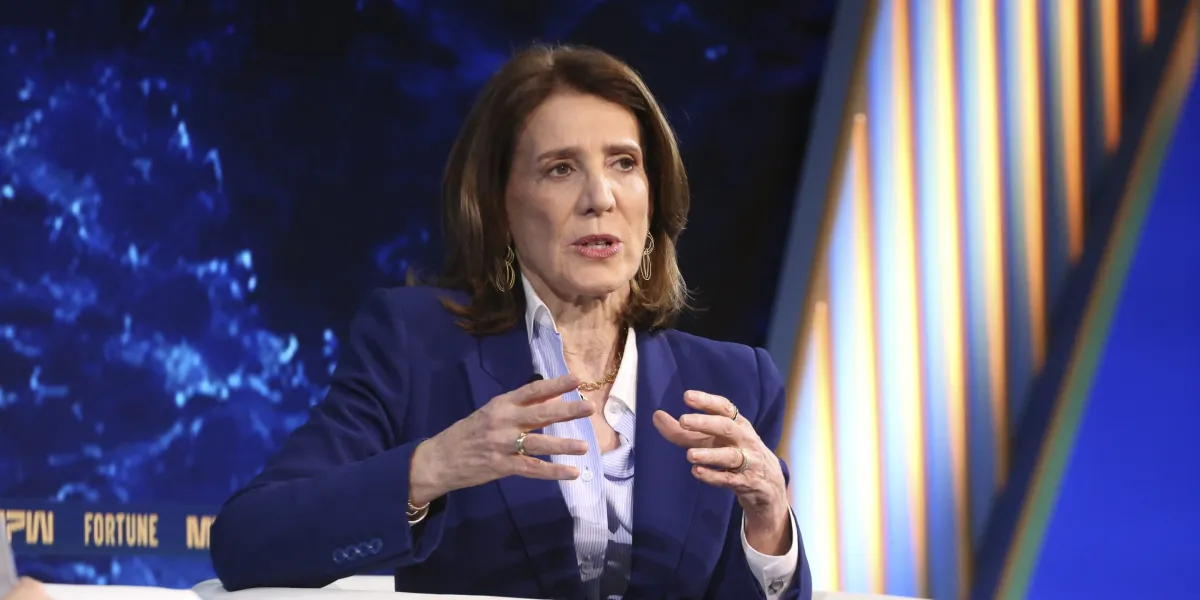
Ruth Porat, Alphabet’s president and chief investment officer, rejected the argument that heavy spending on AI infrastructure is necessarily headed for failure, saying companies that deliver distinctive value will continue to attract paying customers.
Amazon, Alphabet, Microsoft and Meta are expected to spend more than $720 billion on capital expenditure this year, much of it on AI infrastructure, based on analyst estimates. Alphabet alone has forecast spending of between $195 billion and $205 billion, more than twice the $91.4 billion it spent in 2025.
Porat said at the Fortune Most Powerful Women Summit that Alphabet intends to spend “significantly more” in 2027. She also said the company viewed the current investment cycle as being at an early stage compared with the economic value AI could eventually generate.
“We do see this as an opportunity that extends for quite some time,” Porat said.
Chinese open-weight models challenge AI spending
The expansion is increasingly being financed with debt. Private credit funds including Blue Owl, Apollo and KKR are lending to AI-related businesses, with outstanding private loans to such companies estimated at more than $200 billion.
Much of that lending is directed towards special-purpose vehicles and smaller “neocloud” operators rather than the largest technology companies. Alphabet recorded negative free cash flow in the second quarter for the first time since its 2004 initial public offering, while its long-term debt reached about $98 billion at the end of June, more than four times the level a year earlier.
Wood’s warning centres on the growing use of open-weight models, particularly those developed in China. He argued that cheaper alternatives could commoditise large language models, weakening the returns expected from America’s AI investment and leaving many less well-capitalised companies exposed.
The shift is already taking business and usage from closed-model providers such as Anthropic, OpenAI and Google’s Gemini, while new financial figures from Anthropic appeared to suggest its growth had flattened. Moonshot AI, one of China’s leading open-weight model developers, has said that 70% of its usage comes from outside China.
Wood has described China as having become a technological peer to the US in AI and said the most likely long-term outcome of the boom was “massive capital destruction” in America.
Porat said that conclusion did not fit with the strength of demand for AI’s potential to improve businesses and governments.
“It’s illogical to say we’re in a capacity-constrained position because there’s such strong demand for the insight in the ability to improve business and government, and yet you can’t drive a return on it,” she said.
She added that the distinction between open-weight and closed models did not remove the opportunity for companies to charge for services that offered meaningful differentiation.
Porat, who previously led Morgan Stanley’s technology banking team during the dotcom era and later advised then US Treasury secretary Hank Paulson during the 2008 financial crisis, said businesses needed to identify vulnerabilities early while continuing to innovate.
“If anyone is connecting with your customers in ways you are not, because they are using AI and you are not, you’re at a competitive disadvantage,” she said.
Alphabet’s continued investment reflects Porat’s belief that the long-term risks of under-investing could be greater than the costs of the current buildout.
“You must invest for long term growth,” she said. “By the time you need it, it’s too late to say, OK, now we’re going to start.”
