


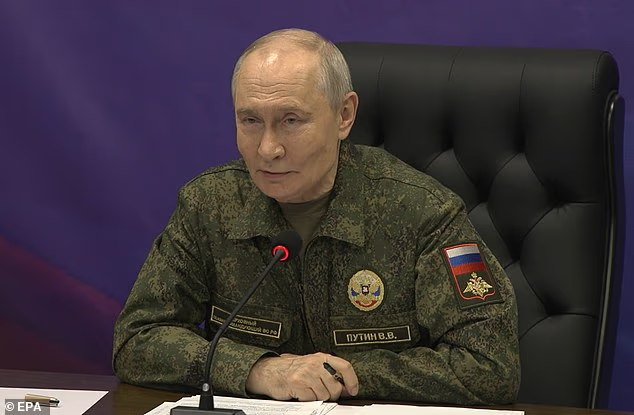
Donald Trump’s suspension of sanctions on Russia will only help Vladimir Putin and give him “every reason” to continue the war indefinitely, Ukraine’s president Volodymyr Zelensky has warned.
The US president signed an executive order blocking sanctions on Russian oil and gas exports that were due to take effect the following day. The Kremlin described the decision as a “historic moment”.
The measures, passed into law last month under legislation championed by the late senator Lindsey Graham, were intended to target Russia’s war finances and penalise countries helping to facilitate Moscow’s energy trade.
Mr Trump said he had waived the sanctions in the “national interest” of the United States. A report explaining the decision was submitted to Congress.
Ukraine attacks intensify as sanctions are suspended
Mr Zelensky’s criticism came after one of Russia’s largest overnight attacks on Ukraine and its energy infrastructure. He said more than 15 critical power generation and transmission facilities had been hit.
More than 320 Shahed drones, alongside cruise missiles, ballistic missiles and other munitions, were fired at Ukraine, according to the Ukrainian president.
“Russia is trying to cause a blackout in Ukraine – right before winter,” Mr Zelensky said. He accused Moscow of trying to leave millions of Ukrainians without electricity and heating.
“A U.S. sanctions blackout, easing pressure on the aggressor, financial rewards for Putin – all of this only encourages him to keep attacking,” he added.
Mr Zelensky said pressure was needed to stop the attacks and urged supporters of Ukraine not to give up ground or abandon efforts to end the conflict.
“To end it, not give Putin every reason to continue it indefinitely,” he said.
Kremlin welcomes Trump decision
Kirill Dmitriev, a Russian presidential envoy, said the Trump administration’s suspension of the legislation was “important and truly historic”.
He said economic dialogue between the United States and Russia would continue, arguing that the sanctions could have halted economic co-operation between the two countries and damaged the US economy and global markets.
The proposed legislation would have imposed tariffs of up to 100 per cent within 30 days on goods entering the US from the five largest importers of Russian crude oil or gas. It would also have targeted Russian officials, banks and a shadow fleet of tankers.
Countries knowingly buying Russian oil or gas, as well as those among the five largest countries helping Moscow evade sanctions, would also have faced penalties. China and India were among the countries that could have been affected.
Senator Richard Blumenthal, a Democrat involved in drafting the legislation, accused Mr Trump of turning his back on most Americans, Congress and European allies.
“These waivers have nothing to do with our national security, and everything to do with sucking up to Vladimir Putin,” he said.
Britain prepares further military support for Ukraine
The US decision came as Britain announced plans to join Germany and France in a major military exercise in Poland next month.
The Royal Navy also said HMS Prince of Wales would return to the North Atlantic, with stealth fighter jets deploying to the High North alongside Nato allies.
The navy described the carrier deployment as a “powerful shield” intended to help protect energy, trade and communications links in the region.
Lord Peter Ricketts, the former national security adviser and Foreign Office chief, accused Mr Trump of “going all out to woo Putin” in pursuit of cheaper diesel, while using Mr Zelensky as a scapegoat.
Speaking about the US president’s approach, Lord Ricketts said: “He has identified Putin as someone who can help with that. He has diesel. He has oil and gas and Zelensky is an obstacle to that.”
He said the situation was a serious problem for Ukraine and urged the British Government to provide more material support, as well as strengthening protection for infrastructure in Britain and across Europe against hybrid attacks.
