


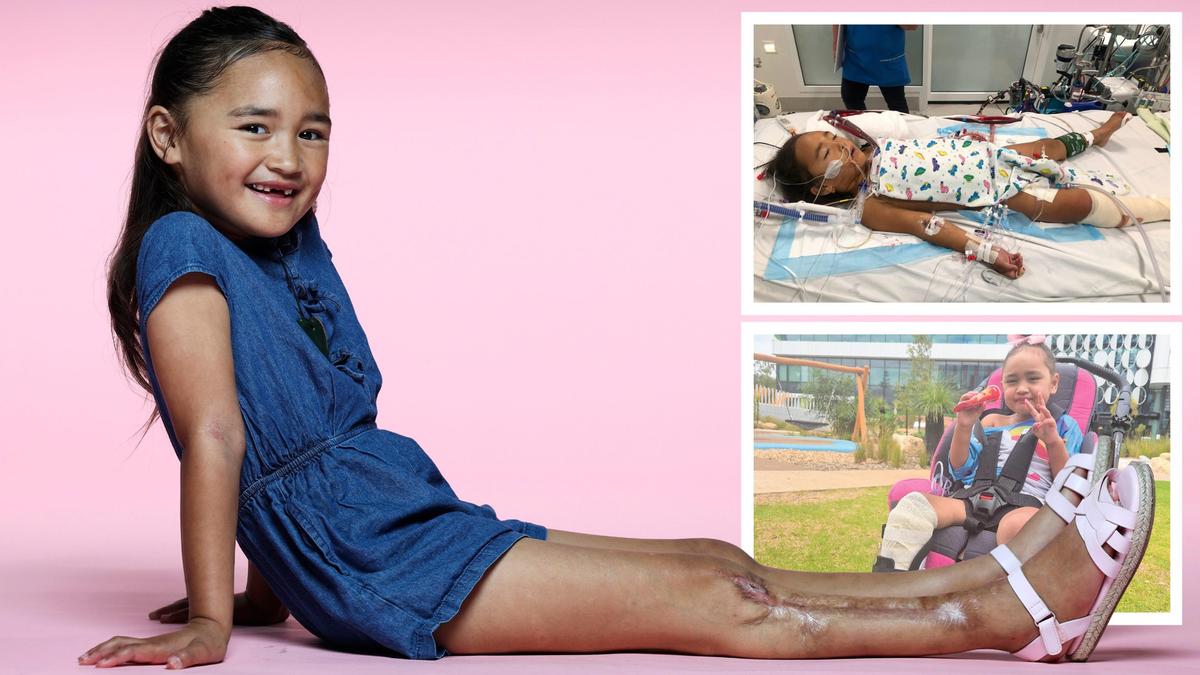
A five-year-old girl who survived catastrophic sepsis after receiving pioneering phage therapy and life support funded by Telethon is being used to highlight the urgent need for wider access to the treatment in Western Australia.
Bubba Kaio Rerekura was just three when an infected cut on her hand developed into severe sepsis. Her condition deteriorated rapidly after she was taken to hospital with a fever and intense pain in her leg.
She underwent surgery to investigate the swelling, but soon suffered septic shock and multiple organ failure. Doctors warned her parents, Charky and Thornton Rerekura, that she needed to be placed on life support immediately.
“We were told that Bubba’s body wanted to die. I can’t even explain the pain after hearing those words. It was a real-life nightmare,” Charky said.
Bubba was placed on an extracorporeal membrane oxygenation unit, known as ECMO, which temporarily took over the work of her heart and lungs. The system is among the advanced medical equipment funded by Telethon.
Her infection was resistant to antimicrobials, leaving doctors with fewer antibiotic options. As the infection damaged her body, surgeons removed tissue from her leg and considered whether amputation would be necessary.
Dr Anita Campbell, an infectious diseases specialist at The Kids Research Institute Australia, said Bubba was one of the sickest children with Staphylococcus aureus sepsis she had treated.
When standard options were proving insufficient, Dr Campbell initiated the process of obtaining phage therapy. The treatment uses naturally occurring viruses, known as bacteriophages, to seek out and destroy specific bacteria.
However, the therapy was not available in Western Australia and had never previously been administered in the State. It had to be requested under compassionate-use protocols, with approvals required from the Therapeutic Goods Administration and hospital ethics and governance committees.
A phage cocktail being used in a clinical trial at Sydney’s Westmead Institute for Medical Research was secured for Bubba. It was flown to Perth after approval was granted, 13 days after her admission to Perth Children’s Hospital.
She received the treatment intravenously and through a nebuliser while suffering from pneumonia and an acute bleed that led to the removal of her right lung.
Family backs wider access to phage therapy
Bubba remained on ECMO to support her remaining lung and underwent 12 major operations. She spent three months in intensive care and was in hospital for 112 days in total.
Two days before Christmas, her family were told to spend as much time with her as they could because her condition was worsening. On Christmas Eve, her vital signs began to improve.
“The doctors, the nurses, the surgeons, they said ‘she is going to be OK,’” Charky said.
“From that day forward, she just started recovering, like miracle after miracle after miracle. Her leg started healing on its own, her vitals were coming right.”
After 65 days, Bubba’s parents were able to hold her. She was eventually taken off sedation and the ventilator, began physiotherapy and was discharged on February 18.
She is now attending school, taking part in martial arts and preparing to play netball. Her family say she can swim with one lung and uses the leg that doctors feared might need to be amputated to deliver a powerful kick in mixed martial arts.
Charky shared the family’s story at the Telethon Ball on Saturday night, telling philanthropists, politicians and business leaders that Bubba’s survival should help other children receive potentially life-saving treatment.
“Bubba was so lucky to have access to the ECMO machine, which was funded by Telethon, and the phage therapy, it saved her life,” she said.
Dr Campbell said Bubba’s recovery showed the importance of continued laboratory and clinical research into phage therapy and its use in children with serious bacterial infections.
Associate Professor Anthony Kicic, the phage lead at The Kids Research Institute Australia, said a dedicated manufacturing facility being developed by Royal Perth Hospital and the institute could help provide doctors with more options when infections were difficult to treat with antibiotics.
He cautioned that phage therapy was not a guaranteed cure, but said it could become an important part of the treatment available to children if research and support continued.
“Our wish is for Bubba’s story to reach far and wide, inspiring awareness and support for phage therapy research,” Charky said. “If sharing Bubba’s story raises awareness about sepsis and saves even one child, then every conversation is worth it.”
