


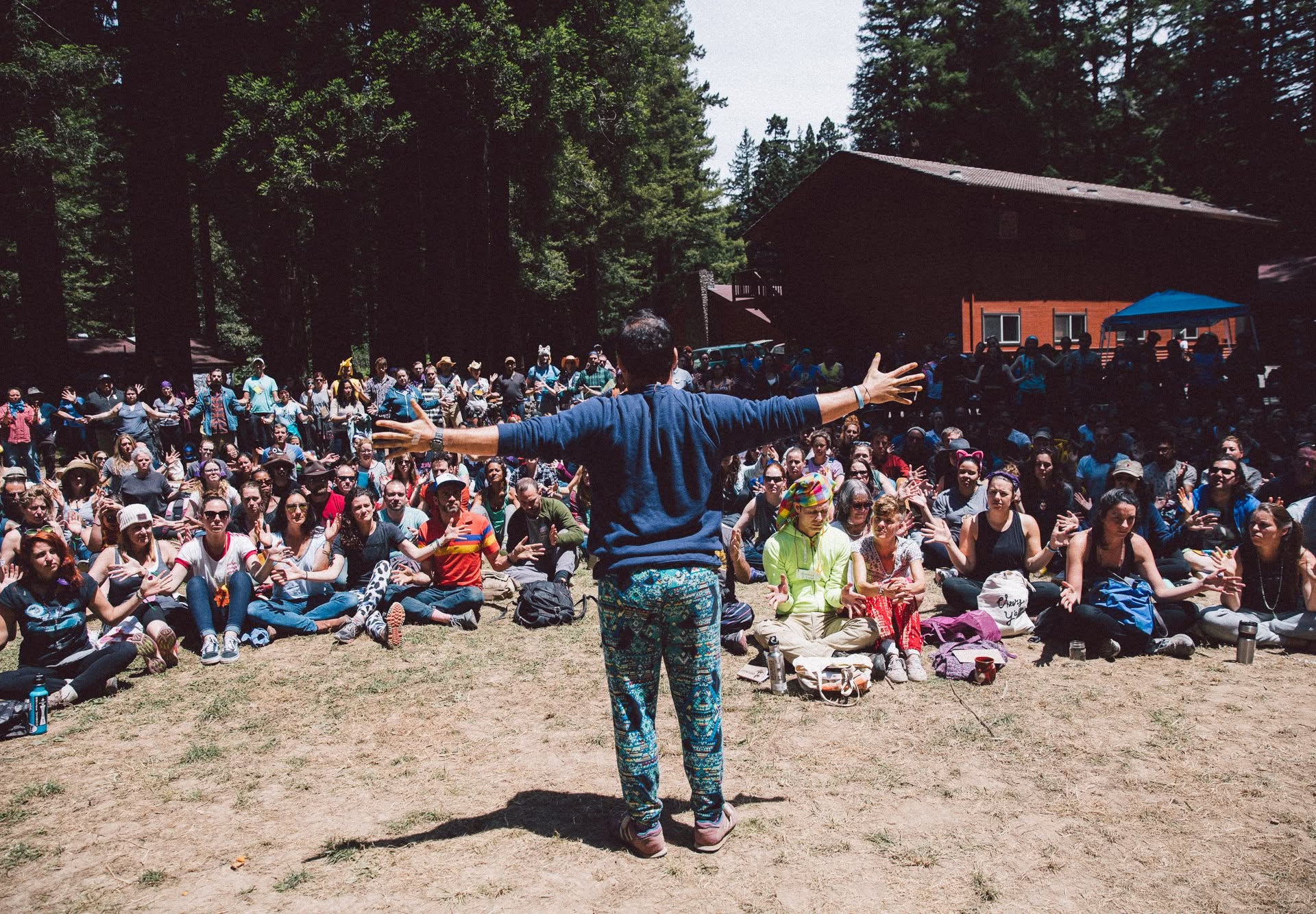
Adult camps are drawing people from Gen Z to Gen X who are seeking relief from loneliness, burnout and the blurred boundaries between work, home and leisure. From art workshops in Colorado to outdoor adventure retreats in the UAE, organisers say the appeal lies in providing structured opportunities to play, meet strangers and spend time away from screens.
Adam “Smiley” Poswolsky, a speaker and author specialising in human connection and workplace culture, said hundreds of millions of people feel a gap between the social contact they have and the connection they want.
He linked the problem to factors including social media, artificial intelligence, remote working, distance from family and the decline of close-knit neighbourhoods. Poswolsky’s own career developed after he worked as an adult camp counsellor at Camp Grounded between 2013 and 2017, where he met his wife, Ali.
“I think the idea of adult camp might initially produce an eyeroll. ‘Why would an adult need camp? It’s childlike; we’re too old.’ But it’s the exact opposite,” he said.
“It’s the very thing many adults are missing the most — this chance to play and opportunity to connect with people that’s not related to networking, your career, your title.”
Adult camps offer a break from productivity
Melanie Kelly, 44, turned to an art camp in Colorado after becoming exhausted by her work in marketing and communications for a solar company. In 2023, the former painting student enrolled for a week at Anderson Ranch Arts Center in Snowmass Village, hoping to rediscover the absorbed, creative state she had rarely experienced in her job.
Her routine changed from emails and computer screens to making physical artwork alongside other campers. The programme also arranged shared meals and activities, making it easier for people to socialise, including those attending alone.
“I was always trying to be more productive in a work sense or seeking professional development aligned with my work,” Kelly said. “It feels like there’s a bit of release in these types of moments or activities because you’re allowing yourself to rest. Rest isn’t sleep. The opposite of work isn’t sleep; it’s play.”
Other camps are deliberately designed to help adults make friends. At Camp Forever Fun in Michigan, founder Joel Reisig encourages people to attend without partners or established groups, promising a setting where introductions are expected and rejection is less of a concern.
Reisig, a film producer, developed the idea about a decade ago after working on a film about girls attending a horse camp. Once filming ended each day, the cast and crew spent time stargazing, petting horses and dancing.
“I thought to myself, adults need a summer camp break every bit as much as kids do,” Reisig said.
He said making friends became more difficult after college, when people often see only a small number of neighbours and colleagues. A weekend at the camp gives adults the chance to climb, kayak, ride horses and have conversations away from their usual routines.
Alyx van der Vorm, 25, who studied neuroscience and founded the social connection platform Clyx, said modern convenience could also be contributing to the problem. Tasks such as laundry and ordering food can now be completed with little effort, while arranging face-to-face meetings may feel increasingly difficult.
“Add the fact that not everyone wants to be reaching out and initiating, and you suddenly have people spending a lot less time in person,” she said.
Camp life expands beyond the US
The retreat from everyday demands has become more significant as work has followed people into their homes. In March 2026, 22.6 per cent of American workers teleworked, compared with 17.9 per cent in 2022, according to the US Bureau of Labor Statistics.
Matthew Leahy, a clinical psychologist who has designed and run camp programmes, said many adults were operating in environments that constantly required them to produce, multitask and remain connected.
“Even our downtime often becomes another form of consumption through our devices,” he said. Camps and time spent outdoors, he added, could interrupt that pattern by encouraging people to be present, try unfamiliar activities and socialise for enjoyment rather than professional gain.
Sarah Boss, a psychiatrist and clinical director at The Balance clinic in Mallorca, described adult camps as a temporary setting where normal expectations were suspended.
“Permission is given to be silly, to be bad at things and to talk to strangers. And that permission does a lot of the therapeutic work,” she said.
Leahy said campers were not necessarily trying to recreate childhood. Instead, they were seeking experiences associated with it, including wonder, playfulness and uncomplicated connection.
The trend is also growing in the United Arab Emirates. The Bear Grylls Explorers Camp in Jebel Jais, Ras Al Khaimah, opened in 2021 with nine cabins made from recycled shipping containers and has since expanded to 16.
Hatta Resorts and Wadi Hub, an outdoor adventure and glamping destination in Dubai’s Hajar Mountains, recorded more than 351,000 visitors between September 2023 and April 2024 — a 40.4 per cent increase on the previous season, according to Dubai Holding.
Sarah El Nabulsi, a clinical psychologist in Dubai, said her patients were often exhausted not only by work but by the lack of informal social contact in their lives.
“Adult life strips out almost every context where people used to make friends without trying: no assigned seating, no shared schedule, no built-in repetition of seeing the same faces,” she said.
Camp, she added, restored that arrangement in a setting that was physical, screen-free, low-pressure and limited in time.
