


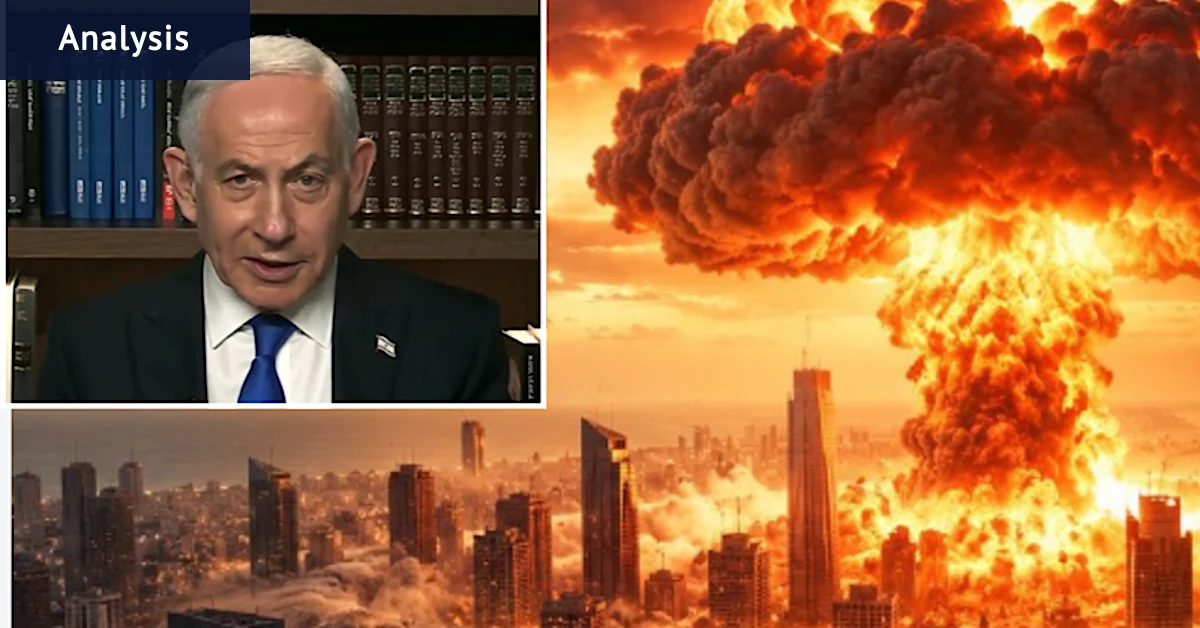
Benjamin Netanyahu has posted an image depicting a nuclear bomb falling on Tel Aviv on the eve of Israel’s first election in four years, intensifying fears that the prime minister is using the threat of war with Iran to preserve his grip on power.
The post was accompanied by a warning from conservative commentator Yuval Blumberg that Israel faced “real and tangible existential danger” and that future generations would not forgive the country if it failed to act against Tehran’s nuclear ambitions.
Netanyahu’s intervention has prompted criticism across Israel, where politicians are engaged in a closely fought campaign before voting on October 27. Tal Schneider, a political commentator for The Times of Israel, said the campaign’s “fear tactics have reached an intolerable extreme”.
Most final opinion polls put Netanyahu’s bloc at about 50 seats, below the 61 needed to form a government. His opponents believe they have gained momentum in the final stages of the campaign, with reports that left-leaning Israelis have been travelling to the country to vote against him.
However, Netanyahu has repeatedly defied predictions of political collapse. He has spent almost 7,000 days in office since first becoming prime minister in 1996, and remains a formidable figure in Israeli politics despite the difficulties facing his government.
His opponents argue that the nuclear image is another attempt to exploit public anxiety over Iran, which is regarded across Israel as the country’s principal adversary. Gadi Eisenkot, a former military chief and one of Netanyahu’s leading rivals, accused him of returning to familiar campaign tactics.
“Like in every election campaign, the same old method of lies and scare tactics again. This time – threatening Israeli citizens with mass destruction. And this after you failed to achieve the war’s objectives against Iran,” Mr Eisenkot said.
Netanyahu’s warnings over Iran
Netanyahu has also faced criticism over comments suggesting that cryptocurrency could be used to avoid the effects of possible international sanctions. More than 100 economists, including two Nobel laureates, said they were deeply concerned by what they described as baffling remarks.
The economists warned that bypassing sanctions through such methods was more commonly associated with criminal organisations and said banking sanctions against Israel would cause “immense and irreversible damage”. The Bank of Israel responded that cryptocurrencies could not provide a route around sanctions.
It urged the government to preserve Israel’s economic relationships with its main trading partners and concentrate on preventing sanctions and their potential impact on the economy.
Mark Sofer, Israel’s former ambassador to Australia, described Netanyahu’s election campaign as “terrible, terrible”, saying some of the prime minister’s decisions appeared to defy logic.
Against that backdrop, Netanyahu was reported to have pressed earlier this month for large-scale strikes against Iran to resume before the election. His proposal was rejected by Donald Trump, although the US president has appeared more receptive to military action after the American midterm elections.
“We may do another little Epic Fury,” Mr Trump told a campaign rally in Florida last week.
Any strikes after the Israeli election would come too late to directly influence the result, but could transform the negotiations over the next government. Talks may last weeks or months if Netanyahu’s opponents fail to assemble a majority, while he would remain in office with control over defence and foreign affairs.
If no coalition can be formed, Israel could be forced into another election. Netanyahu could then argue that removing an experienced wartime leader while Iran was attacking Israel would be reckless.
President Isaac Herzog, who has expressed reluctance to see another election, could seek to broker a national unity government involving Netanyahu and Mr Eisenkot, potentially with the premiership shared between them. Mr Trump, who endorsed Netanyahu for re-election last week, could also become involved in the process.
Netanyahu’s political survival has been tested repeatedly since the October 7 attacks, when his premiership appeared close to collapse. His government nevertheless completed its term, while his bribery and fraud trial has continued for more than six years without resolution.
At 77, and determined to avoid prison, Netanyahu remains focused on extending his time in office. The nuclear warning has raised the prospect that the political crisis could now become inseparable from the risk of renewed conflict with Iran.
