


Arkansas Democrats are mounting an unexpected midterm election challenge by arguing that high prices, dissatisfaction with the Trump administration and frustration with Washington could overcome the state’s deep Republican lean.
Senate nominee Hallie Shoffner and Chris Jones, the Democratic candidate in Arkansas’s 2nd Congressional District, are presenting themselves as candidates focused on local concerns rather than national party labels. Their campaigns are targeting voters who supported President Trump but are now unhappy with the cost of living and what they see as unfulfilled promises.
Arkansas remains one of the most conservative states in the US. Nearly two-thirds of its voters backed Mr Trump in 2024, while Republican Senator Tom Cotton received similar support in 2020.
Political forecasters nevertheless regard both contests as highly challenging for Democrats. The Senate race is rated “Solid Republican”, while the 2nd District, which includes Little Rock, is considered “Likely Republican”.
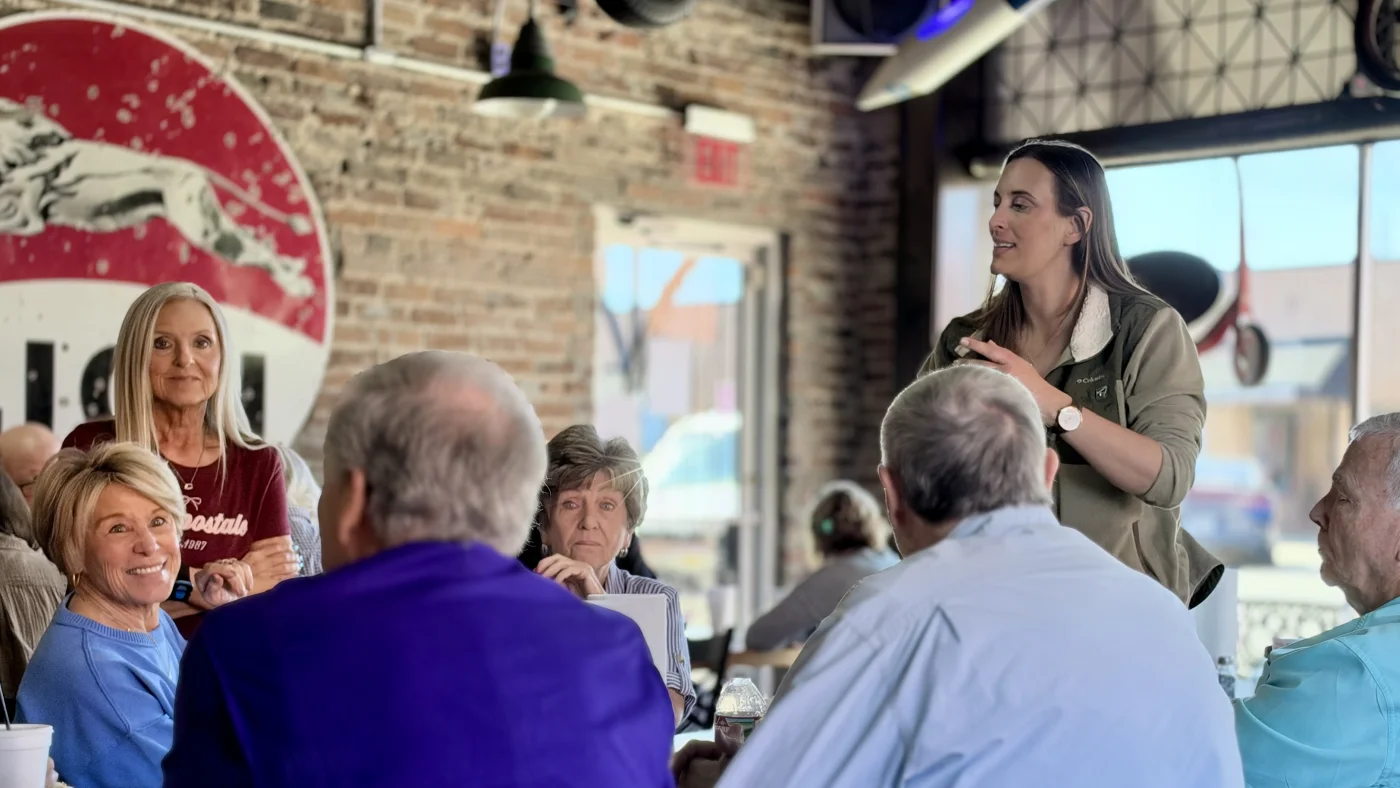
Shoffner, a multigenerational farmer, has sought to make her Arkansas identity central to her campaign. Speaking to voters at a burger restaurant in Hope, she criticised what she described as an unproductive Congress dominated by extreme voices in both parties.
“We’re the sleeper race,” she said. “I mean, we’re the race that no one’s noticed and that no one is going to see coming.”
Republicans have responded by spending millions of dollars on the Senate contest and the Little Rock-based House district, while also investing in efforts to encourage their supporters to vote.
Arkansas Democrats focus on prices and agriculture
Shoffner closed her family farming operation in 2025, citing rising input costs and the impact of tariff and trade policies under the Trump administration. Her campaign has since focused heavily on agriculture, prices and what she says is the failure of politicians in both parties to listen to Arkansas communities.
She has rejected the suggestion that her prospects are too weak to merit serious consideration, saying the contest was about shared values rather than party allegiance.
“This race isn’t about Democrats or Republicans or independents or any of that,” she said. “This isn’t some kind of weird political alignment, this is a values alignment.”
At a family farm near Arkadelphia, supporters said voters were increasingly concerned with practical issues. Vanilla Hannah, who is seeking re-election as a local justice of the peace, said party labels mattered less than whether candidates addressed people’s basic needs.
“When it comes down to basic needs or whatever, the ‘D’ or the ‘R’ after your name don’t mean a thing, because we’re all suffering and all having the same issues and everybody’s ready for a change,” she said.
Shoffner has also emphasised her independence from national Democratic organisations. She said she welcomed the absence of a major influx of outside support and described her campaign as “Arkansas First”.
“I want to talk directly to Arkansans, and I want them to know that when I go to D.C., the only letters that will mean anything next to my name are the ‘A’ and the ‘R’,” she said.
Jones, who previously challenged Republican Governor Sarah Huckabee Sanders in 2022, is benefiting from greater national Democratic support. The Democratic Congressional Campaign Committee has identified him as a target for a potential Republican-to-Democrat flip, while several prominent Democratic figures have visited or endorsed his campaign.
His contest against Republican Representative French Hill has also attracted millions of dollars in Republican spending. Mr Hill is a long-serving incumbent, and the district became more conservative after redistricting following the 2020 Census.
Jones said voters were struggling with the price of petrol and groceries, and argued that many who backed Mr Trump had done so in the hope of lower prices, an end to foreign wars and greater accountability.
“None of that has happened, so they’re super frustrated,” he said.
Black voter turnout could shape Arkansas contests
Democrats are also pointing to increased Black voter turnout across the South after a Supreme Court ruling weakened part of the Voting Rights Act. Arkansas lawmakers did not redraw the state’s congressional map, but the division of Little Rock after the 2020 Census made the 2nd District more Republican.
Jones said some voters believed their right to vote was under threat and were responding by turning out in greater numbers. He argued that frustration with the current administration could reach beyond traditional party loyalties.
Arkansas once had an entirely Democratic federal delegation, Jones noted, saying that economic anxiety and disappointment with Washington had helped produce that political shift.
Marcus Hatley, who met Shoffner at his family farm, described the increased turnout and possible movement between parties as a “course correction”.
For now, however, the Arkansas Democrats’ hopes remain at odds with the expectations of forecasters, leaving Shoffner’s Senate campaign and Jones’s House bid facing a steep test in a state where Republicans hold a commanding advantage.
