


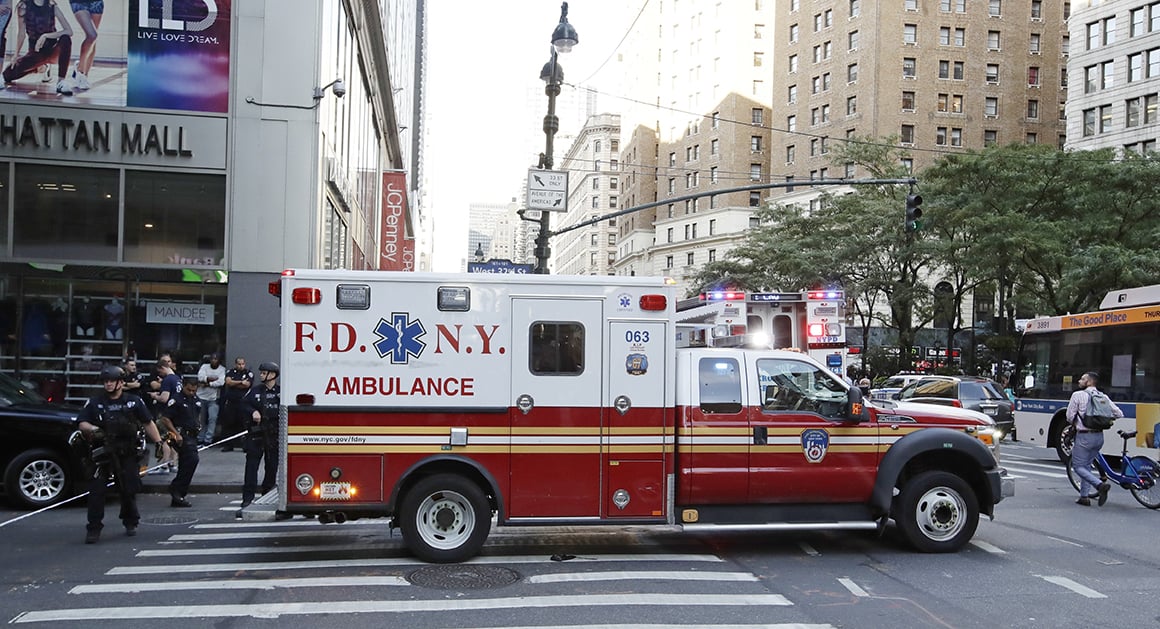
Ambulance response times in New York City have reached an average of 13 minutes for life-threatening emergencies, prompting council members to push for real-time updates to be sent to 911 callers.
The proposal would allow people waiting for an ambulance to receive personalised text alerts showing how far away help is, similar to tracking a bus, train or rideshare vehicle.
Joann Ariola, the Republican chair of the City Council’s Fire and Emergency Management Committee, said the information could help callers decide whether to wait or make their own way to hospital.
“The idea is that I would be able to track my ambulance in real time, just like you’re able to do for your bus, or your train, or your rideshare car,” she said.
Response times for the most serious medical emergencies have risen for five consecutive years and are 41.2 per cent higher than a decade ago, according to a report from the city comptroller. They increased by almost 16 per cent between the 2025 and 2026 financial years, the sharpest annual rise of the decade.
Calling 911 does not always result in an ambulance being dispatched immediately. Patients can be placed in dispatch queues, while crews may be diverted when a higher-priority emergency is reported.
Harvey Epstein, a Democratic council member, supports the plan. He said callers should be told when an ambulance was likely to take too long to arrive so they could consider alternative transport.
“We get live texts about everything under the sun, but for some reason, in our current system, we don’t get alerts about this,” Mr Epstein said. “If I’m waiting for an ambulance because my kid broke their leg, and I learn that it’s going to be half an hour, it’s smarter for me to just hop in a cab anyway.”
Ms Ariola initially proposed legislation requiring broader alerts when the emergency response system was overloaded. After meeting senior New York City Fire Department officials, including commissioner Lillian Bonsignore, she said the department appeared more receptive to specific messages sent directly to callers.
An FDNY spokeswoman said the department was examining the idea as part of efforts to improve emergency medical responses and keep residents informed.
“We are exploring all our options, this included,” Amanda Farinacci said.
Ms Ariola said she had submitted a revised version of the bill and was awaiting a response from the legislative affairs committee.
Staff shortages blamed for longer ambulance response times
The proposed alerts would address the lack of information available to callers, but council members and union leaders say the deeper problem is the difficulty of retaining emergency medical staff.
Ms Ariola said low pay for a high-pressure job had left the city’s emergency medical services facing a systemic crisis. Entry-level emergency medical technician pay is lower than that of sanitation workers, firefighters, correction officers and police officers.
About 4,300 EMTs and paramedics have left their roles since 2019. During the last financial year, 58 per cent of departing EMTs became firefighters elsewhere in the department.
The union representing emergency medical workers is negotiating a contract that expired in 2022 and is seeking pay parity with firefighters. A comptroller’s report found that matching firefighter salaries would increase EMS salary costs by $184 million a year, or 66 per cent.
Vincent Variale, president of Local 3621, and Michael Greco, president of Local 2507, said equal pay and benefits would help reverse the decline and improve safety.
“These actions would not only treat our EMS workforce respectfully and properly; they would save the lives of New Yorkers in peril,” they said in a joint statement.
The latest increase in response times spans the administrations of former mayor Eric Adams and Mayor Zohran Mamdani. Ms Ariola said the issue had been inherited by successive mayors but was now the responsibility of the current administration.
The FDNY said it recognised the situation was unacceptable and was working to improve coordination with hospitals, increase efficiency in high-volume areas and return units to service more quickly.
