


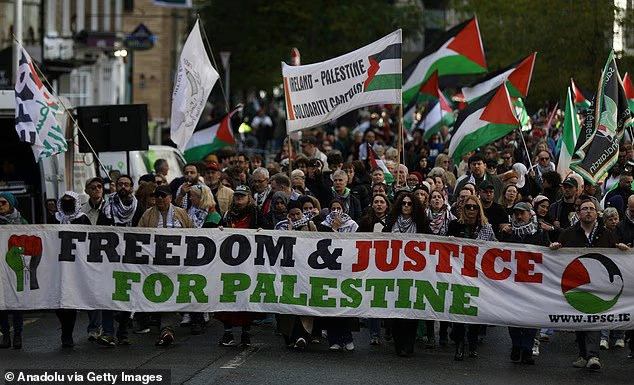
Concerns about anti-Semitism in Ireland have intensified amid widespread pro-Palestinian activism, with Jewish leaders pointing to alleged abuse, intimidation and hostility towards Jewish history and institutions.
The latest controversy centred on the editing of a pendant in the colours of the Palestinian flag from an episode of RTÉ’s property programme Cheap Irish Homes. The broadcaster described the edit as a mistake and said it would review its impartiality guidelines.
The programme’s production company also apologised to Claire Molloy, an accountant and pro-Palestinian campaigner who has volunteered on the West Bank. Ms Molloy said she would not have taken part had she known the pendant would be removed.
“I am pro-Palestinian,” she said. “It is a huge part of my outfit. I am always wearing it.”
The incident prompted protests outside the Dáil in Dublin, online arguments and a complaint to the broadcasting regulator. It also drew attention to the wider debate over how criticism of Israel is expressed in Ireland and whether it has contributed to hostility towards Jewish people.
Anti-Semitism concerns in Ireland
The New York-based Anti-Defamation League has warned that anti-Semitism in Ireland was a “disaster waiting to happen”. Its chief executive, Jonathan Greenblatt, told Taoiseach Micheál Martin that the Government needed to protect the country’s Jewish population before it was too late.
Ireland’s Jewish community is estimated to number between 2,200 and 3,000 people, in a population of 5.4 million. There is no state system for recording anti-Semitic incidents, leaving community organisations to document cases themselves.
The Jewish Representative Council of Ireland recorded 143 self-reported incidents during the six months to January in its first reporting initiative. The cases included verbal abuse, threats, intimidation, hate emails and unsolicited messages, vandalism and graffiti.
The council has cautioned that its figures provide only a partial picture because many incidents may go unreported.
Among the allegations relayed by Jewish community representatives is that a heavily pregnant Jewish woman was verbally abused by a doctor while awaiting emergency Caesarean surgery at a Dublin maternity hospital.
“A doctor started berating her about the Israeli government before she underwent surgery,” said Orli Degani, one of the compilers of the report.
Graffiti daubed on two roads in County Louth earlier this year included a Star of David alongside the words “Jew rat”, according to images circulated online. Another image showed a Nazi swastika.
A Jewish student was also allegedly assaulted in a nightclub because he was wearing a Star of David.
Jewish leaders say such incidents have received limited media attention, while those who speak publicly about anti-Semitism can face abuse themselves.
Writer Rachel Moiselle said she was subjected to an online misogynistic backlash after writing about the issue in a Sunday newspaper. She said she was called “a traitor, an agent of subversion, a paid propagandist, a grifter or plain anti-Irish”.
“I am none of those; I am a very proud Irish woman,” she said. “I love our country, I love our culture and I love our language and I have always endeavoured to be a good citizen.”
Ms Moiselle said the denial that anti-Semitism existed was worse than the personal abuse she received.
Disputes over protests and public institutions
Pressure has also grown around the Ireland Palestine Solidarity Campaign, which calls for sanctions against Israel and an end to what it describes as “Israeli apartheid and genocide”. Some 239 demonstrations were planned around the country during the two weeks to November 2.
At one protest outside the Dáil, campaigners displayed Palestinian flags and a green Starry Plough, formerly associated with the Irish National Liberation Army. The organisation was responsible for several attacks in Ireland and Britain, including the 1979 assassination of Airey Neave and the 1982 bombing of a pub near Londonderry in which 17 soldiers and civilians were killed.
The intensity of the protests has been accompanied by criticism of public figures who have taken strongly pro-Palestinian positions.
Novelist Sally Rooney, who led an authors’ boycott of book festivals funded by investment firm Baillie Gifford because of its financial ties to Israeli defence companies and fossil fuels, has become a prominent figure in the campaign.
Her British publisher withdrew her books from sale after she insisted that royalties should be donated to Palestine Action, which is a proscribed organisation under UK terror laws. An open letter signed by figures including Gary Lineker described the ban as a “repressive absurdity” and called for the books to return to sale.
The row attracted substantial attention, while a separate dispute involving a conference on anti-Semitism received less coverage.
Maurice Cohen said the Herbert Park Hotel in Dublin cancelled a booking for 70 delegates after its general manager asked whether the Israeli Defence Forces would be involved. Mr Cohen said he explained that the event was about anti-Semitism and was not concerned with Israel or the Israeli army.
He said the hotel told him it would consult its owners before accepting the booking, then cancelled the reservation the following day without explanation. The hotel has made no public comment on the matter.
“This was not a minor administrative inconvenience, but a warning,” Mr Cohen said.
Disputes over Jewish history
A High Court challenge is under way over a proposal to rename Herzog Park, which has been dedicated since 1995 to Chaim Herzog, a former Dublin resident who served as president of Israel from 1983 to 1993.
The park is near Ireland’s only Jewish school. The proposed renaming has been condemned as an attempt to erase Jewish history from the country’s public life.
Dr Alexandra Herzog, Chaim Herzog’s granddaughter, said: “The push to rename the park reflects a disturbing willingness to target Jewish history as a stand-in for Middle East politics.”
She said her grandfather was born in Belfast, raised in Dublin and served as an officer in the British Army during the Second World War, fighting against the Nazis.
“When a Jewish legacy – especially one so rooted in Irish history – is seen as the most expendable or most appropriate for a political gesture in support of Palestine – it can only be interpreted as anti-Semitism,” she said.
Lior Tibet, a Jewish woman who attended last year’s Holocaust memorial event, said she was forcibly removed after silently turning her back during remarks by former president Michael Higgins about people searching for relatives in the rubble of Gaza.
Ms Tibet said she and a pregnant friend had protested without shouting or displaying posters. “They didn’t ask, they just pushed,” she said. “I’m a Jewish woman at a ceremony for my community. I [had] a right to be there.”
She accused Mr Higgins, a vocal critic of Israel, of hijacking the commemoration and asked: “How could I, a Jew, be kicked out of my own event?”
Jewish community representatives say the episode was given little attention in Ireland.
There have also been disputes in schools. The mother of a Year Six pupil said another child repeatedly wore pro-Palestinian and anti-Israel badges, despite concerns raised with school authorities about their effect on Jewish pupils.
She alleged that the parent refused to remove the symbols and that school officials feared any action could lead to protests outside the gates.
“By doing nothing they are legitimising the wearing of anti-Israel symbols,” the mother said. She added that staff had been unable to answer how they would respond if a pupil wore a swastika or another inflammatory symbol.
For Ireland’s small Jewish community, the disputes have contributed to what Mr Cohen described as “ambient anti-Semitism” – an environment in which political expressions hostile to Israel can, he argued, make Jewish people feel collectively blamed.
