


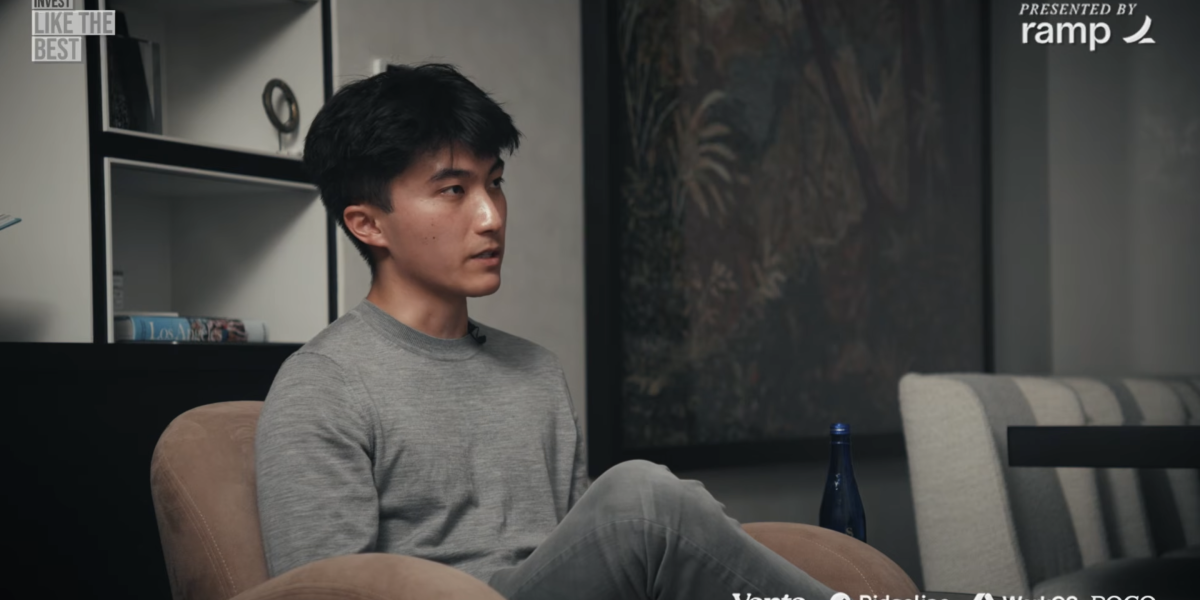
Instinct, an AI assistant startup founded by 23-year-old Noah Shinn, has reached a valuation of $10 billion after raising a further $1 billion in a Series C funding round.
The company, which was founded last year, had raised $250 million at a $2.5 billion valuation in August, taking its total funding at the time to $350 million.
Despite being available only to a limited number of invitees, Instinct is approaching $1 billion in annual transaction volume, Shinn said in an interview published on Monday.
The service has reportedly grown through word of mouth rather than conventional advertising. Shinn said Instinct had spent “$0 on marketing so far”, while demand for access has become so strong that invitations are being offered for sale on eBay.
How the Instinct AI assistant works
Instinct is a free personal assistant that allows users to communicate with it by message or telephone call. It entered private beta in February and moved to an invite-only beta last month, with each user given five invitations.
Shinn has said users have employed the assistant to organise weddings and cancel hundreds of dollars’ worth of subscriptions. He believes such systems could simplify everyday tasks by learning users’ preferences and retaining them in memory.
Travel accounts for about half of the annual transaction volume cited by Shinn. He said the assistant could eventually use stored preferences to make future bookings according to the user’s precise requirements.
Instinct’s rapid rise has brought it into the orbit of Meta, which launched its own personal AI agent, Muse, earlier this month.
Alexandr Wang, Meta’s chief AI officer, has repeatedly mocked Instinct in posts on X while responding to comparisons between the two products. In one post, he said Muse would beat Instinct in an MMA fight.
In another, Wang wrote: “Muse is way hotter than the other personal agents (and also way faster, but mostly hotter).” He later made a play on Instinct’s name, writing: “Muse absolutely crushes Insect.” Shinn reportedly responded to one of the posts with a smiley face.
Wang became a billionaire after founding Scale AI, in which Meta later invested $14.3 billion. His posts about Instinct attracted hundreds of thousands of views and more than 1,000 likes, potentially giving the smaller company further exposure.
The number of Instinct users has not been disclosed. Muse, however, has already built a substantial following and recently became the top free app on the US App Store, replacing ChatGPT. Estimates cited in the source material put Muse’s worldwide installs at 2.8 million during its first 12 days.
Shinn said he believed Muse was “a great product”, but added that he spent “very little of my time thinking about competition and other players in the space.” He said the market remained at an early stage because many people who use AI were not yet making full use of its capabilities.
From university research to Instinct
Shinn grew up in the San Francisco Bay Area and attended a private high school in San Jose, where he played basketball and ran cross-country. He enrolled at Northeastern University in Boston but left in 2023 to work in the technology industry.
His interest in AI agents began before he left university. He worked on type prediction and code generation in Northeastern’s Programming Language Group, researched excited-state molecular dynamics and joined the avionics team of the university’s student aerospace organisation.
As an undergraduate, Shinn co-authored a paper with Ashwin Gopinath, then a professor at the Massachusetts Institute of Technology, examining how language agents could improve by reflecting on feedback and storing the results in memory.
The approach, known as Reflexion, was described by its authors as mirroring human problem-solving. In a coding evaluation, they said it enabled a large language model to achieve 91 per cent accuracy, compared with 80 per cent for GPT-4. The paper has since been cited hundreds of times and was presented at the NeurIPS AI conference in 2023.
That same year, Shinn joined Sierra as one of its first employees. The enterprise AI company, which develops AI agents, was co-founded by OpenAI chairman Bret Taylor.
Instinct is keeping its service invite-only while it increases its computing capacity, Shinn said last month. The startup is now attempting to establish itself in the rapidly expanding personal assistant market alongside Meta’s considerably better-funded Muse.
