


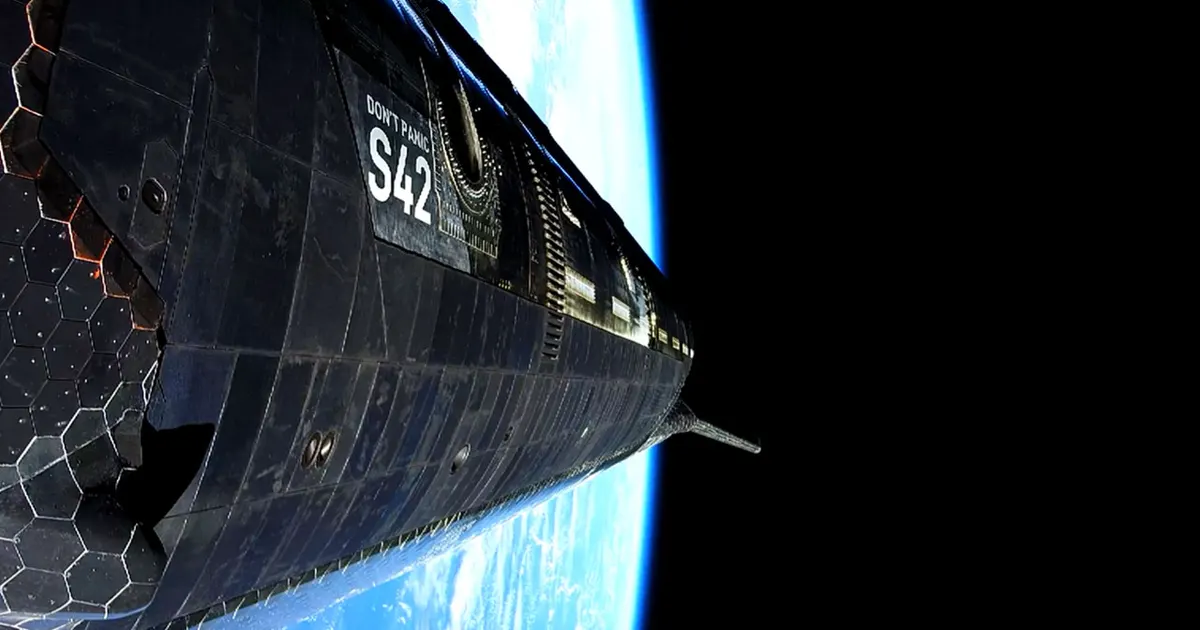
SpaceX’s Starship has been caught by the launch tower at its Texas base for the first time after completing a 22-hour orbital test flight – although the mission fell short of an intended double recovery when its booster was destroyed over the Gulf of Mexico.
The upper-stage spacecraft returned to Starbase on Saturday afternoon, 14 November, and was secured in mid-air by the giant mechanical arms attached to the launch tower. It marked the first time an orbital Starship had been recovered at the site where it began its journey.
Starship lifted off from south Texas on Friday evening, 13 November, carrying 26 of SpaceX’s next-generation Starlink V3 satellites. It completed 14 orbits of Earth before beginning its return, with live views from the spacecraft transmitted through the Starlink network.
Starship catch completes 22-hour test flight
The flight was intended to demonstrate the company’s long-term aim of recovering both stages of the world’s largest rocket. However, the Super Heavy booster was diverted from its planned return to the launch site after its recovery attempt was aborted.
The booster subsequently splashed down in the Gulf of Mexico and broke apart in a fiery explosion. SpaceX said recovery teams had located the spent vehicle and were monitoring beaches in Texas for any debris that might wash ashore.
The company has not yet established the cause of the failure. Associated Press reported that SpaceX believed the booster’s engines had shut down too early during its descent, prompting its guidance system to abandon the landing attempt to protect the launch site.
Despite the loss of the booster, the Starship spacecraft continued into orbit and completed the main objectives of its mission. SpaceX said its heat shield and other systems appeared to have performed as planned before the return to Starbase.
The 26 Starlink V3 satellites deployed during the flight are designed to provide substantially greater capacity than earlier versions. SpaceX has said each satellite can add about one terabit of downlink capacity to its broadband network.
Flight 15 was Starship’s second mission to reach orbit, following the previous test in September. That flight also deployed 26 Starlink satellites but ended with the spacecraft splashing down in the Pacific Ocean after a much shorter mission.
SpaceX is developing Starship as a fully reusable system for launching satellites and carrying people and cargo to the Moon and, eventually, Mars. NASA is relying on a version of the spacecraft for its Artemis programme, with astronauts expected to practise docking with a Starship lunar lander during Artemis III.
The successful capture of the upper stage represents a significant step towards the rapid re-use of the vehicle, even though the failed booster recovery means SpaceX has yet to achieve a complete recovery of both parts of Starship on the same flight.
