


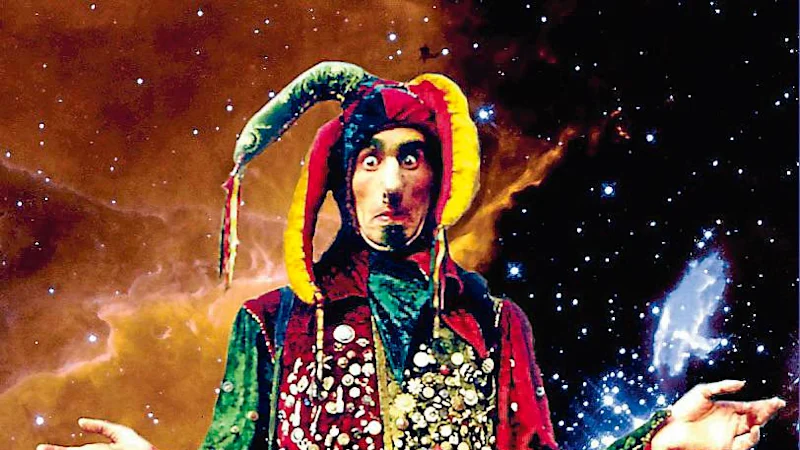
The clowning world is mourning Australian performer Jolly Goodfellow, also known as Rumpel or Rumpelstiltskin, who has died in Los Angeles aged 54.
Police found him last week in the prop-filled van where he had been sleeping during a recent heatwave. His death was attributed to natural causes.
A fundraising appeal has raised just over $37,000 to help deal with his belongings, including costumes, musical instruments, props and drawings, and eventually return his cremated remains to Australia.
The appeal describes its aim as passing “the very final hat” around to “resolve, return, house (or re-house) his endless stashes of props, fabulous costumes, musical instruments, drawing and incredible documentation”.
Arrangements have been complicated by the fact that his body remains with the coroner. His van is impounded until his family receives a death certificate, with further fines accumulating each day.
Born Sean Goodfellow in Adelaide in 1972, he was raised in Melbourne after his family moved there in 1976. His older sister, Antonia Goodfellow, said he frequently changed his name and voice and had struggled to fit into conventional education.
“No education system was really able to contain him,” she said.
Goodfellow developed a reputation for performances built around slapstick, strange noises, rambling poetry and philosophical observations. He was often dressed as a medieval jester, spoke in a high-pitched voice and was said by some to rarely break character.
His shows included a 53-hour performance without sleep and a 16-hour appearance at the Maleny festival. After performing at alternative festivals in Australia during the 1990s, he travelled to Europe, where he played in every country on the continent and appeared at festivals including Glastonbury.
Mike Finch, the former artistic director and co-chief executive of Circus Oz, said Goodfellow was “an unsung genius”.
“In the world of clown and street performance, he really was in a class of his own,” Finch said, comparing his mastery of the craft with that of painters Vincent van Gogh and Frida Kahlo.
Goodfellow’s only conventional job was a spell with Cirque du Soleil’s Beatles show Love in Las Vegas in 2006 and 2007. He was unhappy after his song, The Fool on the Hill, was allegedly removed because Yoko Ono felt the production contained too many Paul McCartney songs.
His career was accompanied by stories of an unconventional life. He travelled with suitcases packed with rubber snakes, balls, spring shoes and other noisemakers, and once arrived at Heathrow in jester costume carrying a bag of Australian coins when asked by customs officials whether he had money for his stay. He was sent back to Melbourne.
Goodfellow was born with muscular dystrophy, a condition his father also had. His sister believed a serious car crash in the United States around 2008 may have triggered a worsening of the disease.
He later settled in Los Angeles, where he performed as a clown and worked as an extra, before returning to Australia in 2019. He went back to Los Angeles in June this year, hoping to perform again and organise his possessions, which included a hurdy-gurdy and a Volkswagen Beetle painted as a ladybird.
Annie Lee, a former partner, long-term friend and member of the comedy trio the Kransky Sisters, described him as “the performer’s performer”.
Tributes have continued to appear on a Facebook page dedicated to him, with friends and admirers sharing stories of a performer variously remembered as gentle, strange, prolific, vulnerable and “properly silly”.
One fan who saw the conclusion of Goodfellow’s 53-hour performance in Poland said his ability to make people laugh remained especially valuable.
“Undoing the serious matters of life if only for a moment, and making us approach reality with a smile and a good laugh,” the admirer wrote, adding: “Jest In Peace, King of Clowns.”
