


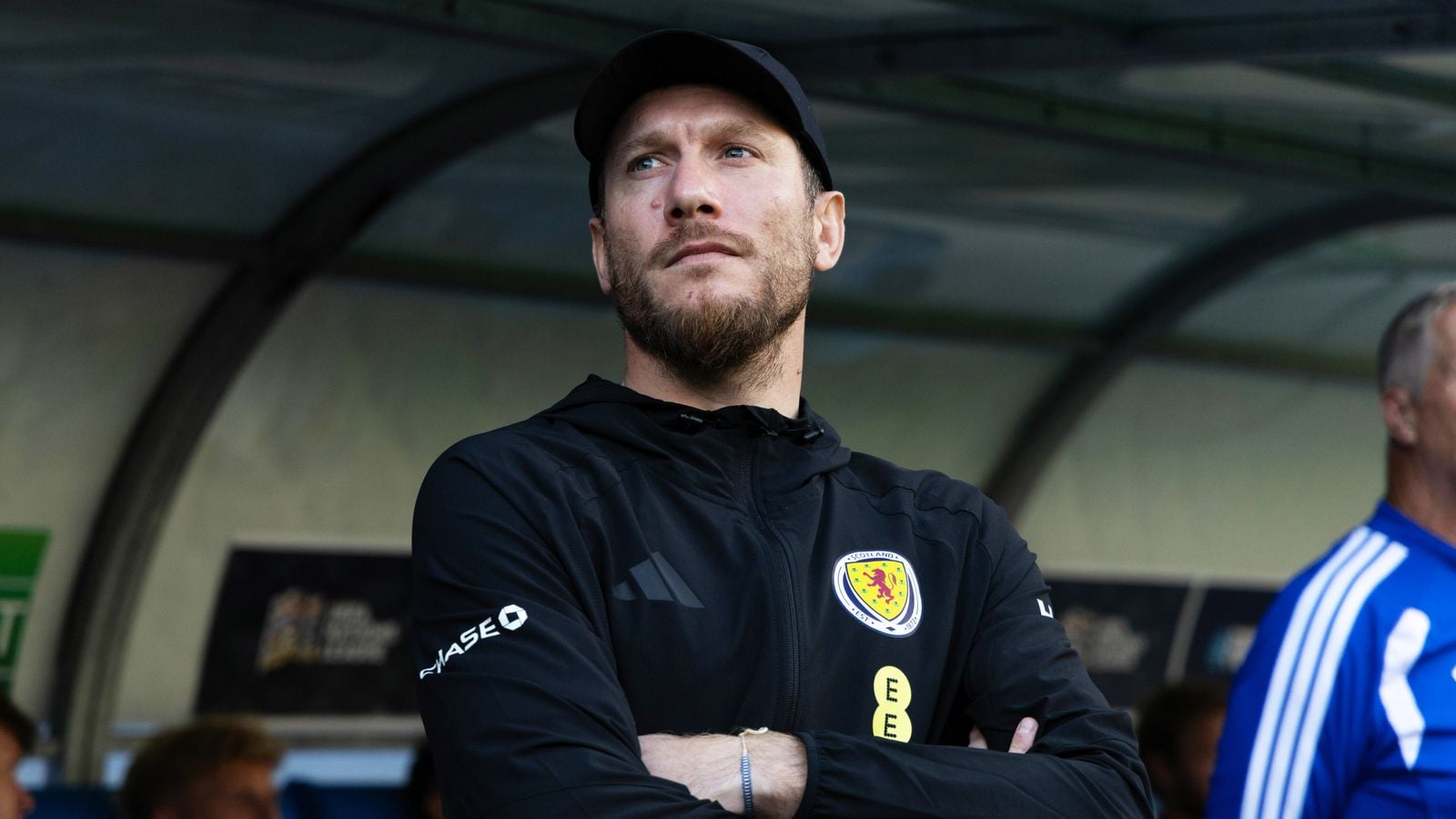
Sebastien Pocognoli’s first game as Scotland manager ended in a goalless draw with Slovenia, but the performance offered an early indication of how markedly he intends to change the side’s approach.
Scotland were vulnerable during a disjointed opening half-hour, yet finished the match in control and created enough opportunities to have won comfortably. Slovenia had a goal ruled out for offside and passed up several chances before the visitors found their rhythm.
Pocognoli had promised a more aggressive team than the one regularly criticised for sitting too deep under Steve Clarke. His solution was a higher defensive line and an energetic press, although Scotland’s back three were repeatedly exposed by balls played over the top.
Scotland’s high press brings both risk and reward
Andy Robertson and Stephen Welsh were among those caught out as Slovenia found space behind the defence. Their opponents’ poor finishing kept Scotland from falling behind, but the danger was clear whenever the press was beaten.
Once Scotland began to impose themselves, however, the same approach created pressure at the other end. It helped produce a clear opening for Oli McBurnie and maintained a frenetic tempo which unsettled Slovenia.
The system will require refinement, but the return of players such as John McGinn and Scott McTominay should give Pocognoli further energy and quality in midfield when both are available.
The formation remained a 3-5-2, but its purpose was far more attacking than the shape had generally suggested in the past. Aaron Hickey and Robertson were encouraged to push forward, with Hickey also moving inside to occupy more advanced areas.
Jack Hendry was similarly given licence to advance from the right side of the defence, at times reaching the edge of the Slovenia penalty area as Scotland sought to add numbers in attack. Ben Gannon-Doak’s introduction for Hickey later in the match reinforced the desire to find a winner.
Welsh operated on the left of the back three, despite Scott McKenna being the natural left-footer in the defensive unit. His distribution nevertheless proved valuable, including a pass which sent substitute Kieron Bowie through before Jan Oblak made the save.
Billy Gilmour was asked to take greater responsibility for directing play after Scotland regained possession in dangerous areas. McGinn, meanwhile, provided the drive to move the midfield forward when the match opened up.
McBurnie and Ure offer Pocognoli attacking options
The match also gave Robbie Ure a debut and McBurnie a first Scotland appearance since 2021. Neither found the net, but both had opportunities to make an immediate impression.
Ure struck the post, while McBurnie missed a one-on-one and saw a powerful header saved from close range by Oblak. Their movement and occasional combination play nevertheless gave Scotland a different attacking dimension.
McBurnie was particularly effective as a target for midfield runners. On one occasion, he held up possession after Scotland won the ball high, allowing Gilmour to move into a promising position.
“It took us a little bit of getting used to in the first half, the new formation,” McBurnie said. “I thought once we did, we looked really good. We created enough chances to kill the game. We are really disappointed we didn’t get the three points.”
He added: “We had them pinned for a lot of the game. We put them under waves of pressure. The only thing missing was a goal or two.”
Welsh said Scotland had struggled to adapt initially but felt the changes made after the interval had transformed the contest.
“We struggled to get into the game in the first half,” he said. “Obviously it’s a new style, some fresh faces and a new way of playing. In the second half, we completely dominated the game.”
According to Welsh, Pocognoli asked the team to sharpen its counter-press at half-time and altered the shape to give Scotland greater control in midfield. The response was encouraging, even if the failure to convert their chances meant the new era began with only a point.
