


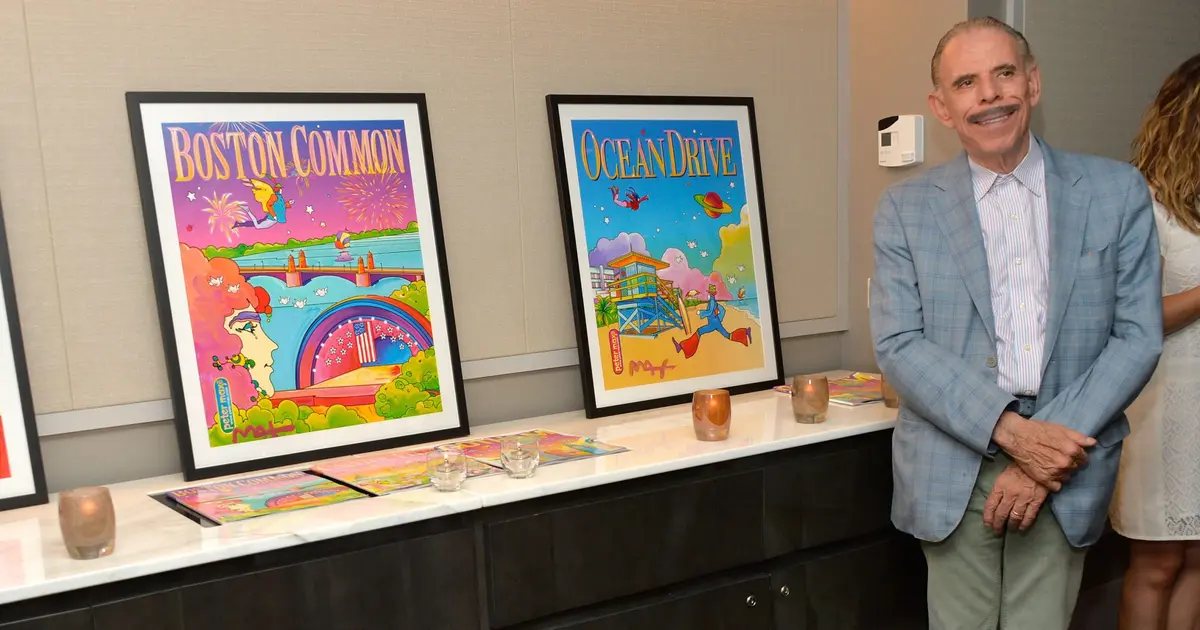
Peter Max, the pop artist whose vivid, cosmic imagery became closely associated with the counterculture of the 1960s, has died at the age of 88.
Max died on Monday, September 14, in hospital in Manhattan, according to statements from his family. His relatives said he had been suffering from a long illness; no specific cause of death was given.
His brightly coloured paintings and posters, featuring starbursts, rainbows, peace symbols, butterflies and planetary landscapes, helped shape the visual identity of the era’s “flower power” movement.
The German-born artist turned that distinctive style into a major commercial business. His designs appeared on album covers, clothing, home furnishings, stationery and corporate products, as well as an aircraft and a cruise ship. At the height of his success, his work was licensed across about 70 product lines.
Max also became known for portraits of cultural and political figures. The Beatles, Jimi Hendrix and Mick Jagger were among the rock stars he painted, while former US presidents Ronald Reagan and Bill Clinton were also admirers of his work.
He was appointed the official artist for a number of major sporting events, including the Olympics, the Super Bowl, the Indianapolis 500, the World Cup and the World Series. In 1981, he painted a series of images of the Statue of Liberty at the White House at the invitation of first lady Nancy Reagan.
Born Peter Max Finkelstein in Berlin in 1937, he left Germany with his Jewish family as a young child. He later lived in Shanghai, Israel and Paris before settling in New York, where he studied art and established a graphic design studio in the early 1960s.
His interest in astronomy and Eastern philosophy fed into the imagery that made him famous. Though the style was rooted in the 1960s, his work remained widely recognisable for decades and featured in museums and popular culture around the world.
Max is survived by his daughter, Libra, and his son, Adam. His daughter described him as her “best friend” and said she hoped he would be remembered not only for his artistic achievements but also for “his kindness, his gentleness and how much he genuinely cherished putting joy into the world”.
Adam Max said the family would remember his father’s “extraordinary creativity, his warmth, his curiosity, and the way he saw beauty and possibility everywhere”.
