


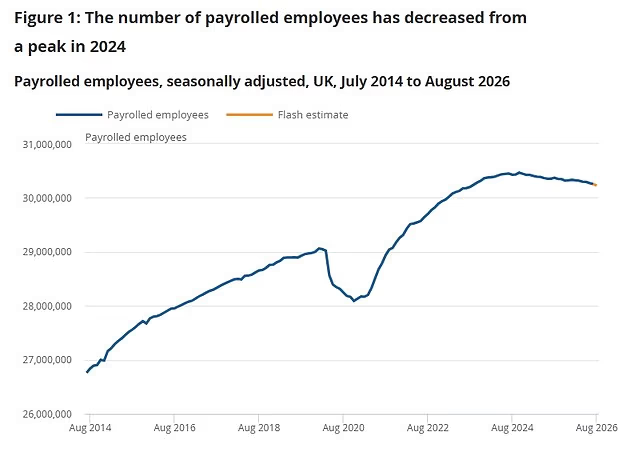
The UK jobs market has weakened further, with company payrolls falling by 26,000 in August and vacancies reaching a fresh five-year low, official figures show.
Payroll employment is now down by 145,000 over the past year, leaving the total number of people employed at 30.2 million. The latest monthly fall was more than twice the 10,000 decline forecast by economists.
A further 19,000 jobs were lost in July, meaning payroll employment has fallen by 39,000 over the past three months.
Vacancies also declined, with around 8,000 fewer positions advertised in the three months to August than during the same period last year. Since the start of the year, the number of vacancies has fallen by 16,000.
The unemployment rate was unchanged at 4.9 per cent over the period, according to the Office for National Statistics.
Liz McKeown, the ONS director of economic statistics, said smaller businesses were continuing to feel the impact of higher employment costs.
“Smaller businesses are continuing to report that increased labour costs are affecting hiring decisions,” she said, pointing to increases in employer National Insurance and the minimum wage.
The figures showed a marked difference between the private and public sectors. Regular pay growth in the private sector was 2.9 per cent, while annual pay growth in the public sector accelerated to 6.6 per cent.
The state also added 11,000 jobs in the three months to June, taking public-sector employment to 6.21 million.
Shadow chancellor Andrew Griffith said the figures showed that Labour was failing to support employment. “Under Labour, job vacancies are at their lowest level in a decade outside the pandemic, 101,000 payrolled jobs have been lost over the past year, and the claimant count is surging,” he said.
Mr Griffith added: “Labour is, and always has been, the party of unemployment.” He blamed the Government’s employment legislation and uncertainty over future tax rises for making it harder for businesses to hire, while pledging that the Conservatives would cut regulation and lower taxes.
Work and Pensions Secretary Pat McFadden said the figures showed “a labour market that remains resilient in the face of significant global economic pressures”.
“But we know there is more work to do, particularly to ensure young people gain the skills, experience and confidence needed to succeed,” he added.
The figures come ahead of this week’s interest-rate decision by the Bank of England, which is expected to leave borrowing costs unchanged at 3.75 per cent on Thursday.
That decision will follow the release of the latest inflation figures. Economists expect inflation to have risen from 2.9 per cent to 3.1 per cent, mainly because of higher oil and gas prices.
Thomas Pugh, chief economist at RSM UK, said the labour market showed signs of stabilising despite its continuing weakness. He said that could give the Bank scope to raise rates in the coming months if inflation reached about 4 per cent.
“We still expect the MPC to hold rates on Thursday, but a rate hike as early as November is now looking much more likely,” he said.
