


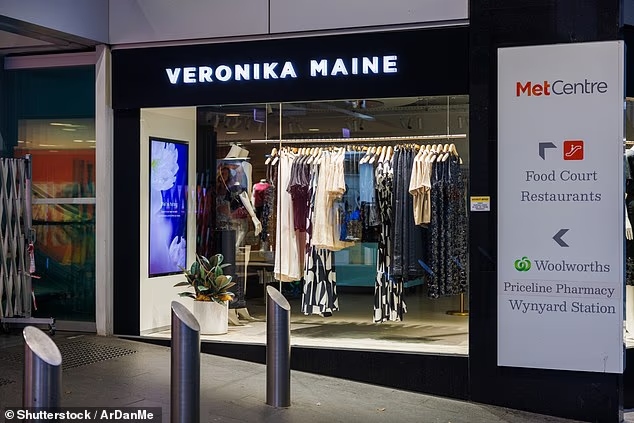
Cue Clothing has entered voluntary administration after its owner failed to secure a buyer, with the Australian womenswear retailer’s 51 shops remaining open while a sale process begins.
Employees across Australia and New Zealand were informed on Tuesday that the company had appointed receivers and managers from FTI Consulting, Kate Warwick and Vaughan Strawbridge.
The stores comprise 42 full-price outlets and nine discount shops. The business will continue trading while its assets, finances and restructuring options are assessed.
FTI said Cue’s improved performance over the last financial year had not been enough to offset its overheads.
“The receivers are continuing to trade the business while they undertake an assessment of the business and restructuring options available,” the firm said.
It added that offers would immediately be sought for the brands as going concerns, with the aim of securing their future, creating a route to profitability and maintaining employment for staff.
Cue’s sales rose to 103.2 million Australian dollars in the latest financial year, up from $98 million. Its losses narrowed to $5.1 million from $14.1 million over the same period.
British assets investor Hilco Capital bought Cue Clothing from the Levis family in April last year, after the company recorded an operating loss of $4.6 million. The group also owns sister label Veronika Maine, which entered administration alongside Cue.
Cue was founded in Sydney by Rod Levis in 1968 and remained family-owned, together with Veronika Maine, until the sale to Hilco for an undisclosed sum.
Hilco appointed Melanie Remai, recruited from rival womenswear company Trenery, as chief executive of Cue Clothing Co in August 2025. The company’s loans were refinanced through Hilco on terms extending to July 2027.
Cue Clothing was put up for sale through FTI Consulting in August, with projected sales of $128.7 million for the 2026 financial year.
The brands target professional women and focus largely on higher-quality workwear. They occupy a position above retailers such as H&M and Zara, but below luxury designers, as ultra-fast fashion businesses including Shein and Temu have disrupted Australia’s retail market.
Cue had also held a major stake in Dion Lee, which entered administration before being acquired by the American clothing group Revolve.
