


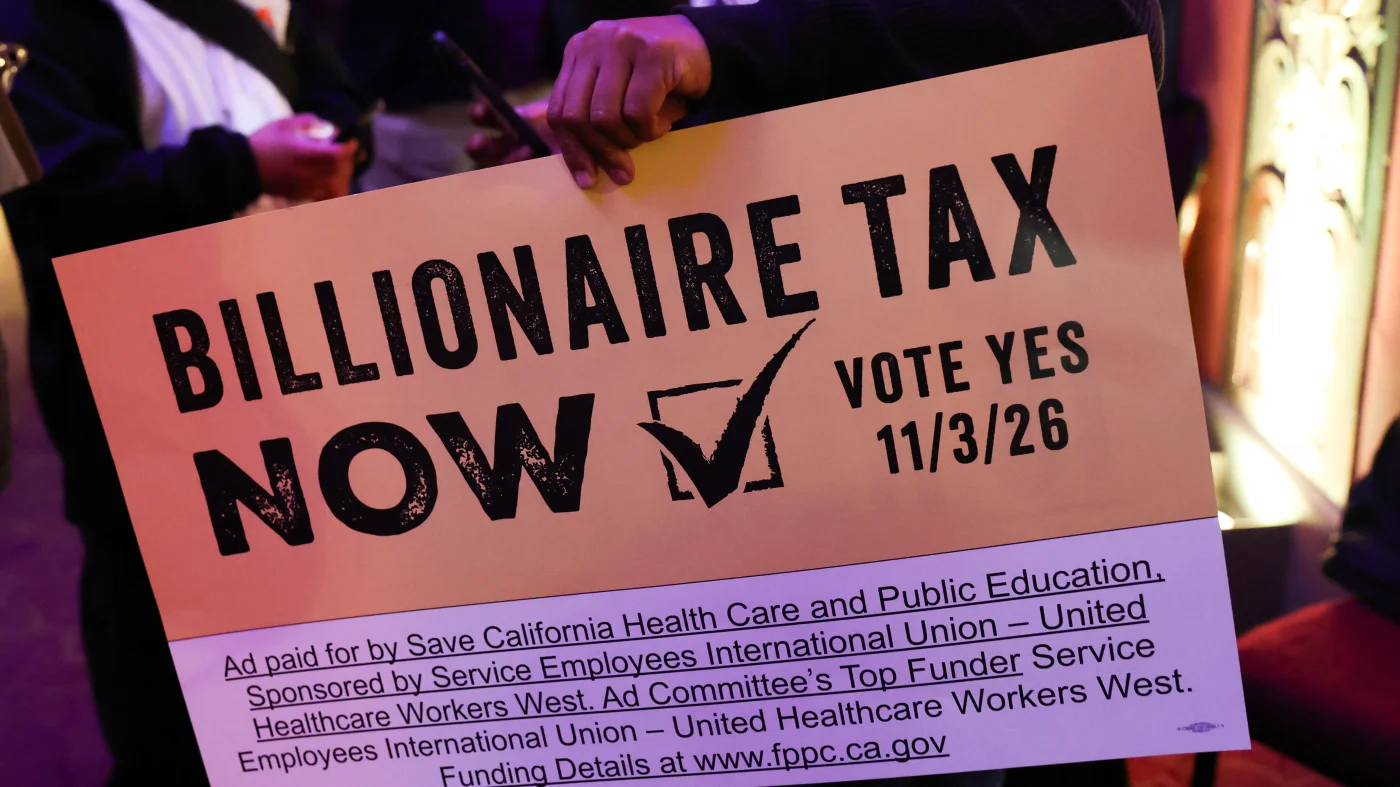
California’s proposed billionaire wealth tax has produced sharply conflicting economic forecasts, with one analysis predicting nearly $100 billion in revenue and another warning it could ultimately cost the state $39 billion.
Proposition 40 would impose a one-off 5% tax on the net worth of billionaires who were California residents on January 1 2026. Most of the proceeds would be directed towards healthcare for low-income residents, partly offsetting federal cuts to Medicaid.
The measure is being put to voters in a ballot contest that could determine whether the United States sees its first wealth tax aimed specifically at billionaires. Its outcome may also influence wider debates over taxing the super-rich across America and beyond.
Gabriel Zucman, an economist at the University of California, Berkeley and the Paris School of Economics, helped produce the more optimistic assessment with Jasper Boll and Emmanuel Saez. They estimate that California’s billionaire wealth reached $2.3 trillion by the middle of 2026.
The economists say that wealth rose by 144% between 2023 and 2025, driven largely by the boom in artificial intelligence. They estimate that taking 5% of the total, while allowing for avoidance, evasion and people leaving the state before the tax date, would raise about $100 billion.
Zucman argues that existing income tax rules fail to capture the growing fortunes of billionaires, who can organise their finances in ways that leave them reporting little taxable income. He believes a wealth tax could reduce inequality, curb the influence of the very richest and provide significant funding for public services.
“If California says, ‘We can tax billionaires. We can tax the wealthiest, most powerful people in the world,’ it will be the beginning of not only a broader US-wide movement, ultimately paving the way for a federal wealth tax,” he said.
Economists divided over California wealth tax
Joshua Rauh, a Stanford economist and senior fellow at the Hoover Institution, reaches a very different conclusion in research carried out with Benjamin Jaros.
They argue that the measure could drive billionaires out of California, reducing the income tax receipts the state already receives from them. Their central estimate is that Proposition 40 would raise only around $30 billion after accounting for departures and possible legal challenges, while further losses could leave the state $39 billion worse off overall.
Rauh disputes the assumption that only 10% of potential wealth tax revenue would be lost through avoidance and relocation. He says at least seven billionaires, including Google co-founders Larry Page and Sergey Brin, had already left California before the January 1 2026 cut-off, reducing the potential yield by about $30 billion.
Zucman disputes that claim, arguing that changing address is not necessarily enough to end California tax residency. He said the legal experts he relied on believed it was unlikely that all those billionaires had successfully established residency elsewhere before the deadline.
The disagreement also extends to the courts. Rauh says the retroactive element of Proposition 40, its attempt to tax assets held outside California and the valuation of privately owned companies could face constitutional challenges. The proposal contains fallback provisions intended to keep parts of the tax operating if other elements are struck down.
Rauh and Jaros have nevertheless halved their estimate to reflect what they describe as legal uncertainty. Zucman rejects that adjustment as too severe.
“You can’t just count the loss and not the gain,” Zucman said, objecting to the inclusion of possible future income tax losses without allowing for revenue from wealth taxes that have not yet been proposed.
Rauh said the calculation followed standard methods for assessing tax proposals. He also argued that public financial disclosures used by Zucman’s team gave an incomplete picture of how much billionaires pay in income tax.
Silicon Valley’s role in the tax debate
A central question is whether California’s technology industry would be powerful enough to keep wealthy founders and investors in the state if the tax were approved.
Zucman points to the concentration of technology companies, workers and investors around Silicon Valley, arguing that the economic benefits of remaining there could outweigh the tax burden. He cited Mark Zuckerberg’s reported agreement to sell non-voting shares to help pay the bill while retaining control of Meta, in exchange for staying in California for eight years under certain conditions.
Nvidia chief executive Jensen Huang has also said he was “perfectly fine” with paying the tax, which could leave him facing a bill of about $8 billion. “We chose to live in Silicon Valley, and whatever taxes they would like to apply, so be it,” he said.
Rauh argues that the technology ecosystem is more vulnerable than supporters suggest. He says startup founders could face substantial liabilities based on company valuations before they had sold their shares, and predicts that investors could withdraw from California if the measure passes.
Supporters view Proposition 40 as a possible turning point in the long-running debate over wealth taxation. Opponents fear it would exchange future income tax receipts for a short-term payment and damage investment in the state.
With voters being targeted by extensive advertising and mail campaigns, California is now deciding whether its billionaire wealth tax would be a landmark source of public funding or a costly experiment.
