


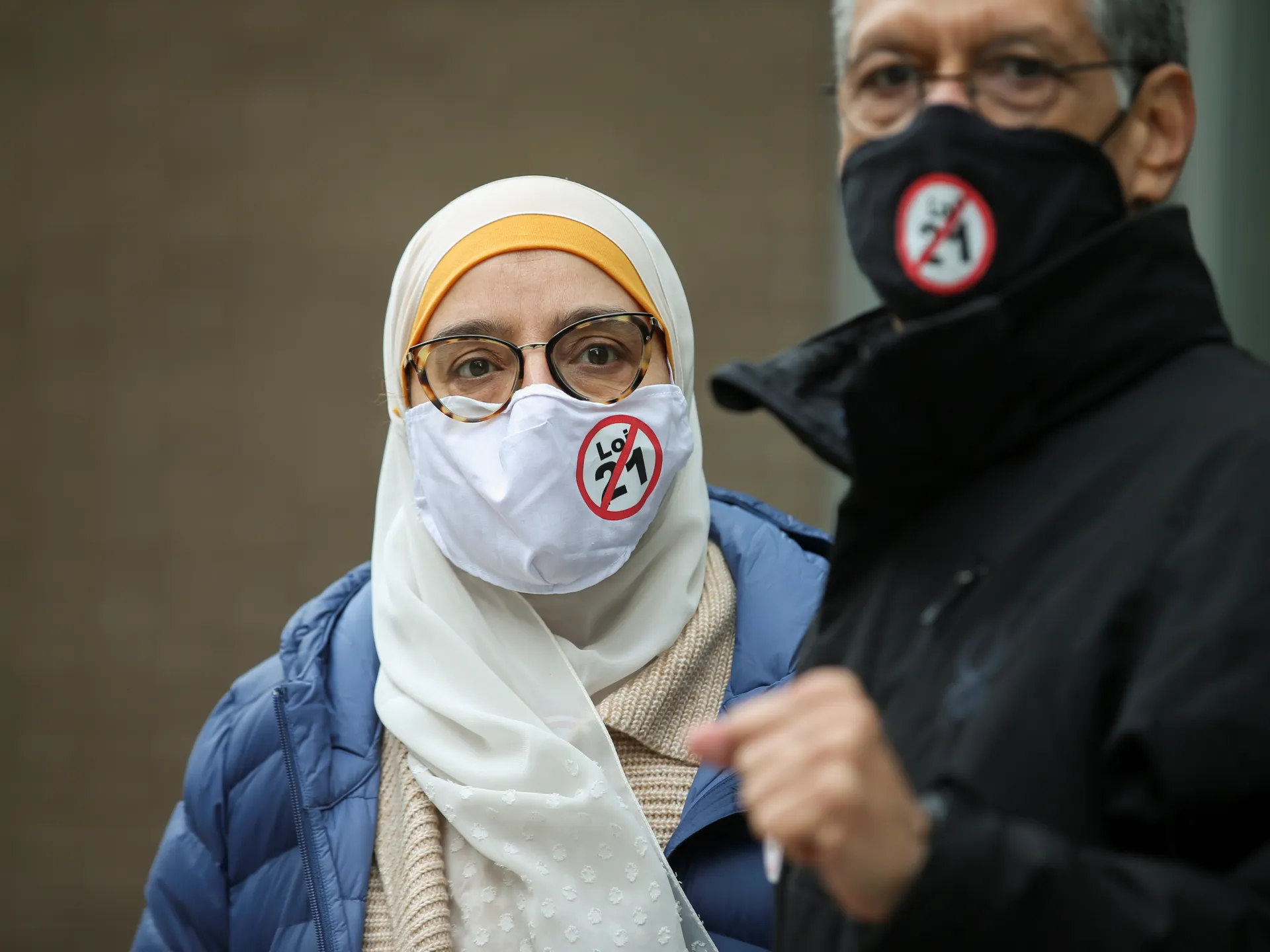
Canada’s Supreme Court is due to rule on Friday on a constitutional challenge to Quebec’s ban on religious symbols, in a case that could determine how far governments can use special powers to protect controversial laws from rights challenges.
The judgment concerns Bill 21, introduced in 2019 and backed by Quebec’s use of the notwithstanding clause. The law prevents public school teachers, police officers and certain other public officials from wearing religious symbols while at work.
Its effects have since been extended. Under Bill 94, passed in 2025, school support staff and volunteers were also brought within the restrictions, preventing parents such as Navien Waly from helping at their children’s schools while wearing the hijab.
Ms Waly had spent about a decade volunteering at school bake sales and graduation committees before receiving an email telling her that she could no longer take part. She had begun wearing the hijab four years earlier, when she was 40.
“I’m the same person I was 10 years ago,” she said. “It doesn’t make me any different. I’ve never spoken about my religion.”
She said the message felt like a “slap in the face”, particularly when her younger children asked what she had done wrong after becoming accustomed to having their mother at school.
Ms Waly had also left a career in finance to train as a specialised educator. She was due to begin work next year, but says she cannot take up the role while continuing to wear the hijab.
Quebec religious symbols ban reaches Supreme Court
The Supreme Court challenge has been brought by the National Council of Canadian Muslims, the Canadian Civil Liberties Association, the World Sikh Organization and others.
They argue that Bill 21 breaches constitutional protections including freedom of religion and the right to equality. Quebec’s government has relied on the notwithstanding clause, which allows legislation to remain in force for up to five years at a time even when it conflicts with certain rights in Canada’s Charter of Rights and Freedoms.
Quebec renewed the protection in 2024, saying it was necessary to preserve “social peace”.
A Quebec court found in 2021 that the legislation infringed the rights of people who wear religious symbols, but upheld most of the law because the notwithstanding clause had been invoked. The Quebec Court of Appeal upheld that decision in 2024 and removed an exemption for English-language school boards.
The Supreme Court heard the case in March. Stephen Brown, chief executive of the National Council of Canadian Muslims, said the organisation wanted the court to invalidate Quebec’s use of the clause in this case.
“The notwithstanding clause is supposed to be an extraordinary power of last resort,” he said, arguing that it should not be used when “governments are deliberately targeting the rights of citizens for political gain”.
The judgment could therefore clarify not only the future of Bill 21, but also the circumstances in which governments may use the notwithstanding clause to shield laws from certain legal challenges.
Muslim women report impact on jobs and daily life
The restrictions have been felt across religious minorities, but their effect on Muslim women has been particularly severe, according to a survey conducted in 2022 and 2023 for a report by the National Council of Canadian Muslims and York University researcher Nadia Hasan.
Of the 411 Muslim women surveyed, 73 per cent said Bill 21 had affected their job search, while 48 per cent believed they had not been offered a job because of their religious identity.
Mr Brown said some women removed their hijabs when they arrived at work and put them back on when leaving. He described accounts of that routine as humiliating.
“Your livelihood or your most deeply held convictions” was, he said, a “dehumanising and cruel situation to inflict on people”.
The survey also found that 88 per cent of respondents believed the law had made Quebec a less welcoming place to live.
Ms Waly, who was born and raised in Canada, said she had experienced hostile looks and racist comments in recent years, including strangers telling her to “go back to your home”.
“What home? This is my home,” she said.
She recalled an incident at a supermarket when a man behind her began singing that immigrants had ruined his life and had cost him his job. He said he had been forced to retire at 30 because of “people like you”, she said. When she turned and asked in French whether he was speaking to her, the man went red.
Mr Brown said some Muslim Quebecers who spoke English and could find work elsewhere had left the province or were considering doing so. Relocating was more difficult for those who spoke only French, he said.
Ms Waly has been advised by some people to move to another province, but does not want to leave the place where she grew up. Her father, brothers, nieces and nephews all live in Quebec.
“You can’t, after living here for 45 years, to just uproot your whole life,” she said.
Restrictions have expanded since Bill 21
Quebec’s secularism debate has roots in the Quiet Revolution of the 1960s, when the province began transferring control of public institutions such as schools and hospitals away from the Catholic Church.
A later commission examining how public institutions should accommodate religious minorities recommended that judges, police officers and others exercising the coercive power of the state should not wear religious symbols at work.
When the Coalition Avenir Quebec government introduced Bill 21, it went further by including public school teachers. Those already in their jobs were allowed to continue wearing religious symbols, provided they did not change jobs or employers.
At the time, Premier Francois Legault described the measure as a way of addressing a debate in which the majority had felt ignored. Polling before the bill was passed found that 64 per cent of respondents in Quebec supported it.
Since then, further legislation has widened the restrictions. Bill 94 extended the ban to school support staff and volunteers, required students to keep their faces uncovered at school and prohibited prayer on school premises.
Bill 9, passed earlier this year, extended the symbols ban to daycare staff, restricted face coverings at Quebec’s public colleges and universities, and limited where people could pray on campus.
The newly elected Parti Quebecois government has also pledged to prevent elementary school pupils from wearing religious symbols in schools.
Ms Waly said she was not optimistic that the Supreme Court would overturn Bill 21, but hoped the decision might allow her to continue with the career for which she had trained.
“At 45 years old, to start thinking of another path? I don’t know what I’m going to do,” she said. “Something’s gotta give.”
She is also concerned about the choices facing her children. Her oldest daughter had considered wearing the hijab in future, but is now weighing that decision against the careers she may want to pursue.
“Either I give up on all these different positions that I can’t do or I don’t wear the hijab,” Ms Waly recalled her daughter saying.
“And it’s just kind of up in the air,” she said. “I don’t have an answer for that.”
