


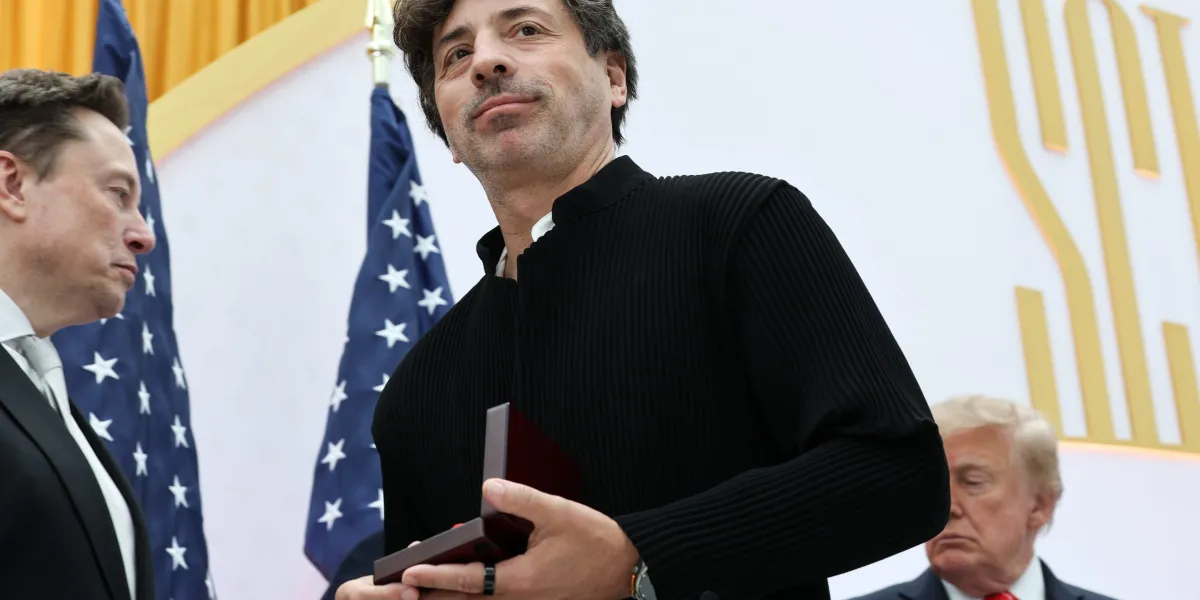
Sergey Brin has committed $102 million to an organisation campaigning against California’s proposed wealth tax, turning the Google co-founder into one of the state’s most influential political financiers.
Building a Better California was established in January with an initial $20 million contribution from Brin. By August, his total funding had risen to $102 million, according to campaign finance filings.
The organisation has become a central vehicle for wealthy technology executives, venture capitalists and business leaders seeking to influence California policy beyond the immediate ballot fight over Proposition 40.
California wealth tax at centre of campaign
Proposition 40, due to go before voters on November 3, would impose a one-off 5 per cent tax on the assets of individuals and certain trusts worth more than $1 billion who were California residents on January 1 2026.
The measure is intended to raise money to offset cuts to federal healthcare funding. Ninety per cent of the proceeds would go towards healthcare, with the remainder allocated to education and food assistance.
The Legislative Analyst’s Office has said the tax could raise tens of billions of dollars over several years. It was sponsored by the Service Employees International Union-United Healthcare Workers West and has been backed by progressive figures including Senator Bernie Sanders and Representative Ro Khanna.
Brin, whose fortune is estimated at $231 billion, has been outspoken in his opposition. In an interview in April, he compared the proposal with the socialism he experienced growing up in the Soviet Union and said he did not want California to end up in the same place.
He relocated to Nevada in December, before the January 1 date that determines which billionaires would be liable for the proposed tax. Despite the move, he went on to organise a campaign aimed at stopping the measure.
Building a Better California spent more than $304 million by October 20 supporting efforts to defeat Proposition 40 and advance Propositions 41 and 42, according to campaign spending data.
About $118.5 million was spent opposing Proposition 40, while roughly $186 million supported the two alternative measures.
Proposition 41 would prevent the state from exempting new taxes from its spending limit and require audits of programmes funded by new special taxes. Proposition 42 would prohibit retroactive taxation, directly challenging a key feature of Proposition 40.
If either Proposition 41 or 42 receives more “yes” votes than Proposition 40, the Legislative Analyst’s Office has said the wealth tax could be blocked even if a majority of voters approve it.
Tech billionaires expand political campaign
Brin’s organisation has attracted contributions from a number of prominent figures in the technology and investment industries, including Kleiner Perkins chairman John Doerr, former Google chief executive Eric Schmidt, Stripe chief executive Patrick Collison and former Sequoia Capital partner Michael Moritz.
It has also endorsed Propositions 1, 3, 37, 41 and 42. The group has put $10 million behind Proposition 45, which concerns California’s environmental review process, and $6 million behind Proposition 37, a proposed $25 billion homebuyer loan fund.
The breadth of the campaign has prompted disagreement among some of its wealthy backers. Schmidt was reported to have objected to the coalition extending its activity beyond defeating the wealth tax.
A close adviser to Schmidt said in August that he was not “irate” about California Democrats endorsing Proposition 40 and that his “only current involvement in politics is his contributions to defeating the billionaires tax”.
Mark Cuban has also opposed the proposal, despite identifying as a “libertarian at heart” and having been closely associated with Democrats in recent years. He became involved in a public dispute with Khanna over the measure and later described the politician as “insane”.
“This is the biggest f*** you in the history of entrepreneurship,” Cuban wrote. “Ever.”
More than 70 current and former California billionaires directed a record $612 million into state elections during the 2026 cycle, according to an analysis of campaign spending. Nearly half went to groups working to defeat Proposition 40, while at least 30 billionaires contributed more than $293 million specifically to the tax fight.
