


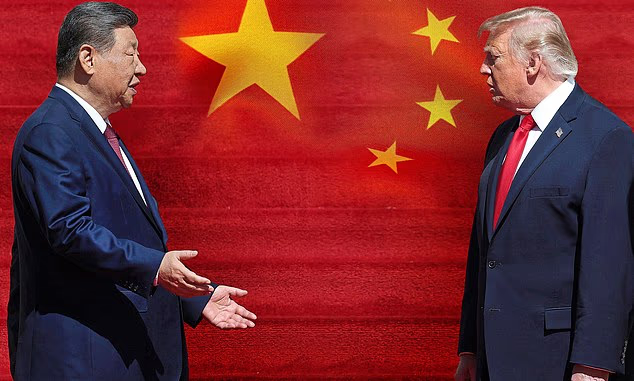
Xi Jinping’s health has come under renewed scrutiny after US officials involved in last month’s summit with Donald Trump said the Chinese president appeared physically weak and required unusually long rest breaks between meetings.
A private room in the White House West Wing was reportedly set aside for the 73-year-old leader. Known as the “hold room”, it was reserved for Xi and his wife, Peng Liyuan, while even his chief of staff, Cai Qi, was not permitted to enter.
The Chinese delegation sought substantial downtime in the schedule and raised concerns about how long Xi would need to stand and walk. Officials also said China rejected an offer of a working lunch with Mr Trump on the summit’s only full day.
Mr Trump publicly described Xi as “strong, vibrant and fit”. Privately, however, American officials were said to have been struck by the Chinese leader’s apparent frailty.
Xi appeared to move cautiously on the stairs during the visit, gripping Peng’s hand as he descended from his aircraft in Washington and later climbed the steps of the National Archives. The scenes prompted speculation that she was supporting him, rather than simply accompanying him.
Peng, a prominent soprano who rose to fame through the People’s Liberation Army, has traditionally held a higher public profile than the wives of previous Chinese leaders. Her access to the private room was unusual in a diplomatic setting where spouses have generally played a ceremonial role.
Xi Jinping health rumours fuelled by public absences
The footage broadcast by Chinese state television appeared carefully edited. Reports showed Xi waving from the aircraft doorway before cutting to formalities on the ground, omitting his descent down the steps.
Rumours about his health had already circulated before the Washington summit. At a gathering of emerging nations in New Delhi in September, Xi withdrew at short notice from a gala dinner hosted by Indian Prime Minister Narendra Modi after reportedly feeling unwell.
Unsubstantiated claims subsequently spread among overseas dissidents that he had been rushed back to Beijing for emergency treatment. One allegation, advanced by exiled China Democratic Party founder Xie Wanjun, said Xi had been carried from his plane and taken to hospital by helicopter. No evidence for the claim was provided.
Further speculation followed unexplained periods away from public view. Xi disappeared for two weeks in May last year, during which analysts noted fewer references in state media to “Xi Jinping Thought”. He was absent again for ten days at the end of May this year, while a monthly Politburo meeting appeared to have been cancelled.
There is considerable uncertainty around such claims because the Chinese Communist Party operates with a high degree of secrecy. Rumours can spread rapidly, while official denials are often treated by sceptics as evidence that something is being concealed.
Former CIA China analyst Dennis Wilder has described Xi as a lifelong smoker who is overweight, unfit and fond of alcohol. Wilder also recounted a conversation with former Chinese foreign minister Qin Gang, who said Xi “loved to drink”, including Moutai, a powerful grain spirit popular among the country’s leaders.
Desmond Shum, an exiled Chinese businessman with connections to the family of former premier Wen Jiabao, has said China’s leaders take extraordinary measures to prevent information about their health from becoming public when travelling abroad.
Xi’s condition carries wider significance because he has concentrated more power in his own hands than any Chinese leader since Mao Zedong. He removed presidential term limits, weakened the expectation of collective leadership and has not identified an obvious successor.
Concerns over China’s leadership succession
Since 2022, a major purge of China’s military leadership has removed dozens of generals and lieutenant generals, according to an analysis by the Center for Strategic and International Studies. Among those affected was Zhang Youxia, formerly the military’s second-in-command under Xi, who was accused of disloyalty, corruption and other disciplinary breaches.
The absence of a clear successor has raised concerns about what could happen if Xi were suddenly incapacitated. Rival figures could manoeuvre for position, while competing factions might adopt more aggressive positions on issues including Taiwan and China’s strategic rivalry with the United States.
Earlier Chinese leaders introduced limits on time in office and a more collective system partly to make transfers of power smoother. Those safeguards have been swept aside under Xi, leaving the country without an obvious mechanism for an orderly succession.
China’s past offers warnings about the consequences of concealing a leader’s decline. Mao’s worsening physical and mental health was hidden from the public, and he died in 1976 after suffering a third heart attack. His death was followed by a bitter struggle for power before Deng Xiaoping emerged as the country’s paramount leader.
Leonid Brezhnev’s final years provide another example. The Soviet leader struggled during a 1979 summit with US president Jimmy Carter, yet his spokesman continued to insist that he was in “excellent health”. His decline coincided with economic stagnation and a collapse in public respect for the leadership.
Xi is not Brezhnev, but the secrecy surrounding his health means every sign of physical strain attracts attention. In the days after his return from Washington, Chinese state media showed him chairing a meeting on national health and described him as calling for “decisive progress in Healthy China advancement”.
The reports did not address Xi’s own condition. But his highly managed public appearances, previous absences and apparent need for additional rest have ensured that questions about the health of China’s most powerful leader continue to circulate.
