


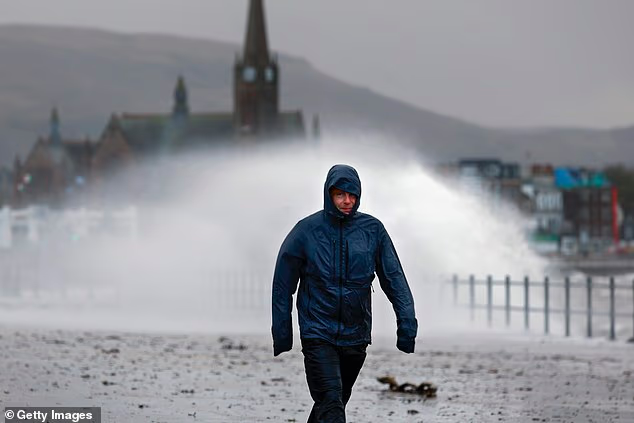
Storm Boelo has battered Britain with gusts of up to 85mph, leaving thousands of homes without power and causing flooding, fallen trees and widespread travel disruption.
The strongest winds were recorded overnight across Scotland, parts of Northern Ireland and the far north of England, where gusts generally reached 60-70mph. Exposed coastal areas saw gusts exceeding 80mph, the Met Office said.
An amber wind warning, the Met Office’s second-highest level, remained in force across Scotland and northern England as far south as Carlisle from 9pm on Saturday until 9pm on Sunday. A separate amber warning covered north-east Northern Ireland until 10am on Sunday.
Wider yellow wind warnings extended into parts of England and North Wales and covered the whole of Northern Ireland. The Met Office warned of a danger to life from flying debris and crashing waves, advising people to stay indoors as much as possible.
Storm Boelo brings flooding and power cuts
Heavy rain had delivered totals of 72mm at White Barrow in Wiltshire, 43mm at Cwm Dyli, south of the Snowdon range in North Wales, and 43mm at Inveruglas on the western shore of Loch Lomond by Saturday morning.
The Environment Agency had issued 66 alerts for areas of England where flooding was possible, alongside 10 warnings indicating that flooding was expected. The Scottish Environment Protection Agency reported 32 flood warnings and 11 flooding alerts at 7am.
In Scotland, flooding blocked the A82 at Dumbuck Quarry in Dumbarton, while floodwater affected the A8 in Port Glasgow. Police in Cumbria said they had received calls about localised flooding and fallen trees blocking roads across the county.
Emergency services were working to clear the routes, while Cumbria Police urged drivers to travel with care. A police road closure was also reported on the A78 near Skelmorlie, where temporary traffic lights were blown over.
The Police Service of Northern Ireland warned that fallen trees had blocked roads across the country and advised motorists to take extra caution. It highlighted closures on the Ballyrobin Road, which could affect journeys to Belfast International Airport, and on the Glenshane Road near Castledawson.
Hundreds of homes in south-west England were still without power after Storm Austen struck the region on Friday. National Grid said electricity had been restored to 131,225 properties by 7pm on Saturday.
Storm Boelo follows Austen, the first named storm of the season, which brought strong winds to parts of the UK on Friday.
Travel and events disrupted by strong winds
Flights were disrupted at Dublin Airport, where nine outbound and 10 inbound services had been cancelled by airlines by 4pm on Saturday. Flights from Belfast City Airport to Edinburgh, Cardiff, Manchester and Kirkwall were cancelled on Sunday morning.
Network Rail shared images of a trampoline beneath a train and a shed beside the tracks, urging people living near railway lines to secure garden furniture and other loose items.
Several events and attractions were also cancelled or closed. Visit Liverpool called off the city’s River of Light event in the interests of safety, while London’s Diwali on the Square celebrations were cancelled following advice from independent health and safety experts.
Edinburgh Castle and the Fountains Abbey estate in North Yorkshire were among the attractions announcing closures for Sunday.
Met Office chief forecaster Jason Kelly said the storm would be felt across the UK, with the strongest winds and greatest potential for disruption in the north.
“Amber warnings are in place across mainland Scotland, parts of Northern Ireland and the far north of England, where gusts of 60-70mph are expected widely, with the potential for 80mph in exposed coastal locations,” he said.
“Strong winds will also affect other parts of the UK, with gusts of 50-60mph possible in places. Heavy rain will provide an additional hazard, particularly in the north, bringing the potential for further impacts.”
Mr Kelly said people should prepare for possible disruption, particularly to travel and power supplies.
The arrival of Storm Boelo coincided with the end of British Summer Time, when clocks went back by one hour. A further yellow warning for strong winds is due to come into force later in the week, running from 3am on Tuesday until midnight.
