


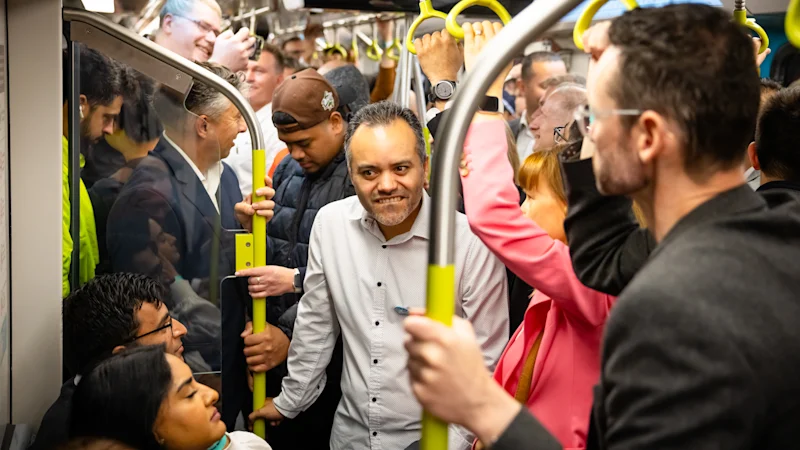
Sydney’s M1 metro line has been completed after more than 18,000 passengers travelled on its new driverless section between Bankstown and Sydenham on Friday morning.
The opening of the 13-kilometre Southwest section brought a celebratory atmosphere to stations across the city’s south-west, ending more than two years of disruption while the former T3 heavy rail line was converted for autonomous metro trains.
About 1,200 people gathered for the first service, which left Bankstown at 4.31am on time to loud cheers. More than 1,000 passengers had queued behind a barrier before boarding the packed train.
By 10am, the 10 stations on the new section had recorded 18,000 trips. Across the full M1 route, which now links Sydney’s south-west and north-west through the central city, there had been 92,000 journeys during the morning period.
Bankstown recorded the highest number of boardings on the new section, with more than 3,000 passengers using the station by 10am, followed by Campsie.
Sydney’s M1 metro line completes its final section
The completed line stretches for 66 kilometres and has been built in three stages over more than a decade. Premier Chris Minns paid tribute to the engineers and project team responsible for transforming a 130-year-old heavy rail route into a modern metro railway.
“It was incredibly difficult. It was expensive. It did take time. I’m so pleased they did it, however,” Mr Minns said.
He said suburbs along the existing metro route had experienced significant growth and expected the same to happen along the Canterbury-Bankstown corridor.
At Dulwich Hill, resident Ylana Magni said the mood in the community was celebratory. “I think it’s going to be more popular than we realise,” she said.
Will Randall, an engineering student at the University of New South Wales, said the service would cut about 15 minutes from his morning journey from Dulwich Hill.
“[It has been a] long time coming, but [I’m] thankful that it’s here. It’s going to make the commute a lot quicker,” he said.
Transport Minister John Graham, who travelled on the first service, said the opening had been a relief for south-west residents. He also acknowledged the bus drivers who had operated replacement services during the works.
“I know everyone’s happy to be off the pink buses … [but the drivers have] been really important to this community over the last couple of years,” he said.
The replacement buses will remain in operation over the weekend as a back-up before being withdrawn, a move expected to ease congestion on local roads.
Metro trains will run every four minutes during weekday peak periods, every five minutes between 10am and 3pm, and every 10 minutes in the evenings and at weekends. Services have been increased to every seven minutes this weekend to meet expected demand.
The full M1 project has cost about 30 billion Australian dollars. Mr Minns said driverless railways could transform cities but warned that they were expensive to build.
He disclosed that the final section cost 10 billion Australian dollars. The combined cost of the city and Southwest sections is nearly 23 billion Australian dollars, compared with an earlier forecast of about 11.5 billion.
