


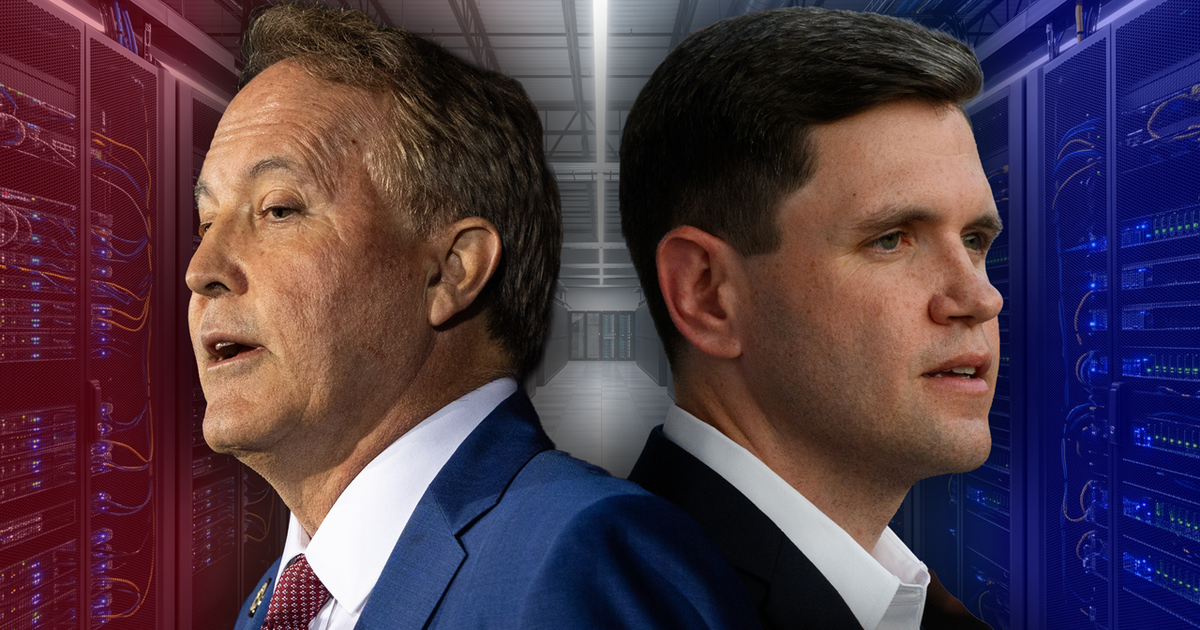
The rival US Senate campaigns of Republican Ken Paxton and Democrat James Talarico have put Texas’s fast-growing data centre industry at the centre of the 2026 election, with both candidates promising to stop households and utility customers from paying for its expansion.
Their proposals share some common ground, including opposition to existing tax incentives and demands that companies fund the electricity infrastructure they require. But they differ sharply over local planning powers, water use, affordability and the wider risks posed by artificial intelligence.
Data centres have become an increasingly contentious issue across Texas as communities weigh the economic benefits of investment against concerns over electricity demand, water consumption, noise, traffic and pressure on housing.
The debate has also moved beyond the campaign trail. Governor Greg Abbott has directed state regulators to protect residential customers from the cost of data centre growth, while his administration has proposed water-efficiency requirements, greater reporting of energy and water use, and an end to outdated tax incentives. ([gov.texas.gov](https://gov.texas.gov/news/post/governor-abbott-directs-puc-and-ercot-to-shield-texans-from-data-center-infrastructure-costs?utm_source=openai))
What Ken Paxton is proposing
Paxton, the Texas attorney general and Republican Senate candidate, has branded his proposals the “Texas First Data Center Plan”. It combines federal measures with support for restrictions being advanced by Mr Abbott at state level.
His plan would seek to bar Chinese technology from American data centres and related infrastructure. It would also impose criminal liability on companies if their facilities powered AI chatbots that endangered children.
Paxton has backed the DATA Act, which he says would remove outdated federal regulations and establish new power systems intended to prevent data centre growth from increasing electricity bills for Texans.
At state level, he supports limits on construction in rural neighbourhoods, as well as controls on noise and lighting, improved traffic planning and closer co-ordination with emergency services.
His proposals also call for the repeal of sales tax exemptions and other incentives, and for data centre operators to pay for the electricity infrastructure they use. Paxton says facilities should add to Texas’s generating capacity rather than place further strain on the existing grid.
He has additionally backed closed-loop cooling systems, which reuse water rather than requiring a constant supply of new water for operations.
“There’s plenty of open space in Texas and other parts of the country that we can put data centres that do not create a different atmosphere for a neighbourhood,” Paxton said at an event with the US Hispanic Business Council on September 28.
He added: “Eventually, we have to move forward with some type of reasonable restriction so that these data centres are not harming people.”
James Talarico’s alternative
Talarico, a Democratic state representative, unveiled his “Hold Data Centers Accountable Plan” in July, presenting the issue primarily as one of household costs and corporate responsibility.
His proposals would repeal tax incentives for data centres and other large companies, give residents a greater say over developments in their communities, and require AI companies to pay for their own electricity and water infrastructure.
The plan would also hold data centre operators responsible for water pollution and establish an “AI Dividend”, under which every American would receive a share of profits generated by US artificial intelligence companies.
Talarico has argued that the rapid expansion of the industry is contributing to higher housing costs, placing pressure on small businesses and pushing up utility bills.
“Texas should be a leader when it comes to innovation and technology, but that only works if Texans get a say and get a share of that economic growth,” he said during a campaign stop in July.
Where the candidates disagree
Tax incentives have become one of the clearest dividing lines in the campaign. Both candidates now support repealing them, but Talarico has made Paxton’s previous support for a sales tax exemption a central part of his criticism.
Talarico says Paxton helped create the conditions for the industry’s expansion when he was a state lawmaker. Paxton’s campaign argues that his current plan would remove the exemption and other incentives it regards as outdated.
The candidates also take different positions on local control. Talarico wants communities to have a greater say, including a role in deciding whether data centres should be built in their area.
Paxton’s approach would support restrictions in rural neighbourhoods and require companies to address practical concerns such as lighting, noise, traffic and emergency response. His plan does not set out whether local authorities would have the final power to approve or reject a project.
On the electricity grid, both candidates say data centre operators should bear the cost of the infrastructure they need rather than passing it to ordinary consumers. Paxton places greater emphasis on expanding overall generating capacity, while Talarico focuses on preventing AI companies from shifting infrastructure costs on to the public.
Water is another point of contrast. Paxton advocates closed-loop cooling technology, while Talarico’s plan concentrates on making companies pay for water infrastructure and face consequences if their operations pollute water supplies.
Paxton’s proposals also contain national security and child-safety measures that do not feature in the proposals released by Talarico.
The issue has already produced action from Paxton’s office. In September, the attorney general announced investigations into hundreds of Texas data centre developments over compliance with water-use reporting requirements, while saying the state could not sacrifice its water and energy supplies. ([oag.state.tx.us](https://oag.state.tx.us/es/node/287396?utm_source=openai))
For Paxton, the issue offers an opportunity to appeal to voters worried about China, child safety, rural development and the reliability of the Texas power grid. For Talarico, it is a way to address concerns over corporate tax breaks, rising living costs and the influence residents have over major construction projects.
Both candidates agree that the industry should pay more of the costs created by its expansion. Their competing plans reflect a wider choice facing Texas voters: whether data centre growth should be managed mainly through state and federal restrictions, or whether local communities and consumers should receive a larger share of the control and economic benefit.
