


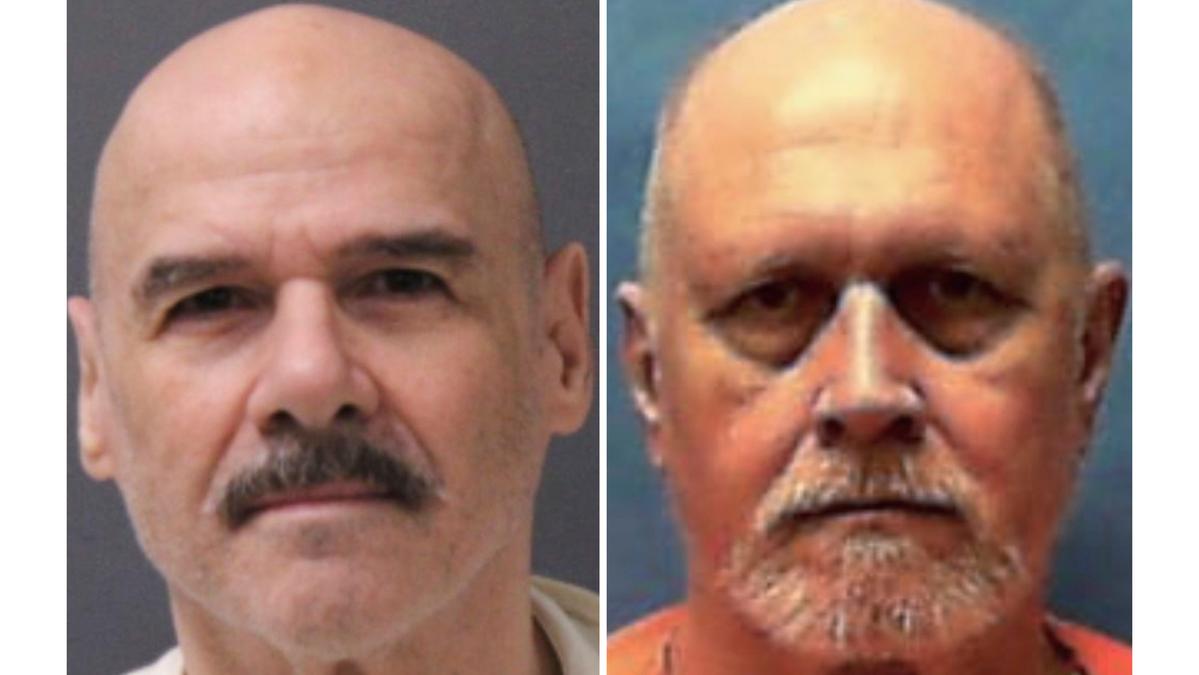
The Texas execution of Reinaldo Dennes lasted 63 minutes after prison staff struggled to find suitable veins for the intravenous lines carrying a dose of pentobarbital.
Dennes, 70, repeatedly complained of pain once the procedure began, groaning and asking God to take him away from his suffering. He was pronounced dead at 7.08pm local time at the penitentiary in Huntsville.
Prison officials said the execution procedures had been followed appropriately. Amanda Hernandez, a spokeswoman, said the team made several unsuccessful attempts before inserting the needles into Dennes’s left foot and the left side of his neck.
She said she did not know how many attempts had been made, but insisted the sites used were permitted under Texas procedures. Ms Hernandez also suggested that Dennes may have been exaggerating his pain, saying he began complaining before the drugs started flowing and reported discomfort in areas where there was no intravenous line.
Asked whether he had been faking, she said: “I think, yeah, there were allegations. … There was nothing abnormal on our part.”
Dennes gave a brief final statement in which he said he wanted his loved ones to know he had been blessed for the past 30 years “knowing the love of the father”. He then told the warden: “Go, warden!”
Almost immediately afterwards, he exclaimed: “The pain! Go! Go!” He repeatedly asked “the father” to take away the pain, saying: “Let me go, father. Let me go. … I’m here. I’ve been your son all these years.”
He later shouted: “My right leg is killing me!” and described the sensation as a cramp. After further groaning, he said: “I don’t think this is normal. Take me, father. Don’t let me suffer like this. C’mon.”
Dennes then made three loud groans, followed by eight progressively quieter snoring sounds and a final loud snore. His breathing subsequently became quieter until a doctor examined him and pronounced him dead at 7.08pm, one minute after the procedure ended.
Capital punishment under renewed scrutiny
The execution came amid renewed scrutiny of capital punishment in the United States following a failed execution in Tennessee in September. Christa Pike survived two doses of pentobarbital, with her lawyers arguing that the drug probably did not enter her bloodstream correctly and instead pooled in her arms, causing burns and blistering.
Dennes was convicted of capital murder in the killing of Janos Szucs, a diamond dealer who was found shot several times in his Houston office in January 1996. Dennes, a jewellery designer whose office was in the same building, was accused of arranging for a cleaner to open a back door after hours so he and his brother could enter.
A security guard, David Copeland, was shot twice during the robbery and identified Dennes as his attacker. Szucs’s safe was emptied of diamonds and about US$200,000 in cash, but the diamonds were never recovered.
Dennes’s lawyers later argued that there was insufficient evidence to prove he had killed Szucs. A year after Dennes’s conviction, his brother Jose Albert Dennes pleaded guilty to murder and received a 45-year prison sentence. He was released on parole in 2019.
Janice Copeland, whose husband David survived the shooting and died five years ago, witnessed the execution. She said: “David always felt Reinaldo would outlive him. Unfortunately he was right. Finally after 30 years, justice has been served.”
Dennes was the second person executed in the United States that day. Earlier, Florida put Thomas Mitchell Overton, 71, to death for the murders of Susan and Michael MacIvor during a 1991 home invasion.
Overton denied the killings in a final statement, saying: “I never killed anyone.” He was pronounced dead at 6.19pm following a three-drug injection at Florida State Prison.
Florida has carried out more than half of the 39 executions in the country so far this year. The state recorded 19 executions in 2025 and has two more planned for December.
