


Global greenhouse gas emissions reached a record 54.1 billion tonnes in 2025 as world leaders gathered in Antalya, Türkiye, for the United Nations COP31 climate summit.
Emissions rose by 0.7 per cent in a year and were 68.5 per cent higher than in 1990, according to figures from the European Commission’s Joint Research Centre and the International Energy Agency. The summit runs from November 9 to 20.
Carbon dioxide accounted for nearly three-quarters of the total, while methane, nitrous oxide and fluorinated gases made up most of the remainder. These gases trap heat in the atmosphere, contributing to rising temperatures and more frequent heatwaves, droughts, floods and other extreme weather.
Power generation remains the biggest source of emissions
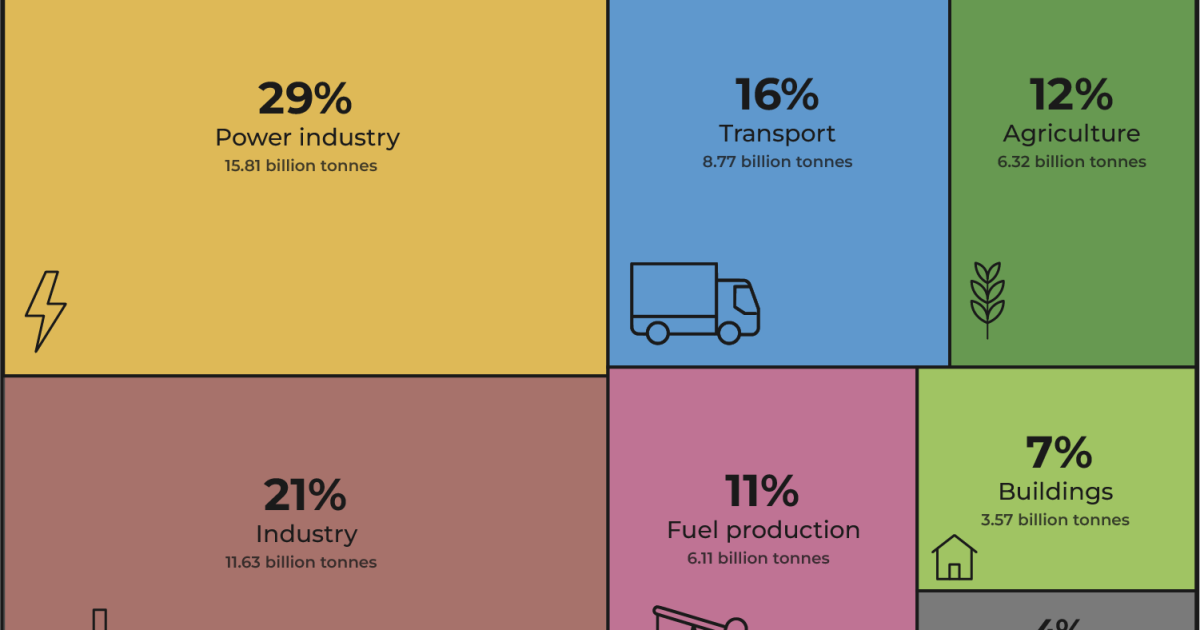
The power sector was responsible for almost 30 per cent of global greenhouse gas emissions in 2025, making it the largest emitting industry. Its emissions have roughly quadrupled since 1970 as demand for electricity increased in fast-growing economies including China and India.
Industry, including manufacturing and mining, accounted for 21 per cent. The figure includes fuel burned in factories and emissions produced during the manufacture of cement, metals and chemicals.
Transport was the third-largest source at 16 per cent, covering cars, shipping and aviation. Together, power generation, industry and transport produced about two-thirds of the world’s emissions.
Agriculture contributed 12 per cent, while the extraction of coal, oil and gas accounted for 11 per cent. Buildings and waste made up 6.6 per cent and 3.6 per cent respectively.
Global emissions have fallen only a handful of times since 1970, including during the early 1980s, after the 2008 financial crisis and during the Covid-19 pandemic in 2020. Each decline was followed by a rebound.
China, the US and India lead national emissions
China was the largest national emitter in 2025, producing almost 16 billion tonnes, or 29.5 per cent of the global total. The United States followed with 6.02 billion tonnes, while India produced 4.51 billion tonnes.
Together, the three countries accounted for almost half of global greenhouse gas emissions. The 27 countries of the European Union contributed 5.8 per cent, followed by Russia on 4.8 per cent, Indonesia on 2.5 per cent, Brazil on 2.4 per cent and Iran on 2.1 per cent.
International shipping and aviation, which are not assigned to a single country, produced a combined 2.6 per cent of global emissions.
The balance has shifted over time. Emissions initially increased in western countries, particularly the UK and US, during the Industrial Revolution before rising sharply after the Second World War. China overtook the US as the world’s largest emitter in the mid-2000s after a rapid economic expansion.
Historical totals present a different picture. Since the mid-18th century, the US has been responsible for 23.5 per cent of cumulative carbon dioxide emissions, compared with 15.4 per cent from China.
How the main emitters produce greenhouse gases
In China, electricity generation produced 42 per cent of the country’s emissions in 2025. Industry accounted for 31 per cent and fuel production for 9.5 per cent. President Xi Jinping pledged in September 2025 to cut China’s greenhouse gas emissions by 7 to 10 per cent from their peak by 2035.
Transport was the biggest source in the US, accounting for 29 per cent of emissions, largely from cars and lorries. Power generation contributed 26 per cent and industry 14 per cent.
India’s power sector produced 35 per cent of its emissions, followed by industry at 24 per cent and agriculture at 19 per cent. The country continues to rely heavily on coal for electricity.
The rising emissions come as the World Meteorological Organization reports that the heat stored in the oceans reached a record level in 2025, with ocean warming accelerating sharply over the past two decades.
Extreme weather events killed tens of thousands of people and displaced millions in 2026, including more than 30,000 excess deaths linked to heatwaves, droughts and wildfires in Europe between May and August. The figures are being discussed as delegates meet in Antalya for COP31.
