


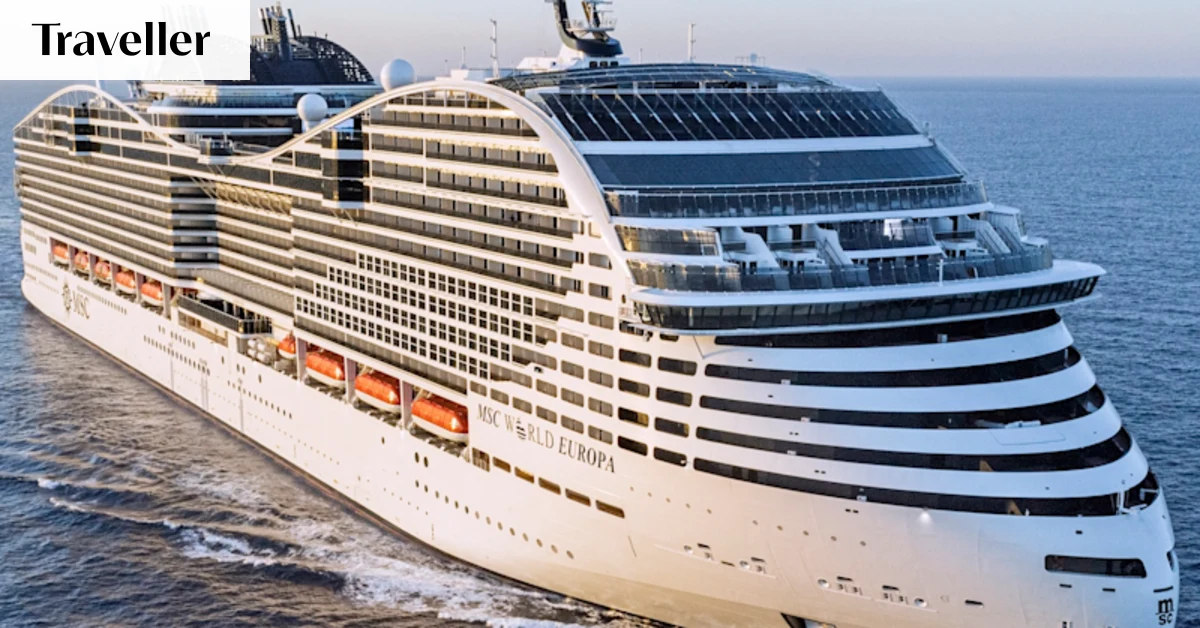
The world’s biggest cruise ships are getting larger, with Royal Caribbean, MSC, Norwegian Cruise Line and Carnival Cruise Line all expanding their fleets with vessels designed to carry thousands of passengers.
Royal Caribbean’s Icon of the Seas, launched in early 2024, remains the largest by volume at 248,663 gross tonnes. The 364.75-metre ship has 20 decks and can accommodate up to 5,610 passengers, supported by 2,350 crew.
Gross tonnage measures a vessel’s internal volume rather than its weight. By that measure, the ten largest cruise ships have roughly doubled in size on average since 2000, when Royal Caribbean’s 137,276-tonne Voyager of the Seas held the top position.
Icon of the Seas has already been joined by two further vessels in the same class, Star of the Seas and Legend of the Seas. Two more Icon-class ships are also on order.
Norwegian Cruise Line’s latest vessel, Norwegian Aqua, carries 3,571 passengers. The company plans to introduce four larger ships in the 2030s, each capable of carrying 5,000 passengers and measuring just under 225,000 gross tonnes.
MSC Cruises has pursued a similar strategy. MSC World Europa, launched in 2022, can carry 6,762 passengers, despite being smaller than Icon of the Seas by volume. MSC World America followed last year, while MSC World Asia is due to arrive towards the end of this year.
Further World-class ships are under construction or have been ordered, extending MSC’s move into the biggest segment of the cruise market.
Cruise ships increase in size across the market
The expansion is not confined to mass-market operators. Viking’s ocean ships now carry 998 guests, up from 930 on earlier vessels, while Silversea’s new Evolution-class ships have capacity for 728 passengers compared with 596 previously.
Regent Seven Seas is also preparing to launch its largest ship so far. Seven Seas Prestige, due later this year, will accommodate 850 passengers.
Larger vessels offer economies of scale, including lower construction and operating costs per passenger. That calculation applies even to luxury cruise lines, although the companies must balance it against the expectations of passengers paying for a more exclusive experience.
At the budget end of the market, filling the ships remains a challenge. The largest vessels therefore operate mainly in the Caribbean, and to a lesser extent the Mediterranean, where substantial customer markets are nearby.
Carnival Cruise Line is planning three ships that will be larger in passenger capacity than any currently operating vessel. The first is due for delivery in 2029, with each ship expected to carry 8,000 passengers and measure 230,000 gross tonnes. Their names and classes have not yet been announced.
There are, however, limits to how far the trend can continue. No existing shipyard can build or service a vessel larger than Icon of the Seas, while some ports cannot handle the biggest ships because of low bridges, tight turns or short quays.
Public opposition has also led some ports to prohibit very large cruise ships, creating further obstacles for an industry whose vessels continue to grow.
